 October 16, 2026
 Categories: Headline / Features / Arts
Behind the Lyrics: Master Composer (and Yeshiva Principal) Baruch Levine
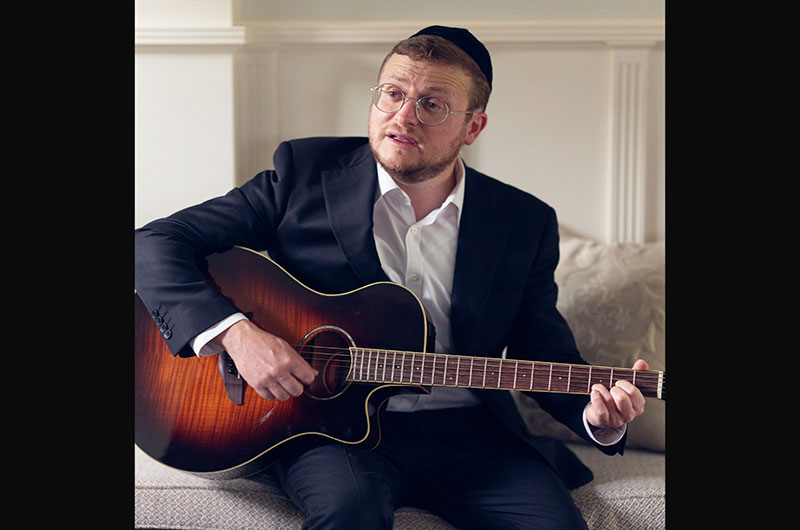


When I told a friend at shul, I was going to interview Baruch Levine for this column, he reacted with excitement: “Wow!”
To be honest, I wasn’t that familiar with Levine myself. He’s only four years older than me, so I can’t exactly say I grew up on his music. However, I did know some of his hits. And after speaking with him, I realized I was familiar with even more of his songs – I just hadn’t realized he was the composer.
He also passed my older son’s test: When I told him I was going to interview Levine, his big smile and excitement confirmed it: Levine is a rockstar in Jewish music. My son even added some details that I didn’t know – for example, that Levine is also a rabbi in a yeshiva. (We’ll get to that later.)
My friend from shul is also an expert in Jewish music in his own right, so I asked him: “What should I ask him when we talk? Give me a question for Baruch Levine.”
“Ask him: Did you ever think the song you wrote, ‘Vezakeini,’ would be such a big hit?”
I’m sure he has been asked that question many times during his career… Still, I opened the interview with that very question.
“No,” said Levine. It was his first album, and the producer was Yochi Briskman. The composition wasn’t anything new – it was even a little bit simple.
The unique thing about the song is the shidduch between the message and the content. It was the first time such a song had come out. Today you have many such songs, such as “Birkat Habanim” by Ohad Moskowitz and other chassidish ones. But back then, it was something completely new just as people were starting to realize the challenges of raising kids in that new generation.
Every time Levine composed a song, he wanted people to be comfortable with it right away. The tune should seem a little familiar, but with a chidush (something new). The chidush can be either in the words or in the tune. It can be a contrast – a melody in which one part is low and one part is high. In “Zeh Hakatan,” for example, he started with a major scale and then transformed to a minor scale, which makes it interesting. Yet generally he still sticks to the basics.
I ask him the question I like to ask many musicians: Why do you not see complex scales in chasidic music?
He answers that in chasidic music, you are praying, asking for rachamim. The focus is on the tefillah, not on the scales. That sets the mood and the message.
“Jewish music is like comfort food,” Levine says. To explain, he told me the story of a Mexican restaurant in Lakewood.
One day, a kosher Mexican restaurant opened in Lakewood. Levine had just finished another successful event; he was exhausted and starving. He walked into the restaurant only to find unfamiliar Mexican dishes. A week later, he returned. By then, most of the menu had changed to cholent, kugel, and the like. That was what the customers actually wanted.
The same goes for music. Jewish people like things that are simple, familiar, and that they are comfortable with. You go to the fanciest wedding in the fanciest hotel and you get cholent, kugel, and sesame schnitzel.
There’s a Mesorah and it has to stay the same way. You can’t be too innovative.
Levine looks at music as something spiritual.
“When you compose a song, do you try to make a hit?” I ask him. “Do you think about it, or do you just compose?”
Yes, when he composes, he thinks about whether the song will be sung under a chuppah, at a kumzits, or while dancing. It used to be that when people got into their car, they would put on an album and it was like a story, from beginning to end. You had slow songs and upbeat songs, and everything had to fit the template. Today, songs are released as singles, and yes, he does think about whether a single is going to be a big hit.
Levine grew up in Toronto. His father loved Carlebach, so as a child, Levine used to listen to his music, even though it was considered more mature. He also listened to Abie Rotenberg – who also lived in Toronto and was a friend of his father – as well as Yerachmiel Begun, and of course, MBD and Avraham Fried.
At the time, Pirchei Miami was based in New York, and Pirchei Toronto had already closed down. His father had a chavrusa – the aforementioned Abie Rotenberg – who was working on the album Dveykus 4. Rotenberg needed a child soloist for one specific song, “HaMalach Hago’el,” because the song was about children. Instead of traveling to New York or Israel to look for a young singer, Rotenberg remembered Levine, who had been part of a children’s album a year prior. He came to Levine’s house, taught him the song, and that was how Levine made his entry into the music world.
Later on, Levine had a keyboard teacher who quickly realized how gifted his student was, noticing he had an incredible musical ear every time they started a new song. One day, his teacher had a bar mitzvah gig but fell ill. This was Toronto in the 1980s. Who could possibly be available to play on just a few hours’ notice?
The teacher told the client he had a student who could handle it. Levine was only 11 years old at the time. His father gave him a ride, helped him carry the keyboard inside, and set it up. The client was shocked – a kid?!
But Levine did a fantastic job.
At the end of the event, the client handed him an envelope and said: “You did a good job.”
When his father came to pick him up, he asked, “Did he pay you anything?” Levine answered, “Yes, he gave me something,” and showed his dad the envelope. Inside was a one-hundred-dollar Canadian bill – a huge amount of money in those days. He was astonished, and from that moment on, he kept performing. His parents fully supported him, and he continued to perform even during his years studying in yeshiva.
Once, when he was 12 years old, he was playing the keyboard in the basement. His father came down and asked, “What song is that? I’ve never heard it before.” Levine answered, “I’ve never heard it before either.” Surprised, his father called out to his mother, “Esther! Come down here! I think Baruch just composed his first song!”
His parents were incredibly encouraging of his talent. He continued to compose throughout his years in yeshiva, often going to a studio to record demos.
When Levine was 13, his father, who knew the singer Yehuda Chick (who went by Yehuda!), offered some of his son’s songs to a friend who worked as a Jewish music producer. He managed to sell three compositions. Later on, Levine took the initiative and began sending cassettes of his compositions directly to producers. This was how his name first became associated with songwriting, though at the time, he never thought of becoming a full-time musician.
He began composing songs for other artists, the most famous of which is likely “Chasoif,” which he wrote for Yaakov Shwekey. At the time, Levine was a student at the Mir Yeshiva. One day, he received a phone call on his landline from the producer Yochi Briskman, who wanted to buy the song. Levine asked who the song was for, and Briskman replied, “A new guy. His name is Yaakov Shwekey.” Levine hesitated and said, “Yochi, it’s a really good song. You should give it to someone famous, like MBD or Avraham Fried.” Briskman replied, “Baruch, trust me. This guy is going to be huge. I’ll give you $500 for it.” To Levine, $500 was more money than he would normally spend in an entire year, so for $500, he’d sell it to anyone. He made the deal and sold it. The rest is history.
Today, Levine is a school curriculum principal, but he spent nearly 20 years as a regular classroom teacher. In that role, his music gave him an unfair advantage. Nowadays, it can be difficult for rabbis to truly connect with their students, but it helped immensely that he had a prominent life outside the classroom; the students were proud of their rebbi. He didn’t sing in class every day – only once in a while. Sometimes, he would even test out new compositions on his students. Since the primary consumers of modern Jewish music are young people, it was the perfect way to get feedback. He would wait until the boys were busy with their desk work, and then he would suddenly start playing a new melody. If they turned their heads and asked, “What is that?” he knew he had a hit on his hands.
A few years ago, his tight schedule forced him to step away from full-time teaching. He became the curriculum principal for grades 1 through 5, a role that allows him to utilize his decades of educational experience while providing the flexibility he needs for his music career. If sometimes he’s busy with music, it’s not disruptive. Previously, he taught fifth-grade Gemara.
While people usually associate Levine with his moving, slow compositions, he has actually written numerous upbeat hits. He points out several popular fast-paced tracks from his catalog, such as “Ufaratzto,” “V’haarev Na,” “Zeh Hakatan,” and “Chosson HaTorah” – all of which have become staples at Jewish weddings. He also mentions two major upbeat hits he composed for Yaakov Shwekey: “Halo Yadaata” and “Yerushalayim.”
We discuss his dance album called… #TheDanceAlbum.
“Dance?” I ask. “Over the years, your style has always been more acoustic and soulful.”
“This is what yeshivish music is today,” Levine explains. “So, I decided, let’s make a dance album. But,” he notes, “it still features real guitars and live brass instruments.”
#TheDanceAlbum gave him the perfect opportunity to showcase this energetic side of his songwriting and prove that he can excel at fast-paced music. Yet even his fast tracks retain the depth of a traditional niggun at their core.
“A kumzits doesn’t mean what it did thirty years ago, when it was strictly slow songs,” Levine observes. “This is an ADHD generation – they need that upbeat energy, too.”
He offers a fascinating insight: “Even when a song is highly produced, electronic, and club-friendly, the true test of its success is whether you can sing it around the Shabbat table without any instruments. If the melody remains catchy and sounds beautiful even without the heavy beat or production, that’s when you know you have a truly successful song.”
Another question I like to ask Jewish musicians on my journey to truly understand and define Jewish music is simply this: “What is Jewish music?”
According to Levine, it has to be music with a chelek ruchani, a spiritual part. Whether the track is slow and moving or fast and leibedik, there must be a connection to spirituality.
From where does he draw his inspiration when composing? He explained that music can explain beyond what words themselves can express. “Words are sometimes limited,” he notes. “For instance, when you see a great talmid chacham, you can’t always express in words how deeply you aspire to be like him. But through music, you can convey those exact feelings.”
When you go to a chassidish shul on SimchatTorah, they’ll dance and sing every hakafah without words. Only “ai-yai-yai” or “nai-nai-nai.” It comes straight from the neshama. This is why so much traditional chasidic music is instrumental or uses repetitive vocables rather than text – it transcends the limitations of language. When Levine writes a song, he tries to access that space beyond the lyrics. He channels the emotions inside him. Just as some people are gifted with the ability to speak eloquently, he was given the tools to play and create – to express deep emotion through music.
You can find Baruch Levine’s albums on Spotify, Apple Music, and other music platforms.