September 11, 2026
 Categories: Parsha / Sivan Rahav-Meir / Torah
Have You Heard Elkana Levi’s Speech?



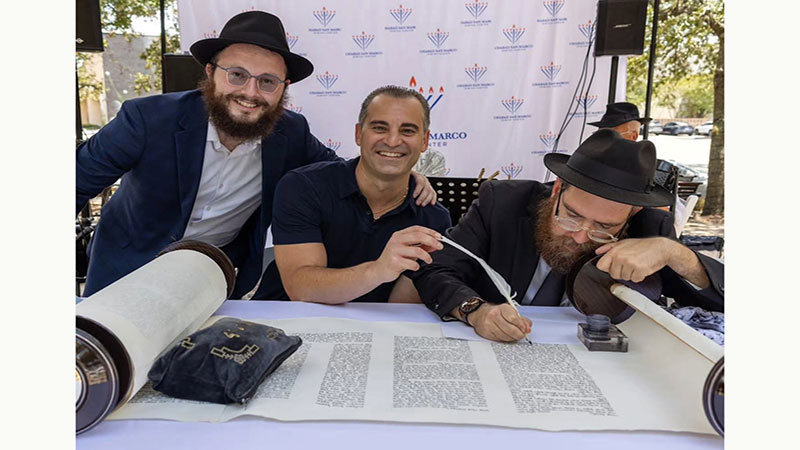
A few days ago, a mesibat hodaya was held for Elkana Levi, an officer in the Golani Brigade who was badly wounded in Khan Yunis a year ago and lost both his legs. You may remember him as “Elkana ben Orit,” the name so many people mentioned in their prayers for his recovery.
More recently, a video from the celebration went viral, showing singer Ravid Plotnik, who came to perform for him. We’ve grown accustomed to moments like these: brief, powerful, moving – and then quickly gone.
But one of the people who attended the celebration urged me to get hold of Elkana’s entire speech. Forty minutes long. Here are some of the highlights:
“Exactly one year ago today, I was blown up. Exactly one year ago today, I had no idea how much goodness there was in this world,” he declared, standing on two prosthetic legs. And then he began listing that goodness.
“I will never have the words to thank the extraordinary people who cared for me at Soroka Hospital, from the doctors to the orderlies. I felt as though I were at summer camp, with the best staff in the world. Every person there, every experience there, is a good memory for me.
“At Soroka, I opened my eyes, and the first thing I saw was a picture that children from a kindergarten had sent me. From that moment on, I have felt embraced. I have no legs, but it’s hard to explain how much my heart has expanded. My happiness doesn’t depend on the number of steps I can take.”
The audience applauded, as they would dozens more times throughout the evening. It was clear to everyone that this was a moment of healing, of coming full circle.
“Already in intensive care, I was dreaming about this thanksgiving celebration. Thank you for coming,” he said.
Elkana did not gloss over the pain or the difficulty. He spoke about friends who had been killed, and about his darkest moments.
“I feel that people don’t understand me – and that they don’t understand that they don’t understand me. How can someone understand what it’s like when the battery dies in your leg, or in your wheelchair? How can someone understand what it’s like to walk so awkwardly, then try to sit down without knowing whether you’ll be able to get back up? Or to walk down the street feeling like a celebrity, as though you belong to everyone? How can someone understand what it’s like to become the center of attention before you’ve even opened your mouth?”
Throughout his speech, Elkana quoted three spiritual teachers. The first was the prophet Yeshayahu, whose prophecies brought messages of comfort.
“Yeshayahu teaches us that G-d has thoughts of peace and hope for all of us. That He will comfort us. He says: ‘You shall draw water with joy from the wells of salvation.’ I feel surrounded by tremendous kindness and deliverance, and I believe there are many more salvations still ahead of us.”
He also quoted Rebbe Nachman of Breslov, who wrote repeatedly about the importance of giving thanks, learning to notice the good and, as Elkana put it, “putting the good in the center.”
Elkana acknowledged every stage of the journey from his injury until that evening, thanking the people who had accompanied him along the way.
There was one particularly unusual thank-you: “I want to thank those who aren’t here with us today – my dear legs. I want to thank you for 23 years of love and devotion. I never realized how hard you worked all that time.
“Since I was injured, I’ve traveled all over the country, and everywhere I go looks familiar. That’s thanks to you. You carried me with love through so many hikes and navigation exercises. And thanks to the parts of you that still remain with me, I will merit to continue to ‘walk before the L-rd in the land of the living.’”
His third teacher was the Tanya, the foundational work of Chabad chassidic thought. Elkana quoted a profound line from the book in Aramaic, translated it into Hebrew – and then translated it into the reality of his own body: “There’s a sentence in the Tanya that contains everything: ‘Pain cries out from one side of the heart, and joy cries out from the other.’
“That is exactly what it feels like. At every moment, I know I don’t have legs. I feel that absence throughout my body. And at the same time, I am doing so well. This is one of the best periods of my life.
“So that’s my formula, and that’s my advice to others: learn to go through the pain and grow from it. To truly feel sadness, and truly feel joy – and to be able to live with those two opposites at the same time.”
Thank you, Elkana.
Do We Want to Go with the Flow – or Grow?
This week’s parsha, Shoftim, opens with the command: “Judges and officers shall you appoint for yourself in all your gates.”
First and foremost, this is a command to establish a functioning system of courts and law enforcement. But the verse also speaks to each of us personally. Every one of us needs to appoint our own “judges and officers,” to develop a system of self-awareness and self-scrutiny.
Rabbi Mordechai Sheinberger offered a beautiful explanation of this idea, which we studied yesterday in the weekly Zoom class of the Mitchadshot community: “Each of us has several gates that connect us to the world: the gate of sight – our eyes; the gate of hearing – our ears; the gate of speech – our mouth; the gate of smell – our nose; and the gate of touch – our hands and feet.
“Each person needs to place judges and officers at all of these gates: to purify and sanctify them, and to make proper use of them. For example, every time I look at something, I should ask myself: Is this leading me toward something good, or the opposite?
“There is hearing that can lead to wrongdoing – listening to lashon hara and gossip – and there is hearing that is a mitzvah, such as listening to Torah classes.
“The same is true of our mouths: there is speech that causes harm, and there is speech that brings blessing into the world.”
May we learn to pay greater attention to our own gates and guard them well.