 October 9, 2026
 Categories: Book Reviews / Arts
Mikraot HaDorot: A Chumash for Our Generation
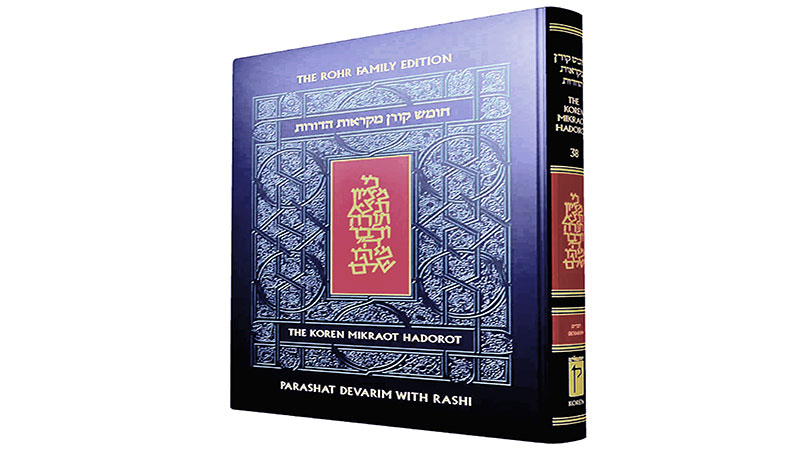


Title: Koren Mikraot HaDorot
Translation and Commentary by Rabbi Lord Jonathan Sacks, zt"l
Koren Publishers
360 pages
Upon first picking up Koren’s newly released volume of Mikraot HaDorot labeled Devarim, you might assume you were holding the fifth and final volume of the set, focused on Sefer Devarim. But upon closer inspection you would realize that it is actually labeled #38, devoted solely to Parshas Devarim. In the Mikraot HaDorot series, each and every parsha receives its own substantial volume. While the series is still being completed, it is exciting to see the first installments on Sefer Devarim arriving just in time for the current cycle.
The title itself is of course a clever play on words. Mikraot HaDorot immediately calls to mind the classic Mikraot Gedolot, yet it also signals that this is something quite different. The traditional Mikraot Gedolot mostly presents the classic commentators from a particular period of Jewish history. This series broadens the scope dramatically, bringing together nearly two thousand years of Torah scholarship, from Onkelos all the way to Rabbi Joseph B. Soloveitchik. The result is not simply more commentary, but a panoramic view of how Jews have studied and understood the Torah across the generations.
The editors organize this enormous body of material in a way that is both logical and inviting. The first section, "The Times of the Sages," gathers sources from the era of Chazal, including the Mishna, Talmud, and Midrash. The second, "The Classic Commentators," focuses on Rishonim and early Acharonim. The third, "Confronting Modernity," presents more recent Torah thinkers. Each section begins with a timeline showing where the commentators fit historically, making it easy to appreciate who may have influenced whom and how the conversation developed over the centuries. It is a simple feature, but an extremely helpful one.
What impressed me most, however, was the breadth of the selections. In the first section, one naturally expects to find citations from Talmud Bavli, but the editors also include passages from Talmud Yerushalmi whenever they are relevant. Likewise, alongside Devarim Rabbah, they draw from works such as Rus Rabbah and Koheles Rabbah when those Midrashim illuminate the week's parsha. The second section includes familiar giants like Rashi and Ramban, but also gives meaningful attention to commentators who are typically studied less frequently, including Chizkuni, Bechor Shor, and Ralbag. The modern section likewise goes beyond the obvious choices. Readers will certainly encounter Ohr HaChaim, Rav Shimshon Raphael Hirsch, Malbim, and Netziv, but they will also meet works such as HaKesav VeHaKabbalah and Meshech Chochmah. Even figures who are sometimes overlooked for various reasons, such as Philo in the early section or the Lubavitcher Rebbe and Nechama Leibowitz in the modern section, are given their place. Perhaps the greatest service the editors provide is not merely collecting these sources, but identifying the particular passages that are most significant for each week's parsha. Even someone with access to all of these works in their original languages and the ability to decipher them would benefit from having experienced scholars point them toward the most important discussions.
The final section, "The Biblical Imagination," consists of brief but thoughtful essays, and is a particularly valuable addition. When studying Chumash, we sometimes become so absorbed in individual words, phrases, and technical questions that the larger themes of the parsha are at risk of being left unexamined. These essays gently pull the reader back, encouraging a broader perspective without replacing the detailed study that came before.
Then comes perhaps the biggest surprise. Everything described so far is only what you discover when opening the book from the Hebrew side. Turn the volume over, and you find what is essentially another book! There is Rabbi Jonathan Sacks's elegant English translation of the Chumash, accompanied by every Rashi in full, translated into clear, readable English. The week's Haftarah is included as well, making the volume practical to bring along to shul on Shabbos without needing a second Chumash. As one would expect from Koren, the physical production is first-rate, with beautiful typography, quality paper, and an attractive layout that makes extended learning a pleasure.
Koren has once again identified a niche that many of us did not realize existed until we saw it filled. Commentary on Chumash is probably the most crowded field in all of Torah publishing, and producing something genuinely new is no easy task. Yet Mikraot HaDorot succeeds in doing exactly that. It is comprehensive without being overwhelming, and scholarly yet still accessible. The only real challenge I foresee is finding enough room on my bookshelf for what promises to become a large, monumental, and thoroughly worthwhile series.