 October 23, 2026
 Categories: Collecting / Arts
Neville Chamberlain and the Jews


Arthur Neville Chamberlain (1869-1940) was born in Edgbaston, Birmingham, into a political household whose influence on British public life was already profound and would go on to become historic. He was the eldest son of Florence Kenrick Chamberlain and Joseph Chamberlain, one of the most formidable and controversial statesmen of the late nineteenth century: an imperialist, a tariff reform advocate, and a political strategist of unusual boldness who had transformed Birmingham through municipal reform before rising to national prominence as Colonial Secretary.

Neville grew up in an environment that combined civic idealism, administrative ambition, and a strong belief in structured social reform. He was educated at Rugby School and later at Mason College (which would become the University of Birmingham) and the fact that he did not attend Oxford or Cambridge, the traditional elite universities, would subtly mark him in the social culture of Westminster. After leaving formal education, he entered business rather than politics, and, in the 1890s, he managed a sisal plantation in the Bahamas, a venture supported by family capital but which ultimately proved unsuccessful. The experience hardened him and gave him an appreciation for administrative discipline and financial caution, traits that would define his later career.
Upon his return to Birmingham, Chamberlain became involved in the family’s industrial and civic affairs and his entry into politics came not through parliamentary ambition but through municipal governance, starting with his election to Birmingham City Council in 1911. He approached local government as a field for practical engineering of social conditions and his emphasis was never rhetorical flourish but, rather, efficient implementation. During World War I, he served as Lord Mayor of Birmingham (1915 – 1916), in which capacity he oversaw wartime mobilization measures, housing initiatives, and public welfare administration.
He entered Parliament in 1918, winning a by-election for Birmingham Ladywood as a Conservative associated with the Unionist tradition, and his parliamentary career advanced quickly as he combined methodical preparation with administrative competence. Shortly after serving as Postmaster General in 1922 – 1923, he became Minister of Health (1924 – 1929) and then, amid the financial crisis that produced the National Government, he served as Chancellor of the Exchequer in 1931. During his tenure at the Treasury, he saw the early stages of rearmament in the mid-1930s, when the rise of Nazi Germany and Fascist Italy made clear that European peace was fragile. British defense spending increased steadily after 1934, with particular emphasis on air defense. Under his chancellorship, funding expanded for fighter aircraft production and radar research, investments that later proved decisive during the Battle of Britain.
When Chamberlain became Prime Minister upon Stanley Baldwin’s retirement in May 1937, he inherited a Europe already destabilized by German reoccupation of the Rhineland (1936), Italian aggression in Ethiopia, and the Spanish Civil War. Because he believed that another general European war would be catastrophic and that Britain, though actively rearming, was not yet fully prepared, his strategy became one based upon negotiation, deterrence, and selective firmness.
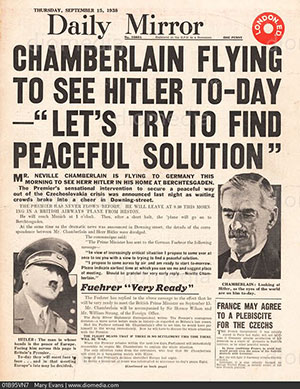
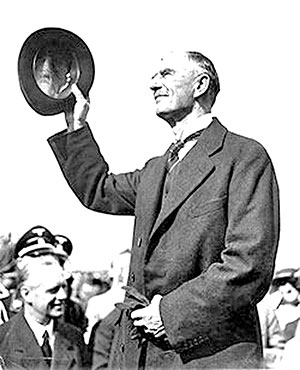

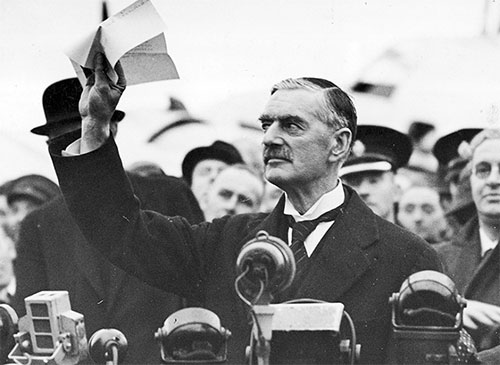
The most dramatic test came in 1938 with the Sudeten crisis, when Hitler demanded annexation of the Sudetenland from Czechoslovakia, claiming to defend ethnic Germans. Chamberlain undertook unprecedented personal diplomacy, flying to Germany three times to meet Hitler and, in the resulting Munich Agreement of September 1938, the Sudetenland was ceded to Germany – significantly, without any Czech participation in the final settlement. In one of the most incongruous statements of all time, Chamberlain declared upon his return to London that he had secured “peace for our time.” While this statement later became the iconic and ironic emblem of failed appeasement, public reaction in Britain at the time was largely supportive, primarily because the trauma of WWI remained vivid and many believed that revision of Versailles grievances might stabilize Europe. Jewish reactions in Britain were initially mixed; relief at avoiding immediate war was tempered by grave concern for Jews in Czechoslovakia, who would soon fall under Nazi domination.
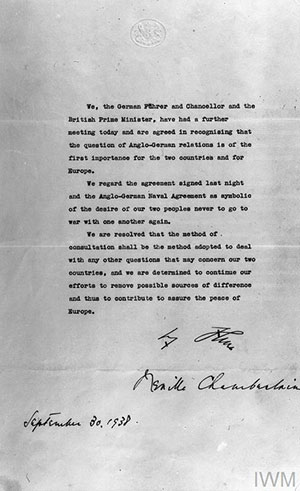
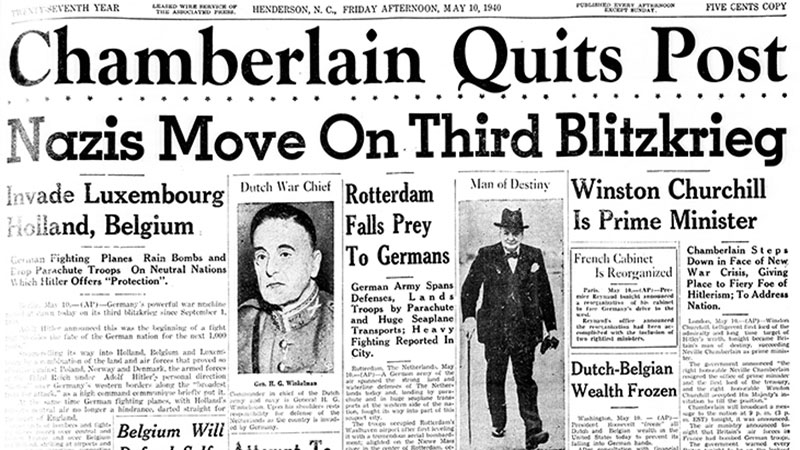
When Germany occupied the remainder of Czechoslovakia in March 1939, Chamberlain, recognizing that Hitler’s ambitions exceeded limited territorial revision, issued a guarantee to Poland and accelerated rearmament. On September 3, 1939, after Germany invaded Poland and ignored British ultimatums, Britain finally declared war, transforming Chamberlain into a wartime prime minister, though his leadership was bitterly criticized in some corners. Following the failed Norwegian campaign (discussed in detail below), he resigned in May 1940 and was succeeded by Winston Churchill.
This biographical outline is essential to understanding Chamberlain’s approach to Jewish issues. His worldview was shaped by administrative pragmatism, fiscal caution, imperial responsibility, and a belief that stability was preferable to ideological confrontation; he was neither a racial theorist nor a populist demagogue, and his outlook toward Jews must therefore be understood within that framework.
It was within this broader political and administrative mindset that Chamberlain confronted the growing Jewish refugee crisis created by Nazi persecution. When Hitler rose to power in 1933 and began implementing anti-Jewish legislation, Britain faced the immediate question of refugees. British immigration policy was already restrictive; the Aliens Order required visas and financial guarantees and public opinion, shaped by unemployment and economic strain, was wary of large-scale immigration. Chamberlain did not initiate refugee policy as prime minister, as much of it had evolved during Baldwin’s government, but he inherited the existing structure and maintained it. With the Nazi annexation of Austria (Anschluss), the number of Jews seeking to escape dramatically increased, which brought additional pressure on the British government’s immigration policy. British Jewish organizations lobbied the government for expanded admissions, but the infamous Évian Conference in July 1938 revealed the reluctance of most nations to open their doors.
Chamberlain’s personal correspondence suggests that he viewed the refugee crisis as tragic but also as politically delicate, and his letters to his sisters Hilda and Ida, to whom he wrote regularly and candidly, provides the most revealing insight into his personal attitudes. These letters, published in edited collections and widely cited by historians of appeasement, often display greater frankness than his public statements, and they manifest neither systematic racial antisemitism nor consistent advocacy for Jewish causes; instead, they reveal a mixture of sympathy, strategic calculation, and occasional stereotypical language characteristic of his social milieu. He worried about domestic backlash and about economic absorption capacity, but he did not speak publicly in moralistic terms about rescuing European Jewry, as he approached the matter from a purely administrative viewpoint.
One of the most frequently cited examples of Chamberlain’s private language in this regard appears in a letter written during the Czechoslovak crisis of 1938 when, in correspondence discussing Central European tensions, he remarked that he was skeptical of what he regarded as exaggerated portrayals of German intentions and referred to what he described as “the influence of Jews” in shaping continental politics. The phrasing, as quoted in historical works drawing from the Chamberlain Papers, reflects a generalized belief common in certain British elite circles (as if that excuses it) that Jewish political activism and press influence played a significant role in European disputes.
Regarding refugees more broadly, Chamberlain’s letters sometimes reveal concern about domestic reaction. He wrote about the “difficulty” of expanding immigration significantly considering unemployment and public anxiety, language that underscores his administrative mindset: he evaluated refugee admissions through the lens of political sustainability. Nowhere in his correspondence does he advocate racial exclusion; rather, he expresses apprehension about scale and absorption capacity.
Respected historians such as R.A.C. Parker and Robert Self have examined the Chamberlain Papers and confirm that his private remarks about Jews reflect social prejudice rather than programmatic hostility. In his work on British responses to the Holocaust, Martin Gilbert cites British Cabinet records to show that the government’s decision to admit refugee children followed rapid deliberation rather than obstruction. These documentary sources suggest that Chamberlain’s personal correspondence did not drive a coherent anti-Jewish policy; instead, it reveals a leader whose worldview was shaped primarily by imperial strategy and fear of another world war.
Other historians argue that it is important to distinguish between Chamberlain’s public stance and his private sentiments, noting that his surviving correspondence does not display ideological antisemitism in the continental sense and he neither advocated racial exclusion nor domestic discrimination. However, some private letters contain remarks that reflect conventional upper-class stereotypes about Jewish influence in European affairs, which defenders shrug off as reflective of British society at the time. In any event, it is true that there is no evidence these borderline antisemitic sentiments translated into a coherent antisemitic program; rather, his decisions appear to have been driven by strategic calculation and administrative caution.
Chamberlain’s personal relationship with Chief Rabbi Joseph Hertz appears to have been formal and institutional. Meetings occurred through official channels and, while there is no record of close friendship, there is also no evidence of hostility. Jewish leaders were received and heard, though they were often disappointed by outcomes; in particular, Chaim Weizmann corresponded with government officials and met ministers, but his appeals regarding Eretz Yisrael, though persistent, were unsuccessful. For example, Weizmann wrote on August 29, 1939 offering Jewish Agency support to Britain’s war effort and asserting that Jews stood by Great Britain in the conflict. Chamberlain replied on September 2, 1939, expressing appreciation and saying the assurances “will be kept in mind” despite differences over Eretz Yisrael policy. Weizmann, as president of the Jewish Agency, also met with Chamberlain in mid-February 1939 at 10 Downing Street in London as part of the broader British‑organized conferences on Arab‑Jewish tensions in Mandatory Palestine.
The British Jewish press reflected evolving attitudes. In 1938, many Jewish commentators welcomed the avoidance of war at Munich, fearing the consequences of immediate conflict for Jews under Nazi rule; yet, after the German occupation of Prague in March 1939 and the issuance of the White Paper, criticism intensified and editorials emphasized that restricting immigration to Eretz Yisrael would trap European Jews in peril. American Jewish organizations likewise criticized British policy, and debates over the Mandate became an international Jewish concern.
The turning point came after Kristallnacht in November 1938, when coordinated pogroms across Germany and Austria destroyed synagogues, businesses, and homes, and led to mass arrests of Jews. The brutality shocked British opinion; parliamentary debates reflected widespread outrage; and it was in this atmosphere that the government agreed to admit unaccompanied Jewish children, the famous “Kindertransport.” Private sponsors would guarantee maintenance costs, the state would allow entry, and approximately 10,000 children were admitted before the outbreak of war. This remains one of the most significant humanitarian actions undertaken by Britain before 1939, and Chamberlain’s government must receive the credit for facilitating it.
However, adult refugee admissions remained constrained. Financial guarantees were required; quotas were not dramatically expanded; and critics later argued that Britain could have – indeed, should have – done more. On the other hand, government supporters argued that Britain admitted tens of thousands, more than many countries, and that domestic political realities limited broader action.
Chamberlain’s private letters post-Kristallnacht reflect genuine shock at the violence in Germany. In correspondence with his sisters, he referred to the pogroms as deplorable and expressed concern about their impact on European stability and, while he did not adopt explicitly moralistic rhetoric, he acknowledged the severity of the events. His support for admitting refugee children shortly thereafter aligns with this reaction and the absence of inflammatory language against Jews in these letters is notable; instead, his emphasis remained on the diplomatic and political consequences of Nazi brutality.
It is noteworthy that Chamberlain did not express enthusiasm for Jewish national revival in Eretz Yisrael, and his comments on the infamous White Paper of May 1939 indicate skepticism toward unlimited immigration and toward the feasibility of a Jewish-majority state under Mandate conditions. Yet, his language remained political and strategic rather than theological or racial.
Unrest in Eretz Yisrael escalated, as Arab opposition to Jewish immigration produced widespread violence beginning in 1936; the Arab Revolt included general strikes, armed insurgency, and attacks on both British officials, and Jewish civilians and British forces engaged in extensive counterinsurgency operations. The infamous Peel Commission in 1937, which concluded that the Mandate in its existing form was unworkable, recommended partition into separate Jewish and Arab states, a proposal that marked the first formal British endorsement of partition, but it encountered serious objections from both the Jewish and Arab sides and was ultimately shelved.
At the opening of the Palestine parley on February 8, 1939 at St. James Place in London, Chamberlain delivered an address specifically to Jewish delegates participating in the discussions. He welcomed the gathering and paid tribute to the discipline and restraint of Jewish communities during a period of conflict in Eretz Yisrael, addressed their historical traditions, and expressed hope for cooperation in finding peace. Among those present and speaking at these sessions were Jewish leaders and intellectuals including novelist Sholom Asch, Rabbi Moshe Blau, and Chief Rabbi Isaac Herzog, along with Zionist and non‑Zionist Jewish representatives, who addressed the conference after Chamberlain’s opening speech.
In 1938 – 1939, British officials increasingly concluded that large-scale Jewish immigration under Mandate obligations was politically unsustainable in the face of Arab resistance and the result was the issuance of the infamous White Paper of May 1939. Approved by the Cabinet under Chamberlain’s premiership and issued by Colonial Secretary Malcolm MacDonald, it limited Jewish immigration to 75,000 over five years, after which further immigration would require Arab consent and it imposed new restrictions on Jewish land purchases and proposed the establishment within ten years of an independent Eretz Yisrael governed jointly by Arabs and Jews. In practical terms, the policy signaled a marked retreat from the expansive interpretation of the Balfour Declaration upon which Zionist leaders had relied, and the policy decisions taken during these months would shape Chamberlain’s historical reputation among Jewish communities perhaps more profoundly than the Munich sellout.
Chamberlain regarded the White Paper as a strategic necessity. He saw the Middle East as vital to British imperial security; the Suez Canal, Iraqi oil fields, and communication routes to India were indispensable and officials feared that large-scale Jewish immigration during wartime would inflame Arab opinion and potentially provoke unrest that Axis powers could exploit. The policy was framed internally as a stabilizing measure before a major European conflict.
As such, records of cabinet-level discussions concerning the 1939 White Paper show that Chamberlain stressed the necessity of calming Arab unrest, and memoranda and minutes reveal that he viewed the “Palestine question” as a matter of imperial defense. In parliamentary debate, he defended the White Paper by arguing that Britain’s obligations under the Mandate required balancing Jewish and Arab interests and he disingenuously framed the policy as fulfillment of Britain’s duty to both communities. In one letter, he wrote that Britain “must consider our position in the Middle East as a whole,” signaling that Jewish immigration policy would be subordinated to imperial security.
Chamberlain’s correspondence also includes references to Zionist leaders. In private letters discussing negotiations and lobbying efforts, he occasionally described Zionist representatives as persistent and politically adept. One letter remarks on the intensity of lobbying from “Zionist circles,” reflecting both recognition of organized advocacy and a certain impatience.
For Zionist leaders, the White Paper was catastrophic. Weizmann argued that Britain was reneging on solemn commitments and Ben Gurion famously declared that Jews would “fight the war as if there were no White Paper and fight the White Paper as if there were no war.” Jewish leaders maintained that limiting immigration at the very moment when Jews were desperate to flee Nazi-controlled Europe amounted to moral abandonment. The debate in Parliament was intense but, at the end of the day, although Churchill denounced the White Paper as inconsistent with prior pledges and several Conservative MPs dissented, the policy passed.
Within the British Jewish community, reaction was sharp and sustained. The Jewish Chronicle carried detailed reporting, critical editorials condemned the restrictions, and Chief Rabbi Hertz voiced strong objections, emphasizing both humanitarian urgency and Britain’s legal obligations under the Mandate. Jewish organizations intensified lobbying efforts, but the government held firm and the White Paper remained official policy until it was effectively superseded during and after the war – and after countless thousands of Jews who could have been saved were murdered.
Modern historiography has reassessed Chamberlain’s overall record. Early postwar narratives, influenced by Churchill’s memoirs and the trauma of appeasement, tended to portray him as naïve or morally deficient, but later scholarship has emphasized the constraints under which he operated and the extent of British rearmament before 1939. Contemporary evaluations among scholars tend to emphasize complexity rather than caricature; Chamberlain’s worldview was shaped by imperial responsibility, financial conservatism, and fear of another catastrophic war.
From a Jewish historical perspective, the White Paper remains the most damaging element of his legacy. Limiting immigration to Eretz Yisrael in 1939, when avenues of escape were rapidly closing, had tragic consequences, and, although 75,000 immigration certificates were technically permitted over five years, the outbreak of war and subsequent events reduced actual admissions. Many Jews who might have sought refuge were unable to secure legal entry, and Zionist memory therefore justifiably associates Chamberlain’s government with obstruction at a critical hour.

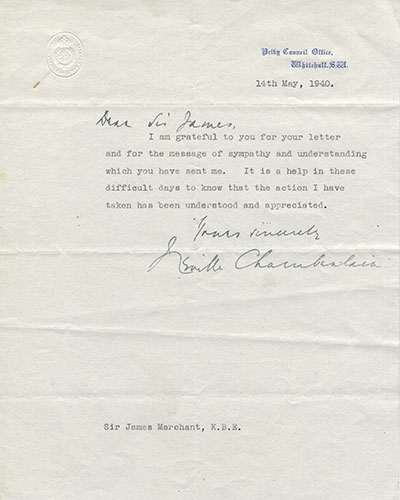
Exhibited here is an original May 14, 1940 letter signed and written by Chamberlain to Sir James Merchant as follows:
I am grateful to you for your letter and for the message of sympathy and understanding which you have sent me. It is a help in these difficult days to know that the action I have taken has been understood and appreciated.
On May 10, 1940 – only four days before this letter was written – Chamberlain had resigned as Prime Minister after losing political support following the disastrous Norway campaign, and “the action I have taken” refers to his tendering his resignation. The phrase “difficult days” is far from rhetorical, as it reflects one of Britain’s darkest weeks: in mid-May 1940, Germany had just invaded the Low Countries and France; British forces were in grave danger on the continent; the political crisis in London had just toppled Chamberlain’s government; and Britain feared possible defeat.
The Norway Campaign of April–June 1940 was the Allied attempt to prevent Nazi Germany from gaining control of Norway and its strategically vital coastline and iron-ore routes from Sweden. Germany moved first with Operation Weserübung on April 9, 1940, launching a bold combined assault that simultaneously seized key Norwegian ports and quickly established air superiority. Britain and France responded with hurried landings at several points, including Narvik and the Trondheim region, but the Allied effort suffered from poor coordination, unclear strategic priorities, and severe logistical and air-cover disadvantages. The campaign ended in a clear German victory and became one of the most consequential early Allied setbacks of the war.
The operation was widely viewed in Britain as disastrous for several interlocking reasons. First, Germany achieved strategic surprise through an audacious amphibious and airborne operation that many British planners had not fully anticipated. Second, the Allied response was fragmented and hesitant; planning was divided among the Admiralty, War Office, and Royal Air Force, and the lack of unified command contributed to slow decision-making and confused execution. Third, the Luftwaffe’s dominance over Norwegian skies severely constrained Allied naval and ground operations, exposing ships and troop movements to repeated attack. Fourth, the eventual evacuation of Allied forces, particularly the abandonment of Narvik after its costly recapture, created a public impression of retreat and mismanagement. These military and operational failures quickly translated into political consequences in London and particularly for Chamberlain.
The immediate political turning point came during the “Norway Debate” in the House of Commons on May 7-8, 1940, when members of Parliament from both the opposition and the governing Conservative Party expressed deep dissatisfaction with the government’s conduct of the war. Although the government technically survived the vote, its majority was sharply reduced, revealing a collapse of confidence in Chamberlain. Within days, amid the escalating German offensive in the West, he concluded that he could no longer effectively lead a national coalition. He resigned on May 10, 1940, recommending that Churchill form a new government. Our correspondence falls precisely in this brief and dramatic interval when Chamberlain had stepped down but remained in the War Cabinet and when supporters were writing to express sympathy and appreciation for what they viewed as his patriotic decision to yield power for the sake of national unity.
While modern historians generally agree that while the Norway Campaign exposed genuine failures, the extent to which Chamberlain personally deserved the blame remains sharply debated. One line of interpretation emphasizes that the campaign’s weaknesses were largely institutional and predated Chamberlain’s final months in office; recall that Britain in early 1940 was still adapting from a peacetime to a wartime footing, and its military command structure was not well suited for rapid amphibious intervention. Inter-service coordination problems, logistical limitations, and the lack of forward air bases in Scandinavia would have posed serious difficulties for any British government. From this perspective, the Commons debate treated what was fundamentally a complex military setback as though it were primarily the result of prime-ministerial misjudgment.
Jewish opinion in Britain tended to follow the general national mood: disappointment at the setback, concern about the worsening military situation, and ultimately support for the formation of a strong coalition government to prosecute the war more effectively. Some Jewish commentators, particularly those deeply alarmed by the Nazi threat to European Jewry, welcomed Churchill’s accession because of his long-standing reputation as an uncompromising opponent of Hitler.
Jewish historical writing about Chamberlain has often been colored more by the earlier appeasement controversy than by the Norwegian episode itself. Yet even here the picture is complex. While many Jewish observers in the late 1930s had sharply criticized appeasement, some contemporaries in May 1940 recognized that Chamberlain’s decision to facilitate a smooth transition of power during a national emergency was an act of political responsibility.
In the final months of his life, as war intensified, the question of Eretz Yisrael receded behind the larger struggle against Germany. Chamberlain’s health deteriorated rapidly after his resignation in May 1940 and he died on November 9, 1940 – the anniversary of Kristallnacht – having witnessed Britain’s survival through the early phase of the Blitz.
Chamberlain’s legacy in Jewish history remains somewhat ambivalent. For most, he represents missed opportunity at a crucial moment of mortal danger, but, for some, he represents a cautious statesman navigating extraordinary constraints who nevertheless enabled meaningful acts of rescue. At the end of the day, the historical record supports neither simple condemnation nor unqualified defense, and, taken as a whole, his relationship to Jewish affairs illustrates the broader dilemmas of democratic governance in an age of totalitarian threat. His government condemned Nazi brutality, admitted refugees within defined limits, authorized the Kindertransport, and declared war on Germany, but it also restricted immigration to Eretz Yisrael and maintained tight immigration controls at home, which led to countless thousands of deaths that could have been prevented.