 October 16, 2026
 Categories: Halacha & Hashkafa / Torah
Omer-Counting Conundrums & Kashrut Caveats


Omer – Sh’mini – Shabbat M’vorchim
The Omer counting is in progress – I hope you are still counting with a b’racha. Know too that even if you are not still able to say the b’racha, you still have the mitzvah of counting each night for the duration.
I guess I’ll start with the numbers since this is Torah by the Numbers. Forty-nine. Obvious, right? But the Torah says, “Tisp’ru chamishim yom” – count 50 days. Okay, we are all aware of the distinction between “up to and including” and “up to and not including.” But why the disparity between the pasuk and our count? Because the Torah also tells us about counting seven complete (“t’mimot”) weeks. That is the basis of counting the Omer being 49 days rather than 50.
One of the famous issues related to the counting of the Omer is whether it is a single large mitzvah with 49 component parts or whether we are dealing with 49 related little “mitzvah-lach.” If we say that there is one huge 49-part mitzvah, and that it has to be complete (let’s call this Opinion A), as the Torah uses the term t’mimot, then missing a day’s count flaws the mitzvah and one cannot continue saying a b’racha on subsequent nights. (Yes, if one missed a night, he still can count during the daytime, without a b’racha, and his t’mimot is not compromised – meaning, he continues with a b’racha on future nights.)
If, on the other hand, we consider the Omer counting to be 49 separate, though obviously connected, mitzvot (let’s call this opinion B), then missing a day does not take away the b’racha from future days.
Interestingly, this machloket (dispute) is unresolved in mainstream halacha. So, what is a person to do if he missed a full day? Which opinion decides the matter? Actually, neither. The halacha does not come to a conclusion, but something else determines the answer: safeik bracha l’hakeil, a doubt as to whether a b’racha is to be said is resolved by not saying it. Not that the opinion supporting not saying the b’racha “wins” the debate, but rather, the rule governing safeik decides for us.
Okay, what about a person who is about to count, let’s say, the 12th night, but is not sure if he counted the 11th or not? For this question, we reason this way: According to Opinion A, maybe he did count, so he would continue with a b’racha tonight; but if he missed, then he wouldn’t say a b’racha. According to Opinion B, it wouldn’t matter if he is sure that he missed the previous day. This is not a 50-50 kind of doubt. It’s more like 75-25, since he might have counted the day before, and both A and B would say to make a b’racha. Only half of one of two possibilities would say don’t say a b’racha. With these unbalanced possibilities, halacha would say to continue with a b’racha.
* * * * *
Now picture this dilemma: The rabbi of a shul who leads the counting every night at the end of Maariv (or immediately after Maariv, according to the Vilna Gaon – the difference being whether to count before or after Aleinu) was away for a couple of days’ vacation. On one of those days, he forgot to count and didn’t realize his error until the following night. He is supposed to continue counting without a b’racha. He returns home and is expected, by his congregants, to lead the counting with a b’racha. It would embarrass him (and the position he holds in the community) to turn over leading the count to someone else. He is permitted to lead, say a b’racha, and count out loud, followed by everyone in shul then counting. The point is, if the halacha would be like Opinion A, then, embarrassed or not, the rabbi would not be able to say a b’racha. But the halacha is not like A. Nor like B. And with the new factor at play – the rabbi’s embarrassment – Opinion B can be used to allow him to say the b’racha and lead the count for the congregation. Some say that even if we are not talking about the rav of a shul, just someone who is the baal t’fila for Maariv in a shul where it is the baal t’fila who leads the count, and the chazan in question skipped a day, he would be able to count with a b’racha to avoid being embarrassed.* * * * *
Here’s another interesting Omer-counting situation. A person has faithfully counted the first 10 days of the Omer. He completely forgot to count day 11. He continues counting without a b’racha on the 12th and 13th nights. However, on the 14th night he can say a b’racha because we are all commanded to count the days of the Omer and the weeks of the Omer. True, the person broke his t’mimut of days, but his counting of weeks is not broken. He can count with a b’racha on nights 14, 21, 28, 35, 42, and 49 when the mitzvah to count weeks is applicable.* * * * *
How about some Omer numbers on the fun side? Ask this riddle of a child, teen, or adult – it doesn’t matter: Let’s say you have a fabulously wealthy uncle who offers you a choice: “I’ll give you $1,000 for each night you count the Omer – or a penny for the first night, 2 cents for the second night, and double the amount each of the nights throughout the Omer period. Which option would you take? And what if he offered $1,000,000 per night or the 1, 2, 4, 8, 16... penny offer. Which would you take? The first options would get you either $49,000 or $49,000,000, respectively. But the penny and doubling each night would get you $5,629,499,534,213.12 – that’s over five trillion dollars! However, if you stopped counting after one week, you’d have been better off with 7 million or at least 7 thousand dollars, rather than the 12 dollars and 80 cents that the second option would have gotten you.* * * * *
There is so much more I could share with you about the Omer, but let’s move on to Parshat Sh’mini. But before we get into the sedra itself, a word about the eighth day of Pesach, the second day of Shavuot, and Sh’mini Atzeret – the three festival days that we do not have in Israel. Well, we do have a Sh’mini Atzeret, but it shares a day with Simchat Torah. The Torah reading for those three Chutz LaAretz Yamim Tovim is the same, more or less, taken from the end of Parshat R’ei. The Shalosh Regalim, the three pilgrimage festivals – Pesach, Shavuot, and Sukkot, all have religious, historical, and agricultural significance. The agricultural aspects of the Chagim are presented in the last part of Parshat R’ei. That’s what is read in Chutz LaAretz on those Yom Tov days that don’t exist in Eretz Yisrael. I speculate that the Sages who chose the Torah readings for the Chagim purposely chose the portion from R’ei for Chutz LaAretz, because the agricultural nature of the three festivals was the most absent outside of Israel. Religious and historical – not a problem. But agriculture mitzvot must mean Eretz Yisrael.* * * * *
This year, on Shabbat Parshat Sh’mini, we bentch Rosh Chodesh Iyar. Rosh Chodesh will be on Friday and Shabbat. Rosh Chodesh Iyar is always two days in our current without-a-Sanhedrin calendar, because Nissan (like September, April, June, and November) has 30 days. In all “plain” (p’shuta) years – 12 months, one Adar – Tzav is always the Shabbat before Pesach, and Sh’mini is always the Shabbat right after Pesach. And Sh’mini will always be Shabbat M’vorchim Iyar. (Except in Israel, when Pesach begins on Shabbat, in one year-type of the seven varieties of shana p’shuta, we read Parshat Sh’mini on the Sh’mini shel Pesach and go ahead of Chutz LaAretz in Parshat HaShavua, and thus our reading on Shabbat M’vorchim Iyar is Tazri’a-M’tzora.) Fun fact: This year, when two-day Yom Tov observers are celebrating Sh’mini shel Pesach, we in Israel will be reading the first aliya of Parshat Sh’mini. So, on Thursday, we will all have some Sh’mini or other. Not the funnest (as one of my daughters used to say), but cute. Another fun fact (that you can turn into a riddle for those at your Shabbat table): Sedra names come from a word or two in the opening pasuk or two of each sedra. There are five sedras whose names have dropped the first letter Hei (“the”) from the beginning of the word in the Chumash that gives its name to the sedra. This week’s sedra begins “Vayhi bayom hash’mini.” The sedra name is Sh’mini, with the prefix Hei dropped. So too for Hamishpatim, Ham’tzora, Hamatot, and Had’varim. Significance? None, really. But the dropped Hei equals five, and there are five dropped Heis. I just think it’s cute to note.* * * * *
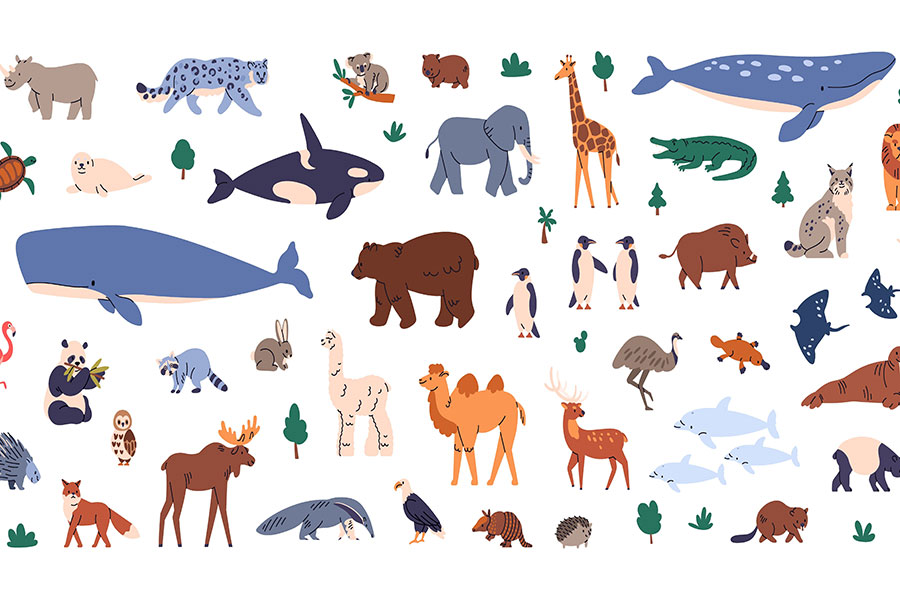
Parshat Sh’mini is on the small side, ranking 41st or 42nd of the 54 sedras, depending on what you are counting – p’sukim, words, letters, or lines. Its only stat that increases its ranking is number of mitzvot. It has 17 mitzvot, 6 of which are positives and 11 are prohibitions. Twelve sedras have more mitzvot, so it ranks 13th, tied with Yitro. That puts it in the top quarter of the sedras. The first four mitzvot of Sh’mini deal with rules for Kohanim vis-à-vis entering the Mishkan. The rest of Sh’mini’s mitzvot deal with the animals we can and cannot eat. Basically, the first two-and-a-half sedras of Sefer Vayikra deal in some way with korbanot. Only then, in the second half of Sh’mini, do we begin to see animals as food (or not), rather than as defined by their sacred use in Temple service. This sequence – first the sacred use of animals and then the secular? mundane? non-sacred? (I’m not sure what the correct term is) use of animals shows up in two other places. The first is in Parshat No’ach after the Flood. Until then, people were not permitted to kill animals for food. No’ach offered sacrifices to G-d from the kosher animals on the Ark, and only after that were people given permission to kill animals for food. And then we look at the fifth Order of Mishna (out of the six, as in “Who knows six? Six are the Orders of the Mishna), which is Kodashim. The first volume in Kodashim is Zevachim, which deals with korbanot from the animal kingdom. Then comes Menachot, which deals with Temple offerings from the plant kingdom (flour, olive oil, spices). Only then do we come to Chullin, the tractate that deals with kashrut, ritual slaughter, meat in milk, and a variety of other topics related to the non-sacred use of animals.* * * * *
“All the animals that I eat “must chew their cud and have split feet, “kosher meat just can’t be beat “so, I want only kosher.” Thus goes the opening verse of Uncle Moishy’s “Kosher Song.” The animals we can and cannot eat are presented – with differences – in Sh’mini and in R’ei. Again, it is an interesting bit of trivia that on Thursday, the last day of Pesach or Isru Chag of Pesach (depending upon where you live), both Sh’mini and R’ei will be read from – although not the part about animals. Let me conclude this column with a lesser-known set of mitzvot. The four categories of animals presented in both Sh’mini and R’ei are mammals, fish, birds, and locusts. Each category has prohibitions associated with it. You may not eat a mammal that does not have the two signs of kosher, even if it has one of them. Fish that don’t have scales and fins may not be eaten. Birds on the list of non-kosher birds may not be eaten. Do not eat creepy crawlers. And so on. There are, however, four positive mitzvot (three in Sh’mini and one in R’ei) that sound like a command to eat the kosher animals. For example, “These are the animals that you shall eat...” That mitzvah is not commanding us to eat the meat of kosher animals. We have permission to eat meat if we so choose. Same for fish. Same for birds, and so on. So, what does the Torah mean when it presents us with a mitzvat asei that is the flip side of the prohibitions against eating non-kosher animals? This we understand from the Oral Law, that which G-d explained to Moshe Rabbeinu and told him to teach all of us. “And this you shall eat from all that is in the water... scales and fins...” This means that we must check animals for their kosher signs and status. A guy is fishing by a river and catches a good-looking fish. He skins it, fillets it, grills it, and enjoys a delicious meal. A friend walks by and the guy tells him about the tasty fish he just ate. “What kind of fish was it?” “I don’t know, but it was really good.” “Was it kosher?” “Oops, I didn’t check.” He rummages through his garbage bag and pulls out a piece of the fish’s skin. He looks and sees that it indeed had scales and fins. Relieved, he tells his friend that it was kosher. This person has not violated the prohibition against eating non-kosher fish. But he has not fulfilled the mitzvat asei to check for kashrut. Two takeaways from this. First, that the positive mitzvah for each category of animal is technically unnecessary. We would have to check the animal for kashrut to avoid eating non-kosher. But Hashem elevated the practical act of checking to the level of a mitzvah. That is a special bonus from G-d. Second, the spirit of these positive mitzvot translates to each of us, requiring us to check all foods, restaurants, and so on for kashrut information – hashgacha and other halachic details. We should not just say, “Well, I saw guys with kipot eating this or that, so I don’t need to look that carefully.” Read the kashrut info. Read the certificate in a restaurant. Be proactive in determining that you are serious about your kashrut standards. Chag Samei’ach (if you are reading this before or on Yom Tov), Shabbat Shalom, and don’t forget to count the Omer!