October 2, 2026
 Categories: Halacha & Hashkafa / Torah
Omer Quandaries, Divine Dermatology, & the Meaning of Mila


Parshat Tazri’a-M’tzora – Rosh Chodesh Iyar
There’s an old riddle used by teachers to challenge their students and see which of them can think out of the box. It goes like this:
Rosh Chodesh is always on the first of a month and on the 30th (when there is one). But when is Rosh Chodesh on the 15th?
The answer is this coming Shabbat, the first day of Iyar, the second day of Rosh Chodesh Iyar. And it coincides with the fifteenth of the Omer. And if you think the riddle was misleading, go back and read it carefully. When is Rosh Chodesh on the 15th? It did not say “of the month.” Try this one out with your children, grandchildren, or your Shabbat guests. The riddle is harder when you ask it any other day, so asking it on the day that is the answer might make it too easy. But maybe not.
* * * * *
We have Shabbat-Rosh Chodesh either twice or thrice each year. To be statistically specific, there are two occurrences of Shabbat-Rosh Chodesh in 52.33% of years, and three in 47.67% of years. Remember that for these stats, Rosh Chodesh can be Friday-Shabbat, Shabbat alone, or Shabbat-Sunday. On most Shabbat-Rosh Chodesh, we read from two Torahs. For Shabbat-Rosh Chodesh Tevet (Shabbat Chanukah), Shabbat-Rosh Chodesh Adar and Adar Bet (Sh’kalim), and Shabbat-Rosh Chodesh Nissan, we use three Torahs. Note that when Rosh Hashanah is on Shabbat-Sunday, then that is another Shabbat-Rosh Chodesh – it’s Rosh Chodesh Tishrei – but I’m not including Tishrei in these stats. Also note that Rosh Chodesh Kislev and Rosh Chodesh Sivan are never on Shabbat.* * * * *
Tazri’a and M’tzora are read together in all variations of shana p’shuta (12 months, one Adar) and are separated in all variations of shana m’uberet (13 months, two Adars). Our years have 50 or 51 Shabbatot (12-month years) or 54 or 55 Shabbatot (13-month years). Four sedra-pairs – Vayakhel-P’kudei (VP), Tazri’a-M’tzora (TM), Acharei-K’doshim (AK), and B’har-B’chukotai (BB) – are combined or separated to accommodate the extra Shabbatot of a 13-month year. TM and AK are the neat ones, needing no asterisk to mention exceptions. There are three other sedra-pairs – Chukat-Balak (CB), Matot-Mas’ei (MM), and Nitzavim-Vayeilech (NV) – that combine or separate for other calendar situations.* * * * *
Tazri’a and M’tzora are the 27th and 28th sedras of the Torah’s 54. That makes Tazri’a the last sedra of the first half of the Torah, and M’tzora the first sedra of the second half. Combined, they are the middle of the Torah in sedras. With 67 p’sukim, Parshat Tazri’a ranks 48th among the sedras. Same rank for lines in a Torah, words, and letters. Tazri’a consists of two p’rakim (chapters – remember that chapters in the Torah are of non-Jewish origin, yet we commonly use them). The first is the shortest perek in the Torah, with 8 p’sukim. It deals with birth, tum’a and tahara (ritual purity and impurity), and brit mila. The second perek has 59 p’sukim, the longest perek in the Book of Vayikra, and the fourth largest perek in the Torah. And this much bigger, second part of Tazri’a has very detailed aspects of tzora’at and nega’im (bodily afflictions that have a spiritual source), and various other aspects of tum’a and tahara. And that long perek moves smoothly into Tazri’a’s partner sedra of M’tzora.* * * * *
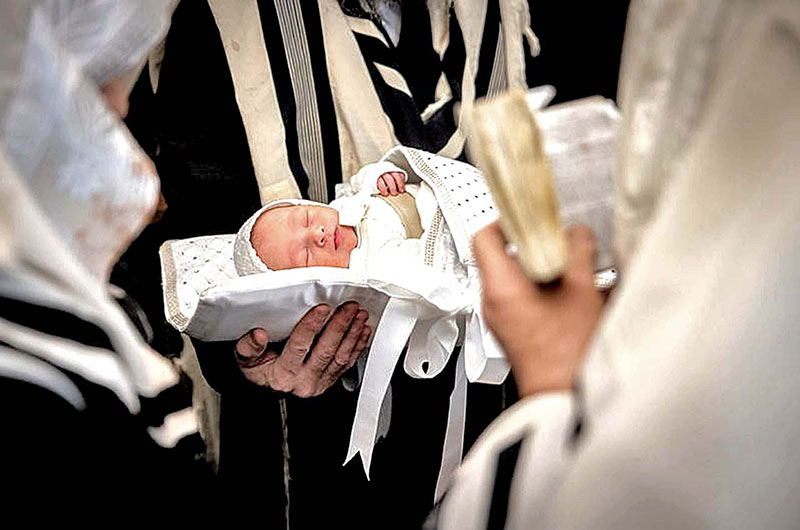
“Speak to B’nei Yisrael, saying, ‘When a woman becomes pregnant and gives birth to a male... and on the eighth day he is circumcised.’” Sounds like a command – and it is – but it is not counted among the Torah’s 613 mitzvot. How come? Because circumcision has already been counted from way back in Parshat Lech L’cha. The two commands concerning circumcision help explain the double name of circumcision – brit and mila. Those words are used separately and together. Notice (not an invitation): The brit will be Thursday morning, davening at 8:00 a.m., the mila not before 9:00 a.m. Bagels & lox to follow. Brit and mila are not synonyms. They each point to a different aspect of what is supposed to happen on the baby boy’s eighth day. First, we have the mila, the circumcision itself. Usually, the father of the boy will appoint the mohel as an agent to perform the circumcision. The mohel will give the father a knife (officially, as a gift). He will then say to the father, “If you want me to circumcise your son, you will give me the knife to do it.” The father will do so, and the mohel, having already prepped the baby, then makes the b’racha – “Asher kid’shanu b’mitzvotav v’tzivanu al hamila.” In much less than a minute, the mila is done. But even before it finishes, immediately after the mohel’s b’racha, the father recites a second mitzvah-b’racha – “Asher kid’shanu b’mitzvotav v’tzivanu l’hachniso bivrito shel Avraham Avinu,” G-d Who has sanctified us with His mitzvot and commanded us to enter him (the baby) into the Covenant of Avraham. In Israel, the father follows his second b’racha with She-he-che-yanu; in many communities outside Israel, that b’racha is not said. The mohel, as the shali’ach (agent) of the father, took a short moment to do the mila. But the father (together with his wife, the mother of the baby) has the ongoing mitzvah of raising a good person and a good Jew, faithful to the values of a Torah way of life. This is the brit part of the brit mila. In Lech L’cha, the brit of Avraham, as representative of all his descendants, includes more than performing circumcision. Yes, the circumcision is called a brit in that context, but more so (perhaps) it is also called the ot brit – the sign of the Covenant. And that covenant, as expressed by G-d to Avraham, includes both His promise to be our G-d and His gift to us of Eretz Yisrael. The word brit occurs ten times in the portion about Avraham’s circumcision and that of Yishmael and the other males of Avraham’s household. This explains why the mitzvah is counted (by most mitzvah-counters) from Lech L’cha, rather than from the clinical, short command of the eighth day. It is significant that the father gives over the mila and its b’racha to the mohel but retains for himself and his wife the commitment to prepare a new member of Klal Yisrael for a life of Torah and mitzvot. Mila – a number of seconds; brit – many years. Viewed another way, mila is one of the mitzvot of the Torah; the brit represents all of the mitzvot. We could say, the other 612 mitzvot. The gematria of brit is 2 + 200 + 10 + 400 = 612. Brit (612) + mila (1) = 613.* * * * *
Take another look at the two b’rachot we mentioned (not counting the she-he-che-yanu). Mitzvah-b’rachot come in two styles: Al and L’ – “on” and “to,” respectively. A gerund noun and an infinitive verb. We say, “…on the eating of matzah,” “…on the reading of the Megillah,” “…on the washing of the hands,” “…on taking the lulav,” “…on the mila.” And many others. We also say, “…to light the candle of Shabbat,” “…to light the Chanuka candle,” “…to affix the mezuza,” “…to dwell in the sukka,” and “…to enter the child into the Covenant of Avraham Avinu.” These b’racha-forms are not random, nor are they interchangeable. And each form tells us something different about the mitzvah. It’s a mitzvah to eat matzah on Seder night. You take a kazayit (or two), make the b’rachot, bite, chew, swallow, bite, chew, swallow... and the mitzvah is completed. And you did it all. On Purim, you say the b’racha on Megillah reading, and 35-50 minutes later (more or less), the mitzvah is done. The reader and the listeners have done the whole mitzvah. You wash for HaMotzi, wash your hands, make the b’racha, dry them – and the mitzvah is done by your action. Similarly, the mohel makes his b’racha and then performs the mila – done. But when you light Shabbat or Yom Tov candles, you only start the mitzvah going. The candles must continue to burn beyond your performance of the mitzvah. You start it and it keeps on going. That’s “L’hadlik” – to light. Same for Chanuka candles. They must burn for at least a half-hour after stars-out. You set the mitzvah in motion and it continues beyond your first action. You must affix a mezuza to your doorpost and it must remain there beyond your initial action. If you take it down for painting or if it falls off, you must put it up again. The mitzvah is ongoing; therefore, we say Likbo’a rather than Al k’vi’at. You eat in the sukka. The mitzvah is not completed yet. It is ongoing. You ideally learn there, read there, play games with your kids there, sleep there – so Leisheiv rather than Al. And the brit part of brit mila is ongoing. As long as parents are capable and the children are hopefully responsive, chinuch is an ongoing part of the mitzvah.* * * * *
M’tzora, with 90 p’sukim, is on the small side, but is larger than Tazri’a. Following on the Torah’s treatment of bodily afflictions and that of a garment, M’tzora introduces Nig-ei Habayit. We’ll get back to that in a moment. But the sedra begins with the procedures for a “cured” m’tzora, one who is afflicted with tzora’at. Please note that leprosy is a poor translation for tzora’at. Tzora’at and nega’im are bodily conditions that might be indicative of a spiritual defect and have nothing to do with physical disease. Let’s look at a simplified situation to glimpse the concepts of tzora’at. During the time of the Beit HaMikdash and everything that goes with it, including attention to tum’a and tahara, ritual purity and its opposite, a person notices that a rash has developed on his arm. Today, he would show it to his family doctor, if it were serious-looking, or just go to the pharmacy for a salve. But at that time, he would contact a kohen-expert in both the laws and details of nega’im, as well as a degree in dermatology. The kohen would examine the rash and make one of the following determinations.- He could say: “Not a nega; here’s a prescription for a salve to treat the rash.”
- Declare it immediately as a nega, and thus the person is tamei.
- Take measurements of the rash, maybe photograph the rash for coloring. And say, “I’ll see you in a week and recheck the situation.”
* * * * *
My bar mitzvah parsha was Tazri’a-M’tzora. I remember being envious of friends whose sedra was B’shalach or Yitro or B’reishit... Any sedra that did not focus on a whole variety of “adult subjects” (more than I have mentioned in this column). The saving grace for an appropriate D’var Torah for a bar mitzva boy was the fact that I was born during S’firat HaOmer and before Pesach Sheini. Good, appropriate material for a 13-year-old. Let me finish with a S’firat HaOmer situation. First, imagine a non-Jew who wants very much to convert to Judaism. He’s been studying and practicing for two years. (And properly avoiding complete Sh’mirat Shabbat – a topic for another time.) His conversion is scheduled for, let’s say, the tenth of Iyar. Comes the second night of Pesach and our soon-to-be Jewish fellow begins counting the Omer – with a b’racha – as part of his training. Comes the 10th of Iyar, circumcision is taken care of, as well as immersion in a mikveh. It is now the eve of the 11th of Iyar. The person has counted with a b’racha (as a Jew-in-training) every night – all 25 of them – until tonight. He is now Jewish – 100% Jewish. He counts the Omer for the 26th day of the Omer, but he cannot make the b’racha because his counting is incomplete. Yes, he has counted until now, and yes, he was permitted to make a b’racha each night. But that was only for practice. Now as a Jew, he has the mitzvah to count, yet his count (for this year) will be incomplete. Hence, no b’racha. See the irony? As a non-Jew, he makes the b’rachot; as a Jew, he cannot. What about a Jewish boy or girl who reaches the age of mitzvot during the Omer period? Is it the same? How do we view his or her counting each night until the bar/bat mitzvah? Most authorities say that as a Jew, the child almost at the age of mitzvot had a Rabbinic obligation of chinuch. That is not the same as a non-Jew’s practicing. He or she has been connected to the mitzvah to count the days of the Omer and has done so without missing a day. The level or type of obligation might be different, but “t’mimot tihyena” (the count shall be complete) has not been compromised. So, the new bar/bat mitzvah continues counting with a b’racha. Shabbat Shalom and Chodesh Tov.