 October 23, 2026
 Categories: In Print / Headline / Torah
Parshat Vayeira
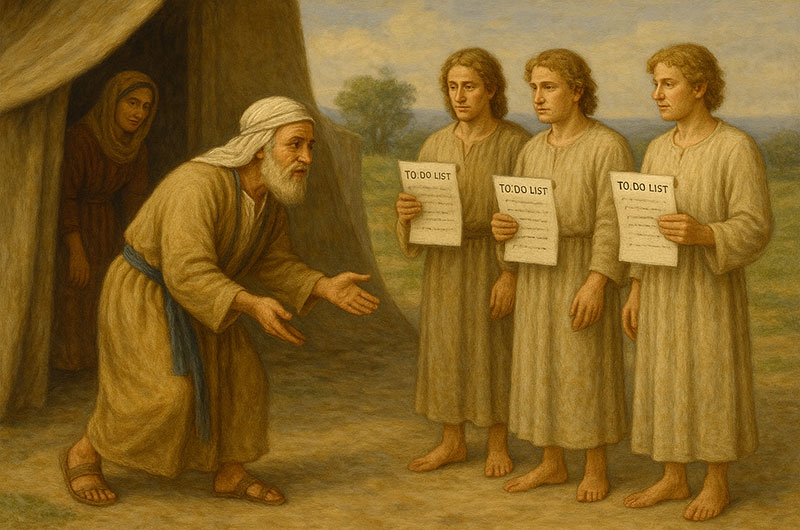


Parshat Vayeira is the 7th, 5th, 3rd, and 2nd longest sedra of the Torah’s 54 sedras.
What do I mean by that?
If we count the length of a sedra by the number of pesukim it has, then Vayeira’s 147 pesukim puts it in 7th place. Just for perspective, the six sedras that are longer than Vayeira are Naso (176), Pinchas (168), Bamidbar (159), Noach (153), Vayishlach (153), and Vayeitzei (148).
If we count length of a sedra by how many lines of a Sefer Torah it consists of, then it rises to 5th place with 255 lines, bypassing Noach, Vayeitzei, and Vayishlach – but falling closely behind Parshat R’ei, which has fewer pesukim but many more parshiyot, meaning more blank spaces that add to the number of lines.
But if we count length by the number of words or letters, then Vayeira jumps to 2nd (2,085 words) and 3rd (7,862 letters), respectively.
(Naso, by the way, is first in all four categories – 311 lines, 176 pesukim, 2,264 words, and 8,632 letters.)
You decide what should the determine length of a sedra. In any event, all told, Vayeira is a long sedra.
* * * * *
After the word Vayeira that opens the parsha, we would expect the next words to be “Hashem el Avraham,” And G-d appeared to Avraham. Instead, we find “Vayeira eilav Hashem,” And to him G-d appeared. The use of a pronoun (“him”) rather than a proper noun (the person’s name) indicates that we are in the middle of a story rather than at the beginning of something. “Eilav,” to him, refers to Avraham, and specifically to his having circumcised himself at the age of 99.This is where our sedra begins.
Avraham has just circumcised himself. He is 99 years old. Yitzchak is a year away from being born.
Avraham was born in the year 1948 from Creation. (The significance of the same number year, counting from a different starting point, cannot escape our notice.) Sara was born in 1958.
So, the year at the beginning of the sedra is 2047. There were ten generations from Noach to Avraham. As of 2047, then, Avraham’s father is still alive and would live for another 36 years. The following ancestors are still alive at this point: Sheim ben Noach. Arpachshad, Shelach, Eiver, and S’rug (who would die two years later). Sheim, Shelach, and Eiver would outlive Avraham Avinu.
The sedra ends with Akeidat Yitzchak and the passing of Sara in 2085. Thus, Parshat Vayeira spans 38 years. A bit different from Parshat Bereishit’s 1,638-year time-span…
Before there was Torah Tidbits, there were Torah Tidbits. And one of the very first Torah Tidbits was entitled “Angel Arithmetic.” (Kind of appropriate for Torah by the Numbers.) Based on the “rule” that an angel is given a single mission and that one angel cannot do two missions, G-d sends three angels to visit Avraham with three missions:
- to heal Avraham from his brit milah
- to announce the birth of Yitzchak (in one year)
- to destroy Sodom
(1) to save Lot
(2) to destroy Sodom
Okay, here are the questions:
Four tasks – three angels. Are angels in such short supply that G-d didn’t send four angels in the first place? Why use one angel who had finished his task and give him an additional task instead of sending a different angel?
Or, if an angel can take on a new task upon completion of a previous task, then only two angels were needed in the first place.
The second question is easier to answer. Not only are angels one-task-at-a-time, they also each have the same kind of tasks. An angel who heals, for example, does not also destroy. This is why a third angel was necessary – tasked with destroying Sodom.
This leaves the first question. Is G-d stingy with angels?
Here is an answer suggested by the Chidushei HaRim, as found in Maayana shel Torah (Wellsprings of Torah). Originally, there were three tasks for which three angels were sent: heal Avraham, announce the birth of Yitzchak, and destroy Sodom. Saving Lot was not originally part of the plan. His worthiness to be saved was not certain. True, he was Avraham’s nephew and had learned a few things from his uncle. But was it enough to save him? Not for certain.
When it comes to a person’s merit, he can get credit (so to speak) from his past and present actions and character – and also from his future actions. Lot had another thing working in his favor – he was the progenitor of Ruth, the mother of Royalty – Ruth, from whom David HaMelech and the entire Beit Malchut David (the House of David) would descend, including the Melech HaMashiach.
Pretty impressive. Certainly, that would be enough to save Lot.
Ah, but there is a little technical problem: The Torah states that a Moavite cannot marry into the “Congregation of G-d.” Specifically, even though a Moavite can convert to Judaism, there are marriage restrictions. If these restrictions were to apply to Ruth, then she could never become the mother of Royalty.
The issue revolves around the word Mo’avi, or Moavite. Does it refer to men and women, or just to men? Many words in the Torah can be sometimes inclusive and sometimes exclusive. Which is it for Mo’avi?
The Sanhedrin in the time of Boaz and Ruth declared that Mo’avi was specific to males, and the rule (of restricted marriage) did not apply to a Mo’aviya, a female Moavite. Thus, Ruth was able to marry Boaz... and the rest is history.
On what grounds was that clarification of Mo’avi made? The Torah gives a reason for excluding a Mo’avi from marrying into Khal Hashem. Devarim 23:5 states: “Because they did not greet you with bread and water on the way, when you left Egypt...” The Sanhedrin reasoned that it would have been the men who were hostile towards the Israelites, not the women, who would modestly have remained in the background and not been part of the hostile encounter.
And where does that reasoning – that women are innately modest – come from? From Sara Imeinu! Sara, not only the Matriarch of the Jewish People, but of many nations.
Bereishit 17:16, at the end of Lech Lecha, states: “And I will bless her, and I will give you a son from her, and I will bless her, and she will become [a mother of] nations; kings of nations will be from her.”
Be patient – just a little more... What was the defining moment at which Sara displayed this modesty-trait of womanhood? When the angels asked Avraham where his wife Sara was and the answer was, “Behold in the tent.” That justified our Sages’ ruling that the marriage restriction did not apply to Ruth, which led to her becoming the mother of Royalty. And it gave Lot the merit he needed to be saved from the destruction of Sodom.
And so, an angel who had just healed Avraham was available to join the destroying angel heading for Sodom, in order to save Lot and his daughters.
* * * * *
Now here’s a famous number for you: ten. Pirkei Avot 5:4 tells us, “With ten trials, our father Avraham was tried, and he stood firm in them all, to make known how great was the love of our father Avraham.”Quick: What was the tenth and final test? Most people will answer “Akeidat Yitzchak,” the Binding of Isaac. And most commentaries who list the ten trials of faith will agree. But not all of them.
The wording in the Torah (Bereishit 22:12) seems to point to the Akeidah as the final test of faith – “And he [an angel] said, “Do not stretch forth your hand to the lad, nor do the slightest thing to him, for now I know that you are a G-d-fearing man, and you did not withhold your son, your only one, from Me.’”
However, Rabbeinu Yona (Yona ben Avraham Gerondi, 13th c. contemporary and mechutan of Ramban) says that the death and burial of Sara was a further test of Avraham’s faith. He had been promised repeatedly that the Land of Canaan would be his, and yet he had to buy land there to bury Sara.
Others say that marrying off Yitzchak was also a test of faith.
From the fiery furnace (which some count and others don’t) to Lech Lecha – down to Egypt, back to Canaan – to the second Lech Lecha, which sent Avraham with Yitzchak to Har HaMoriah for the Akeidah – and even more… Avraham did not have an easy life. But his life set the precedents of Jewish character throughout all the generations since.
* * * * *
The gematria of Avraham is 248, the number of mitzvot asei – positive commands of the Torah. It’s also the number of parts of the body, and the number of words in the Shema. A very significant number for a very significant person – the progenitor of the Jewish People.Shabbat Shalom.