 October 16, 2026
 Categories: Headline / Perspectives / Op-Eds
Parshat Vayeishev and Lessons in Sibling Rivalry


One of my sisters-in-law is a thoughtful and creative gift-giver whose yearly Chanukah presents remain one of the touchstones of my daughters’ childhood memories. The presents weren't expensive, but they were always eclectic, perfect, and wrapped in a manner that was a gift in itself.
The year my girls were twelve and nine, my sister-in-law sent a jewelry box for the oldest and Bananagrams for the youngest. At the time, my sister-in-law was the proprietor of a gift store and she knew that Bananagrams was the hot new word game of the season – a seemingly perfect choice for my precocious and verbal little girl. My little girl, however, didn’t care that the cute banana-shaped sack contained the coolest game of the year – all she wanted was her sister’s new purple suede jewelry box.
One of the overarching themes in Sefer Bereishis is sibling rivalry. The outcome of each successive conflict propels the narrative forward, shaping our destiny through events that are sometimes confusing and surprising – especially since the reason why the Torah doesn’t begin with mitzvos and laws is so that we can learn from the actions of our forefathers. Shortly after Creation, the first older brother in the world kills the first younger brother in the world in a shocking and violent act fueled by jealousy. As any parent can attest, jealousy is one of the root causes of strife between siblings and stems from a combination of factors: the perception of material inequality, parental favoritism (perceived or otherwise), and any family dynamics that elicit the predictable cliche of “It’s not fair!”
The other fateful sibling hostilities in this sefer are those between Yitzchok and Yishmael, Yaakov and Eisav, and Yosef and his brothers. The first two fraught sibling relationships are understandable because they are, in essence, the fight between good and evil. The discord between Yosef and his brothers is infinitely more troubling because these are the twelve Shevatim, the twelve tzaddikim from whom all of us descend. How is it possible that they allowed their hatred to escalate to the brink of almost murdering their little brother?
In Parshas Vayeishev (37:3), we read: “And Yisrael loved Yosef more than all his sons, because he was a son of his old age, and he made an embroidered coat for him.” There is no ambiguity here, no perceived or imagined favoritism in the minds of the Shevatim. It was a fact that Yosef was the favorite son. The consequences of this favoritism are also no secret – immediately in the next pasuk (37:4), we see the brothers’ reaction: “They hated him and could not speak peaceably to him.” This raises another troubling question: How is it that Yaakov played favorites with his children?
Rav Reuven Feinstein, in his sefer Nahar Shalom, teaches us how to understand this complicated topic. He starts the discussion by reminding us that we are talking about virtually perfect people, and when they make mistakes, it is a testament to how difficult it is not to become ensnared in such a mistake. When we read this portion of the parsha about favoritism and sibling rivalry, we immediately know that this kind of behavior can destroy a family, yet the only reason we have that knowledge is precisely because we learn it from this parsha! We learn from the Avos and the Shevatim not only what to do, but also what not to do.
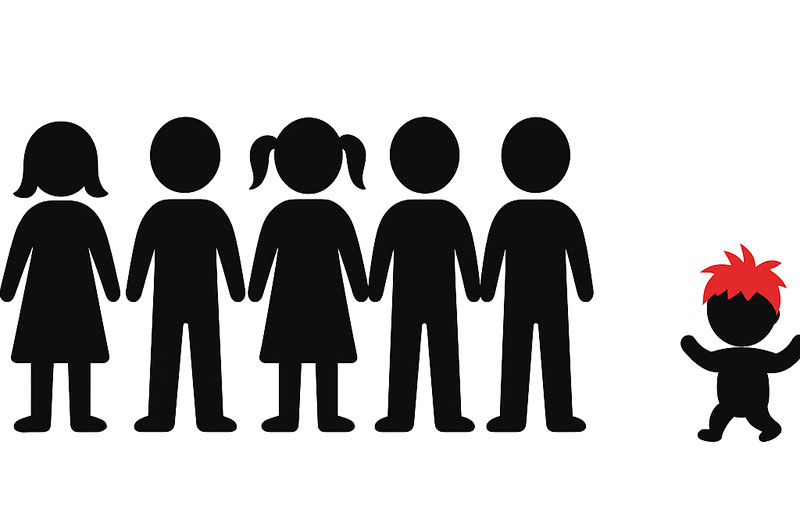
As the oldest of six children, I am intimately familiar with the particulars of sibling rivalry. Five of us were born in the span of ten years, and then ten years after the fifth, my mother had another baby. My brother was born with fiery red hair and a temperament to match. He was a difficult baby and then a difficult toddler; his saving grace was that he was adorable and it was hard to stay angry at him for too long. We called him “the ben zekunim” to his face, and his special status afforded him a lot of latitude as he got older, causing the rest of us to kvetch about how he was being raised with a different set of rules than we had been.
There is, however, a dark side to being a ben zekunim, a sad promise that this child will experience heartache in a way that is unique to children born to older parents. When our father passed away, my youngest brother was still only in his twenties. Although all of us mourned equally, there was an inherent inequity in the quantity of time and the milestones that the rest of us had shared; we had been walked down the aisle at our weddings and had subsequently seen the nachas our father derived from his grandchildren. My brother, who grew up to become an amazing man with a beautiful family of his own, experienced none of this; nor does he have memories of our father as a younger man doing the things that younger fathers do. I am not jealous of my little brother, not one little bit.
If we look at the text of the pesukim in Parshas Vayeishev very carefully, we see that the brothers were not jealous of Yosef after he was given the kesones pasim, nor were they jealous after the first dream. The coat elicited hatred and the first dream exacerbated this antipathy, but it was only after Yosef’s second dream that the brothers became envious of him. Rav Soloveitchik in his discussion on this parsha explains the inherent difference between the two dreams, and specifically what it was about the second dream that generated the brothers’ envy.
In the first dream, Yosef had a vision that he and his brothers were in a field piling up sheaves of wheat when suddenly his sheaf arose and remained upright while his brothers’ sheaves bowed to his. In the second dream, the sun, the moon, and eleven stars were bowing down to him. The Rav explains that the first dream represents material and economic power while the second represents spiritual greatness. The primary tension between the brothers wasn’t because Yaakov loved Yosef more, nor was it because of the coat; as per the Rav, they were jealous of Yosef’s “kishronos” – his talents, his potential, his magnetism.
After Yaakov’s death, someone was going to become the head of the family, and Yosef felt that he was that someone. After the second dream, the pasuk says in 37:11, “V’Yaakov shamar es hadavar,” which Rav Shamshon Raphael Hirsch explains as “Yaakov pondered the matter.” Once the brothers saw that their father was giving credence to the dreams, they realized that the dreams could actually come true, and this provoked their jealousy because they too wanted to become the spiritual leaders of Klal Yisrael.
When I began to write this article, I realized that while I remembered, of course, that Daughter #2 had received Bananagrams, I couldn’t remember exactly what gift Daughter #1 had received, other than the fact that it was something feminine and pretty, so I texted my younger daughter to find out what it was. She responded almost immediately, “She got purple suedey!! I was so upset!” After a little more texting, I remembered the purple suede jewelry box and went to go look for it in my older daughter’s room, which still contains random remnants of her childhood that got left behind when she got married. I couldn’t find it, so I texted Daughter #1 to ask where it was. Almost simultaneously, both girls texted me. Daughter #1: “I gave it to Daughter #2, lol.” Daughter #2: “She finally gave it to me when I was 21!”
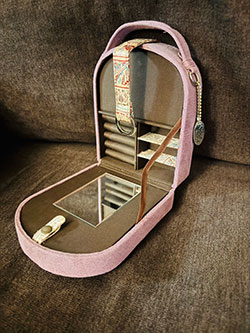
I was shocked that I had lost track of this story, that I didn’t know they had nicknamed the jewelry box “purple suedey” and that Daughter #2 had actively coveted it for over twelve years. Although Daughter #2 wanted the jewelry box because it was beautiful, it was actually more complicated than that. She wanted to be seen as her sister’s equal, to be perceived as a young lady who was feminine enough and mature enough to receive a purple suede jewelry box. But also, part of her wanted it simply because it was her sister’s.
The sibling rivalry between the Shevatim precipitates Yosef’s sale and a chain of events that lands Yosef in Mitzrayim, where he eventually becomes second in command to Pharaoh and ultimately reconciles with his brothers. In Parshas Vayigash, after Yehudah offers himself up as a slave instead of Binyamin, Yosef clears the room and begins weeping loudly, revealing himself as their brother and inquiring about their father. He urges his brothers to come closer and tells them not to grieve or reproach themselves for his sale, because this was meant to be; he was sent to Mitzrayim to pave the way for their subsequent survival in the land. Rav Soloveitchik marvels at Yosef’s behavior towards his brothers – at his generosity of spirit and lack of vindictiveness –and says that only the son of Rochel, who gave away Yaakov to her older sister, was capable of this kind of behavior, of this elevated level of chesed.
I’m not sure what prompted Daughter #1 to give purple suedey to her sister at that particular moment in time. Of course I can ask her, but for now, I’d rather dream. I’d like to imagine that while reaching for something on her dresser, her fingers brushed against the soft suede of the box, releasing dust motes into the air that made her sneeze, that made her smile, that made her remember her little sister who was no longer so little. And then, in an act of chesed, a character trait she no doubt inherited from her namesake, Rochel Imeinu, she gifted it to her sister who was thrilled to receive it, even twelve years later. There are other, more practical, less altruistic reasons for purple suedey’s transfer of ownership, but like all mothers who only want their children to love each other and get along, I’d rather dream.