 October 23, 2026
 The Maharatz Chajes at Work


Every so often, a manuscript emerges that reminds us why collectors and historians become captivated by old paper. Its importance lies not merely in its rarity or in the prominence of its author, but in its ability to transport us into another century and allow us to witness greatness in the midst of its creation rather than only in its finished form. Such is the case with the recent acquisition of an extraordinary autograph notebook belonging to Rabbi Zvi Hirsch Chajes (1805-1855), universally known as the Maharatz Chajes.
Few nineteenth-century rabbinic figures occupied as many intellectual worlds as the Maharatz Chajes. Appointed rabbi of Żółkiew while still in his twenties and later serving as rabbi of Kalisz, he established himself as one of the leading Talmudic authorities of his generation. His incisive glosses eventually found their way into the standard Vilna editions of the Talmud, while his Mevo HaTalmud secured his reputation as one of the foremost interpreters of rabbinic literature. At the same time, he mastered European languages, engaged deeply with historical scholarship, and corresponded with many of the leading rabbinic and literary figures of his day. Although he stood firmly against the emerging Reform movement, he demonstrated that careful historical research and unwavering fidelity to Torah tradition were not mutually exclusive. His scholarship showed that the tools of critical inquiry could illuminate rather than undermine the mesorah.
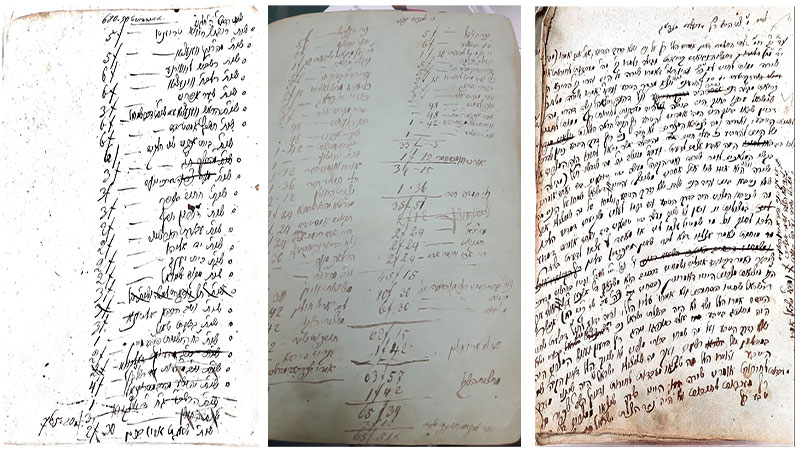
The printed volumes that established his reputation, however, present only the public face of the man. This notebook opens an altogether different window, revealing the private workshop of one of nineteenth-century Jewry's greatest scholars. Rather than carefully prepared copy destined for the printing press, its fifty-seven folios preserve the Maharatz Chajes thinking aloud on paper, revising ideas, drafting responsa, keeping accounts, and attending to the countless practical matters that filled the life of a communal rabbi.
The contents move effortlessly between the sacred and the mundane. Unpublished comments on passages of Talmud, Midrash, and Targum Tehillim are followed by inventories of books ordered for purchase, calculations recording the sale of his own works, lists of etrogim, shipping records, private loans, and household expenses. Far from diminishing his stature, these seemingly ordinary entries enrich it, reminding us that even one of the century's greatest Torah scholars had to oversee the business of publishing, manage finances, arrange the transport of books, and support a household while maintaining an astonishing level of scholarly productivity.
Among the notebook's most touching details are the casual appearances of his sons' names, Wolf Chajes and Salomon Chajes, written almost absentmindedly in the margins. The notebook is equally significant for what it reveals about the Maharatz Chajes's scholarly ambitions beyond the works that ultimately reached print. In the introduction to Imrei Binah, he notes that he had begun reorganizing and substantially expanding Rabbi Chaim Yosef David Azulai's monumental biographical encyclopedia, Shem HaGedolim. Although the project remained unfinished, portions eventually appeared after his death. This manuscript preserves the work in its earliest surviving form, with entries arranged under the letter aleph as part of what his son would later call Seder HaDorot HaChadash. Instead of the polished text familiar to later readers, we encounter the project as it developed on the author's own desk, before editorial decisions shaped it for publication.
Equally revealing are several drafts of rabbinic correspondence. Here are responsa taking shape before assuming the form in which they would later be printed, including material connected with Rabbi Mordechai Dov Friedenthal, Rabbi Zvi Hirsch Teveles Katz, and Rabbi Mordechai Shmuel Ghirondi of Padua. One particularly fascinating letter survives both here, among the Maharatz Chajes's working papers, and in a fuller copy preserved by Ghirondi himself, allowing scholars to glimpse different stages in the evolution of a nineteenth-century rabbinic exchange. The notebook thus demonstrates that even responsa eventually regarded as authoritative texts often emerged only after considerable drafting and revision.
The manuscript also preserves what appears to be preparatory material for correspondence with Rabbi Zvi Hirsch Edelmann concerning Gedulat Shaul, Edelmann's study of the legendary Saul Wahl, remembered in Jewish folklore as the "one-day king" of Poland. The Maharatz Chajes's involvement in that work illustrates another dimension of his remarkable career. He was not simply a consumer of Jewish historical scholarship but an active participant in the nineteenth-century effort to recover, document, and interpret the Jewish past, contributing directly to the literature through which much of that history became known.
Elsewhere, the notebook contains a draft recommendation supporting a proposed marriage between members of distinguished Jewish families in Kalisz and London, while financial records dated to the eve of Rosh Hashanah 1854 belong to the final year of the Maharatz Chajes's life. An additional account apparently written in 1861 suggests that the volume continued to serve members of his family after his passing, perhaps in the hands of one of his sons, adding another chapter to the manuscript's own remarkable history.
Physically, the volume survives in its original hand-sewn paper binding, comprising fifty-seven folios on contemporary blue paper. Time has inevitably left its mark: several leaves have partially detached, part of one page has been lost, and a handful of entries appear in a second hand, perhaps that of a family member. Yet these signs of use only underscore the notebook's authenticity. This was never intended as a presentation manuscript but as a working companion, carried, consulted, revised, and reused over many years.
For collectors, autograph manuscripts by the Maharatz Chajes are exceptionally uncommon. For scholars, this notebook preserves unpublished Torah commentary, drafts of responsa, historical research, correspondence, financial records, and evidence of literary projects whose development has until now remained largely hidden. More broadly, however, it offers something that no printed edition can provide: a vivid portrait of the complete working life of a great nineteenth-century rabbi. Within these well-worn pages we encounter not only the celebrated Talmudist whose writings became classics, but also the publisher overseeing book sales, the historian assembling biographies of earlier scholars, the communal leader handling everyday obligations, the businessman balancing accounts, and the father whose children's names found their way into the margins. It is precisely this convergence of intellectual achievement and ordinary daily life that makes the notebook such an exceptional survival, allowing us to meet the Maharatz Chajes not as a distant figure preserved in print, but as a living scholar at work.