 October 23, 2026
 Categories: In Print / Headline / Halacha & Hashkafa
Peddler
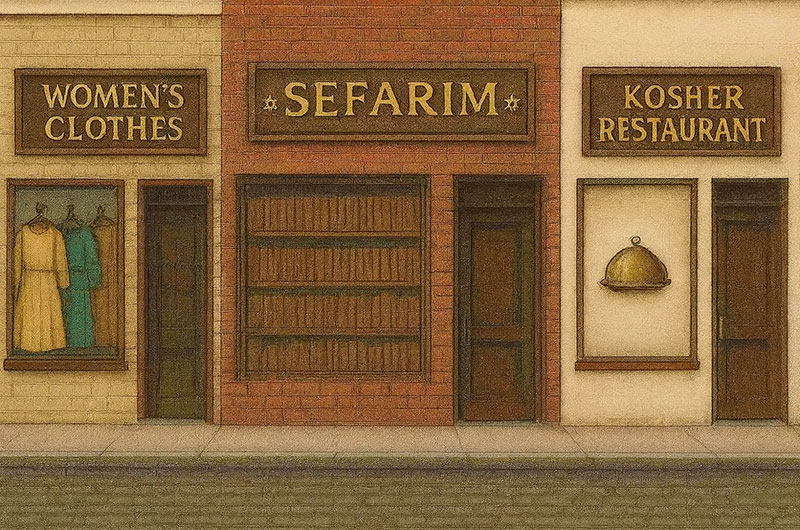


Yidville was a relatively small town, but it had all the needs for day-to-day Jewish life. It had several shuls, eateries, sefarim stores, a local sofer, Mr. Stam, and clothing stores with appropriate dress.
There was also an active communal life, with a Jewish Center that provided services for young and old alike. Each shul also served as a communal hub for its members.
Congregation Ahavas Yisrael was the most active shul. During Aseres Yemei Teshuvah, the Rabbi invited a sofer he knew from a nearby town to come for the day. The sofer would check tefillin and mezuzos in shul, which people would collect when they returned for Mincha/Maariv.
Meanwhile, before the chagim, the ladies’ committee invited outside vendors to sell jewelry, women’s clothing, and sheitels for Yom Tov.
Mr. Stam davened in a small shul on the other side of Yidville. His wife ran a women’s clothing store, which also contained a small jewelry and sheitel department.
“Just think,” Mr. Stam said to his wife. “I usually get about two tefillin to check each week. I heard that the sofer in Ahavas Yisrael checked 15 tefillin while he was here. That’s about two months’ worth!
“I also heard that many women bought dresses there for Yom Tov, not to mention jewelry,” his wife replied. “I can feel the difference in my store since Ahavas Yisrael started these pre-Yom Tov sales.”
“I need to talk to the Rabbi,” Mr. Stam said. “Perhaps we can stop them from bringing in outside vendors for these sales. They should turn to us, the local people, first.”
“I agree,” replied Mrs. Stam. “But maybe check before you approach the Rabbi.”
Mr. Stam called Rabbi Dayan. “I’m not asking for a ruling, but I would like to know your view on this issue:
“Can we prevent outside people from selling in our community when it affects our businesses adversely?”
“The Tannaim dispute (B.B. 21b) whether a tradesman may prevent someone from opening a competing business adjacent to his (commonly called hasagas gevul),” replied Rabbi Dayan. “Most Rishonim rule that the tradesman may not prevent him unless the potential competitor lives and pays taxes in another city (C.M. 156:5). Nowadays, due to circumstances of modern commerce, we often cannot prevent a competitor even from another city.”
“Moreover, the Gemara (B.B. 21a-22b) teaches that townspeople may not prevent a Torah teacher from another city, because such competition raises Torah standards (C.M. 156:6).
The townspeople also may not prevent a peddler (rochel), typically one who sells fragrances, since Ezra established that peddlers travel from city to city so that beautification items would be readily available to Jewish women. Rema (ibid.) infers that this applies only to peddlers of beautification items; regarding other wares, an occasional peddler is subject to no more leniency than one who opens a store.
Furthermore, Rema (C.M. 156:7) qualifies that local tradesmen may restrain outsiders only when there is no loss thereby to the local customers. However, if the outsiders provide better quality merchandise or a better price, local tradesmen may not prevent them at the expense of the local customers.
Similarly, if the outsider provides better service and does a better job, that is considered a different product (Kessef Kodashim 156:7). Convenience may also qualify as a benefit for the local people.
Sho’el u’Maishiv (I:1:20) qualifies the criterion of a better price, though. He writes that if the outside competitor sells for cheaper simply because he sells “off the books,” this does not constitute selling for a better price, because the local seller who pays his taxes properly cannot reasonably lower his price “on the books” to match; therefore, it is considered that the local vendor’s price is fair and reasonable (Pischei Choshen, Geneivah 9:8[18]).
Here, it is possible that the out-of-town sofer is similar to a Torah teacher. Furthermore, the convenience that he collects the tefillin in shul right after davening and returns them in the evening could be a factor in favor of leniency.
Similarly, someone who comes to sell jewelry, wigs, and likely also women’s clothing, is included in Ezra’s institution and permitted.
“Nonetheless,” concluded Rabbi Dayan, “it is certainly proper to turn first to local tradesmen, if they can provide comparable service and equivalent merchandise (Chavos Yair #42).”
Verdict: The ability to restrict outside competitors is limited. Outside competitors are certainly allowed in order to raise Torah standards, to provide women with beautification items, and when they provide better quality merchandise or better prices or service.rabbi meir or