 October 16, 2026
 Categories: Ask the Rabbi / Torah
Q & A: Learning Torah on Tisha B’Av (Conclusion)


Question: I was taught that due to our mourning on Tisha B’Av, we are not allowed to learn or discuss Torah. Since Torah causes us joy, we are forbidden to lessen our mourning with its study. While I understand why we read from Kinot and Eicha, how do we justify reading from the Torah at Shacharit and Mincha? A further question: Do these halachot apply to an individual during his or her seven days of mourning?
H. Ellis
Via E-mail
Synopsis: Last week, we cited the Mechaber’s ruling that although a mourner during the entire seven-day period of his mourning is forbidden to read from the Torah, the Prophets and Writings, the Mishna and the Gemara, and also halachot and aggadot, because they offer pleasure and enjoyment, he is allowed to read Job and Kinot, including Eicha, and the elegies in the Book of Jeremiah, as well as the laws pertaining to mourning.
* * * * *
Answer: The Jerusalem Talmud (Mo’ed Katan 3:5) cites yet another verse indicating the prohibition for a mourner to read from the Torah (Job 2:13), “Ve’ein dover eilav davar ki ra’u ki gadol ha’ka’ev me’od” – No one said a word to him for they saw that his pain was very great.
From this Gemara, we might infer that the prohibition applies to both the mourner and the consoler or other non-mourners who come into contact with the mourner. The reasoning would be that the greatest joy of Torah study is the discussion it generates. Otherwise, why cite this particular verse, whose main element is dibbur (speech)?
Indeed, there are those who prohibit any type of Torah study to the mourner, even the elegies in Jeremiah or Perek Hanizakin in Gittin, for example, for such study and conversation are contrary to the spirit of mourning since a mourner cannot be consoled. This is the view of Rabbeinu Yitzchak, citing Rabbeinu Yaakov (Tosafot, Mo’ed Katan 21a s.v. “ve’asur”), and of the Tur (Yoreh De’ah 384, citing “yesh omrim” – others say).
In the Babylonian Talmud, only the two verses we cited last week are found regarding this matter: “He’anek dom” – Sigh in silence (Ezekiel 24:17) and “Pikudei Hashem yesharim mesamchei lev” – The commands of Hashem are straight [i.e., righteous]; they gladden the heart (Psalms 19:9).
From the former, we infer total silence that precludes any type of Torah study, and we derive the halacha from Ezekiel’s personal mourning; the latter verse suggests that only study that gladdens the heart is precluded. Thus, the elegies and Kinot would appear permissible, for such activities surely do not gladden the heart; on the contrary, they add to one’s sorrow.
Tosafot (loc. cit.) note that the view of Rabbeinu Yaakov prohibiting all Torah study, even that which increases one’s sense of mourning, was later retracted by Rabbeinu Yaakov himself.
This, indeed, is the view of the Tur (Yoreh De’ah 384:4), citing his father, Rabbeinu Asher (the Rosh). He also related that studying by oneself, where there is no public display, is surely permitted. He goes further and allows public discussion if the community needs him, even all day long.
As regards the periodic reading of the Five Megillot and their related blessings, the halacha is found in Masechet Soferim (Chapter 14:3): “When reading Ruth [on Shavuot], Shir HaShirim [the Song of Songs, on Passover], Kohelet [Ecclesiastes, on Sukkot], Eicha [Lamentations, on the 9th day of Av] and Megillat Esther [on Purim], one recites beforehand [the blessing of] ‘…al mikra Megillah…’ (Blessed are You…who has commanded us to read the Megillah) even though it [that particular Megillah] is included among the Hagiographa.”
The Mishna adds this last statement due to the halacha cited in the Mishna that immediately follows (infra 14:4): “One who reads from the Hagiographa (Ketuvim) is required to recite ‘Blessed are You…who has commanded us in His command to read from the Holy Writings [Kitvei HaKodesh].’”
NachalatYaakov, the main commentary to Masechet Soferim, cites a dispute (ad loc.) on this matter among the halachic authorities, namely, whether one is to bless on the other four Megillot (there is no dispute regarding Megillat Esther, as all agree that we bless on that reading). He cites Rema (Orach Chayyim 490:9, quoting the Beit Yosef), who notes that it is our custom not to recite a blessing on these other four Megillot.
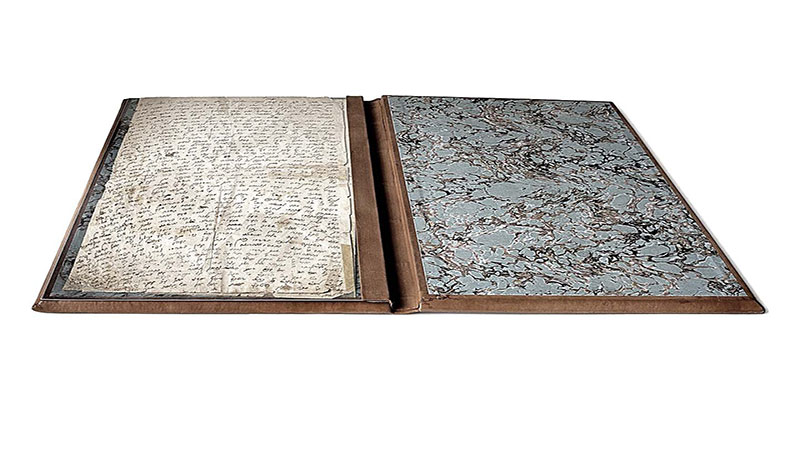
Nachalat Yaakov explains: “This ruling is probably due to the fact that these other Megillot are [generally] not written on [and read from] a scroll. Rather, they are read from a book that includes the other Scriptures.
“In earlier times, when Megillot were written on scrolls, we read the blessing beforehand, as Masechet Soferim suggests.”
Rabbi Yosef Grossman, zt”l, offers the following reason (Otzar Erchei HaYahadut p. 39) for not reciting a blessing on Megillat Eicha: “We read it from a book and not from a scroll as we would other Megillot, and [thus] we do not bless beforehand ‘al mikra Megillah’ because the scribes were not accustomed to write it [on a scroll] since we hope and look forward each day to the possibility that our Tisha B’Av mourning will be transformed into a day of joy and happiness, with no further need to read Eicha.”
Finally, Rabbi Grossman cites the Gaon of Vilna, who rules that one is to read from a scroll and bless accordingly. However, we who do not read from a scroll follow Rema’s ruling. Such is the nearly universal practice.
Yet the fact that we do not recite a blessing beforehand does not diminish the importance of this special reading of Eicha as well as the reading of the other Megillot.
May we merit the arrival of Mashiach, thus precluding the need for any further reading of Eicha, speedily in our days.