 October 16, 2026
 Categories: Features / Book Reviews
Rambam's Introduction to Mishne Torah
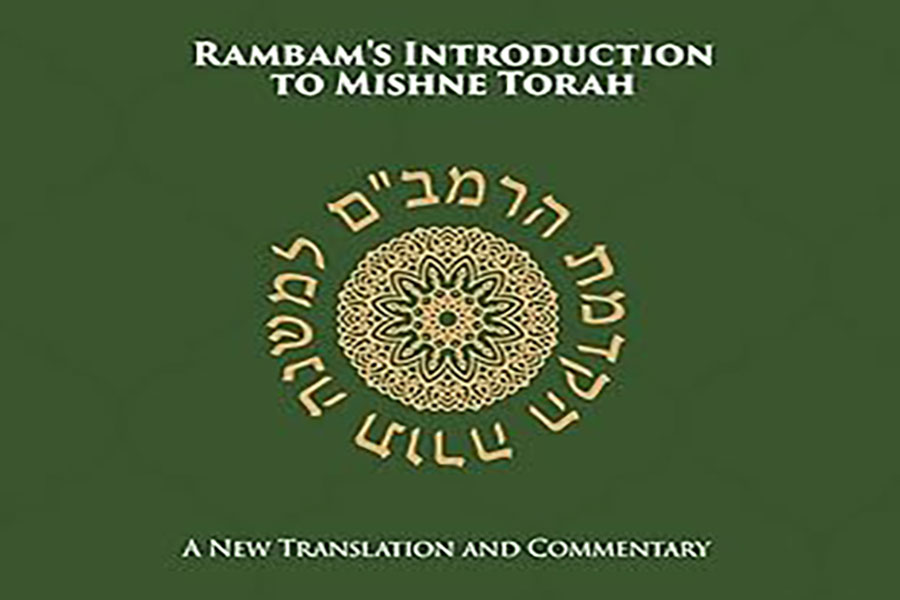


Title: Rambam's Introduction to Mishne Torah: A New Translation and Commentary
Translated by Ben Rothstein
Salama Edition
If you ask most people what Rambam’s Mishneh Torah starts with, they will tell you Sefer HaMada. But, in fact, it starts with an introduction. While it may seem inconsequential that there’s an introduction, it is, in fact, quite significant.
In Rambam's Introduction to Mishne Torah: A New Translation and Commentary (Da’at Press), author Ben Rothstein offers a new translation of the work, and it is clear to anyone who reads it why the introduction is not filler to be ignored.
While it is often skipped, a book’s introduction serves as a bridge between the reader and the content. In the introduction, the author will outline the book's purpose, provide context, and explain why the topic is worthy of the reader's time.
An introduction gives the reader a sense of the big picture of what they are getting into. Rabbi Joseph Dweck, who until last year was the senior rabbi of the Spanish and Portuguese Jewish community of the United Kingdom, and now resides in Israel and would make for an amazing future chief Sephardic rabbi of Israel, writes in the foreword that we don’t tend to teach principles as a core component of modern Jewish education.
Dweck notes that we immerse ourselves in the information, but neglect the frame. We know many laws, but don’t necessarily know how they were established, by whom, or in which context or category they belong.
Rambam’s Introduction to the Mishneh Torah is a grand tour through the earliest underpinnings of Jewish law to its manifestations of Jewish jurisprudence. It firmly situates the student within the eternal study hall of the Jewish people, and it is the gateway to the covenant of G-d with the Jewish people.
When one learns Mishnah, it is assumed that the reader already understands the essential background. For instance, the first Mishnah in tractate Sukkah presumes familiarity with what a sukkah is, while the first Mishna in tractate Berachot presumes the requirement of and knowledge of the recitation process for the Shema.
In his introduction to the Mishneh Torah, Rambam’s provides the reader with information on the origin of the Torah, its transmission, and the entire line of transmission from Sinai to his time. As the Mishnhe Torah is a law book, knowing this chain of transmission is critical.
Rothstein has written not just an excellent translation of the introduction, but also a commentary on it, with a focus on its Geonic–Andalusian context, which is the basis for everything the Rambam did.
One fascinating insight Rothstein explores is why Moshe did not write down the explanation of the Torah. He explains that by definition, the explanation of a text cannot be textual. Since a text is a semiotic system (a structured framework of signs, symbols, and rules used to create, convey, and interpret meaning within a culture or context), it can only be explained via another, different semiotic system. In the case of the written Torah, an oral explanation.
Rambam's Introduction to the Mishne Torah is a vital text for understanding his Mishneh Torah. And Rothstein’s translation and commentary are a valuable guide to that endeavor.