 September 25, 2026
 Categories: Features On The Jewish World
Rav Elchonon Wasserman in the 1930s


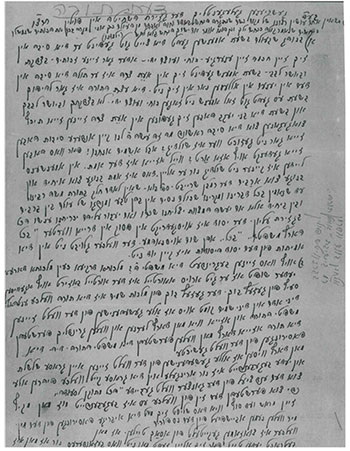
This week, I was granted the singular privilege of brokering the transfer of a manuscript that is not merely rare, but profoundly historic. The complete manuscript of Kuntres Da’as Torah, authored by the revered Rav Elchonon Wasserman, Hy”d, during his 1930s sojourn in the United States – shortly before his fateful return to Poland – is a document that resonates with undiminished urgency. Its voice, forged in crisis, speaks to our own unsettled age with striking immediacy.
Written contemporaneously with his more widely recognized Ikveta DeMeshicha, Da’as Torah has, inexplicably, remained eclipsed. Though it saw limited publication, it is frequently absent from enumerations of Rav Elchonon’s sefarim – an omission as perplexing as it is consequential given the work’s lucidity, breadth, and enduring relevance. Composed in Yiddish, the vernacular of the suffering yet steadfast European Jewry to which it was addressed, this kuntres does not lend itself to cursory perusal. It demands rigorous engagement from a discerning talmid chacham. In an era in which confusion parades as sophistication and moral relativism is canonized as progress, a meticulously restored and critically prepared edition would constitute an immeasurable gift to lomdei Torah and to the broader Torah world.
To understand Da’as Torah, one must first grasp the crucible from which it emerged. In response to the 1936 kashrut ban in Poland – a decree that struck at the very sinews of Jewish religious life, Rav Elchonon eschewed political grandstanding and sociological commentary. Instead, he undertook something at once radical and resolutely traditional: he applied Torah. In 1936, the Polish Parliament advanced legislation mandating the electrical stunning of animals prior to slaughter, thereby rendering shechitah effectively impossible. Framed under the auspices of animal welfare, the measure threatened not only religious liberty but the economic viability and spiritual stability of Polish Jewry. The community mounted vigorous protests, contending that the law constituted a grave infringement upon their religious rights. Ultimately, the legislation was shelved in 1938 following the dissolution of the Polish Parliament – but the theological and communal tremors it generated endured.
Within this sefer, Rav Elchonon articulates foundational axioms of emunah: Hashgacha Pratit, middah k’neged middah, and the uncompromising imperative of integrity in commerce and conduct. He brooks no notion of happenstance. No decree, no convulsion of history, no societal upheaval is severed from the animating Hand of Hashem. The authentic Jewish response to adversity, he contends, is not accusatory deflection toward regimes or ideologies, but disciplined introspection. When calamity descends, the essential question is not “Who has perpetrated this against us?” but rather, “What does the G-d demand of us at this hour?”
In late 1937, Rav Elchonon journeyed to America to solicit funds. Measured in material terms, the proceeds were modest – approximately $10,000, equivalent to roughly $182,000 in contemporary currency. Yet to quantify his success in pecuniary terms is to misconstrue the very essence of his mission. During those seventeen months, he accomplished something infinitely more enduring: he sowed the seeds of uncompromising Torah life upon American soil. When R. Aharon Kotler arrived in 1941, he did not encounter a spiritual wasteland. A nucleus of resolute Torah leadership had already taken shape – men whose vision had been clarified, emboldened, and fortified by Rav Elchonon’s indelible influence.
Among them were Shraga Feivel Mendlowitz, Mike Tress, Irving Bunim, R. Shimon Schwab, and Moshe Sherer – institution builders, communal architects, vigilant stewards of mesorah. Their resolve was neither accidental nor born of ease; it was forged in moral clarity and tempered by Rav Elchonon’s unwavering insistence that Torah remain inviolate, untouched by dilution or compromise.
Two years after his return to Europe, Rav Elchonon would sanctify the Divine Name al Kiddush Hashem. Yet he did not depart these shores empty-handed. He left behind not merely funds raised, but foundations laid – an enduring spiritual infrastructure whose reverberations continue to shape the Torah landscape to this day.