 October 9, 2026
 Remembering the Beit Hamikdash and Unlocking the Mystery of Tefillin


Seventy-five years ago, I celebrated my bar mitzvah in Kansas City, Missouri. It was a festive and memorable occasion but the memory of one peripheral feature of the event has troubled me to this very day. My father, zt”l, approached me a day or two after the celebration was over and held in his hands a pair of tefillin. They were antique, twisted and gnarled, their color resembled tarnished bronze, and the surface of the leather straps was discolored and mostly peeled away. All in all, these tefillin had a strange patina, a complexion that was markedly different from the sleek and gleaming new black tefillin that I had only begun to put on a few days earlier
“I thought maybe you would want to have these?” he queried tentatively as he extended them to me. “What are they?” I quizzically asked in return. “These are very old tefillin,” he answered. “They have been in the family for ages. I got them when we lived in Uman, in the Ukraine, from a great uncle who gave them to me even though he had sons of his own. They are a family heirloom said to have been passed down for three to four generations, at least.” My father continued, “I can trace their owners back for the last 100 years. They were reputed to have belonged to one of our ancestors who was himself a talmid of the Ba’al Shem Tov.” It was clear that my father treasured the tefillin; equally clear, however, was the fact that no one had actually put them on for a very long time.
Having turned thirteen, and now an adult, I was very practical. I knew nothing of antiques and even less about “talmidei HaBesht.” Life in Kansas City at that time was not conducive to appreciation for vintage items on the fringes of Jewish tradition. Keeping Shabbat and observing kashrut were paramount in my parents’ home, but I attended a public school. There was no alternative at the time. I shrugged and asked my father somewhat dismissively: “Why would I want to have them?” That ended the matter.
Yet over the years, I have felt guilty for not having accepted the gift. Maybe not so much guilty as haunted: why did I refuse? On the other hand, what would I have done with them? And what in fact happened to them? And what of the parshiot – were they kosher? In pristine condition? The lack of closure has gnawed at me. Especially the somewhat belated curiosity about my father’s feelings! Was he hurt?
This memory has added to the great mystery of tefillin that has perplexed me ever since. Tefillin are unique; they are unlike any other observance in our repertoire of mitzvot. I have often wondered: why in the world would anyone want to place small black boxes on their forehead and forearm? With straps encircling their head, their arms, and descending to beneath their waistline? The fact that the boxes contain parchment scrolls with sacred texts from the holy Torah folded up and inserted inside only makes the entire ritual seem even more bizarre. What is this mitzvah all about?
In seeking an explanation, one discovers that the enigma deepens. It seems that most of the physical properties of tefillin – their shape, color, and construction – originate in Halacha l’Moshe miSinai. Meaning, these laws are not even derived from verses in the Torah. They are simply attributed directly to the Almighty’s verbal command to Moshe Rabbeinu, inexplicably, by fiat, immune to challenge!
But despite the bewilderment, or perhaps adding to it, we learn that Hashem Himself dons tefillin (Berachot 6a)! To my knowledge, Hashem is not said to own or to use a Kiddush cup, for example, or to wave a lulav, or to light the menorah. Apart from tefillin, all our ritual mitzvot are performed for Hashem, not by Him! Why does Hashem choose to perform this mitzvah in particular?
Another striking piece in the puzzle: Tefillin are called “oht” – a sign – a distinctive symbol of the unbreakable covenant between Hashem and Israel, an official seal of authenticity testifying to our exclusive relationship with Him. Only two other commandments in the Torah share that formal designation as oht. One is brit milah; the other is shmirat Shabbat. Like tefillin, these are foundational mitzvot. We know intuitively that these three ohtot have guarded and preserved the eternity of Klal Yisrael.
And yet, even within this august grouping, tefillin are unique. Other cultures have imitated and adopted versions of circumcision and Sabbath observance. But tefillin have remained exclusive to us, uncopied by any other religion. Indeed, a non-Jew who is even familiar with tefillin (or “phylacteries” for that matter) would be a very rare creature.
Which might explain yet another piece in the puzzle: the Torah teaches that if a gentile were to encounter a Jew wearing tefillin, he would be taken aback and overcome with fear. As it is written, “V’rau kul amei ha’aretz ki sheim Hashem nikra alav v’yaru mimekah – And all the peoples of the earth shall see that G-d’s name is proclaimed upon you, and they shall stand in fear of you (Devarim 28:10).” Chazal explain that this pasuk is referring to the head tefillin (the location of the “name of Hashem”) based on the words “proclaimed upon you.” This is the oht par excellence. No other mitzvah is so visible and salient that an adversary will turn tail and flee from before you. And Jewish lore is filled with anecdotes contending that such events actually occurred.
All of which brings us to one more spectacular piece of the mystery: why is it that so many secular Israeli soldiers requested a pair of tefillin during their combat in Gaza? Thousands of pairs were distributed in the recent war. Was it fear of the enemy? Was it the contagious faith of the observant soldiers with whom they fought? Or was it the compelling sense that Hashem was watching over them through the many "miracles" they witnessed? Or perhaps all of the above? In any case, the inspirational mystique of tefillin is undeniable. They speak to the heart in a silent but eloquent language that transcends their modest appearance.
The foregoing discussion attests to the status of tefillin as an extremely challenging conundrum in Torah life. The insistent question therefore is “why?” How do we explain the allure of the mysterious mitzvah of tefillin?
Classical mefarshim help us comprehend bits and pieces. The shel yad is said to symbolize our physical prowess; the shel rosh represents our thoughts and mental prowess; according to this popular interpretation, both must be totally committed to the service of Hashem.
Another theory is the compelling power of the Torah discipline which requires that we bind ourselves to Hashem daily. That is why we are bidden to handle the tefillin with absolute purity and cleanliness. The problem is that none of these approaches actually clarifies why tefillin are as they are – small portable cube-shaped leather boxes containing sacred scrolls placed upon our bodies every day.
Two such rationales – that tefillin provide protection and that they endow us with prominence – are mentioned by Tosfot (Shabbos 57). Both arguments imply that tefillin are meant to be highly visible. That seems to be why the Sages also explain that the “yikar” mentioned in “La’Yehudim hayta orah v’simcha v’sasson v’yikar” (Esther 8:16) is a reference to tefillin, because they convey the public pride we exhibit at being servants of Hashem (according to the K’tav V’kaballah).
One day, as I put on my tefillin, I examined them in a small mirror that I keep in my tefillin bag for that purpose. I wanted to make sure they were in exactly the right position above my forehead. For some reason, the shel rosh struck me as being strangely reminiscent of something else: its shape, its proportions, its simple linear elegance, were all familiar. But from where?
And then it hit me! Like a sledgehammer! All these years, I’ve put on this special adornment every morning with pride. Gleaming with a perfect six-sided cube shape, projecting up from its base atop my head like a small crown while presiding over my entire body. The tefillin shel rosh had to be precisely positioned above my forehead (where the fontanelle was) aligned with an imaginary vertical line running down my face and intersecting with a point exactly between my eyes.
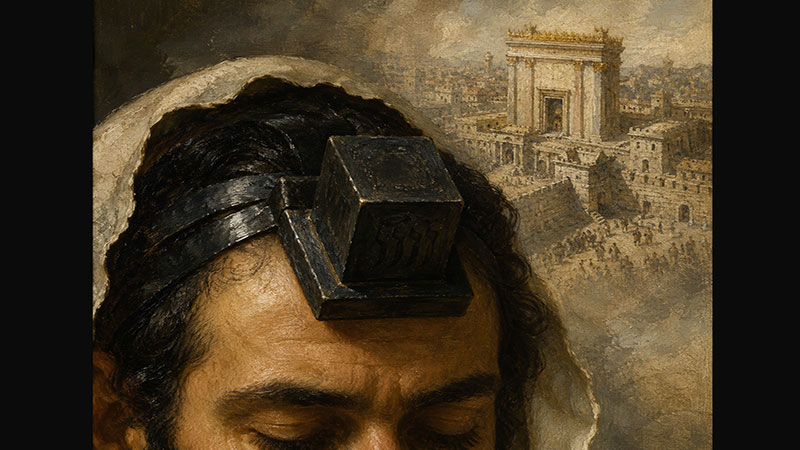
It was a copy of the Beit HaMikdash! My tefillin shel rosh duplicated both the Temple’s perfect rectangular shape, and its location, above my head, like the Beit HaMikdash elevated majestically, overlooking all else below. Like a great rocket indeed ready to launch toward Heaven carrying a payload of prayers, a consignment of petitions and entreaties for healing and forgiveness and blessings to deliver to the Heavenly throne. Just like the holy Temple – the Beit HaMikdash – as it once stood in Jerusalem.
Fascinating! Are they not identical in so many other ways? The individual tefillin box and the Mikdash (the communal Beit Tefillah) are both called bayit – literally a house or “home” – to serve as a residence for Hashem. As we frequently read in Tanach, the Mikdash is the home of Hashem. “Lech v’amarta el avdi, el Dovid, ko amar Hashem h’atah tivneh li bayit l’shmi – Go and say to My servant David: Thus said G-d: Are you the one to build a house for Me to dwell in?” (Shmuel II 7:5). And “Ki beiti beit tefillah yikarei l’chol Huamim – For My House shall be called A house of prayer for all peoples” (Yeshaya 57:7).
Additionally, the resplendent beauty of both the Mikdash and the tefillin is described uniquely as “pe’er” and “tiferet” – a root which means to glorify something as beautiful because of its inner dignity and harmony. The Malbim defines it as “inner grandeur.” Yechezkel the prophet (47:18, 47:23) often uses variants of this root to allude to the Beit HaMikdash, as well as to describe the headdress of the High Priest, as in “Pe’erei fishtim ye’heyu al rosham… – They shall have linen turbans on their heads…” (Yechezkel 44:18).
Better known is the verse: “…pe’ercha chavosh alecha… – …bind your turban upon yourself…” (24:17). Here, the reference is famously and clearly interpreted by Chazal as an adornment worn on the head. In context, Yechezkel is using the adornment as a symbol of the destroyed temple! This is precisely the point which this essay attempts to demonstrate.
We find another parallel between tefillin and the Beit HaMikdash. Biblical texts connected to both frequently use the Hebrew roots “re’eh,” to see, and “zachor,” to remember. From the earliest appearance of the Temple Mount in history, Avraham Avinu refers to it as “the special place”: “Vayikra Avraham sheim ha’makom hahu ‘Hashem yir’eh,’ asher ye’amer hayom, b’har Hashem ye’raeh – And Avraham named that site ‘Hashem-yireh,’ from which comes the saying, on G-d’s mount there is vision” (Bereishit 22:14). Like the Temple, later built on that very spot, it is the place where Hashem sees and is seen. It is a place of divine reciprocity. tefillin are described in a similar manner – meant to be visible to others, “between your eyes,” and visible to the wearer as well.
Consequently, the Torah commands us, “u’le’zikaron bein einecha” (Shemos 13:9) – that we must see them and be reminded. Our tefillin evoke remembrance as we saw in the case of the Beit HaMikdash. On the three pilgrim festivals, our ancestors “went up” to visit the Beit HaMikdash. In that commandment, we also find seeing and remembering explicitly in tandem; “Sholosh pe’amim bashana ye’raeh kol zichorcha – Three times a year your males (zichorcha, bearers of memory) should see and be seen” (Shemos 23:17).
Parenthetically, note that tzitzit, and the “Keshet,” the rainbow in Noach’s time, also convey the same message that seeing leads to remembering, that vision facilitates memory: “Ve’hayta hakeshet b’anan, u’r’itiha l’zicharon brit olam… – When the bow is in the clouds, I will see it and remember…” (Bereishit 9:16).
What we are being taught, implicitly, seems to be that noticing the tefillin and gazing upon them should remind us of, and elicit, the same awe-inspiring effect, emotionally, as did the Beit HaMikdash, seen from afar, for the pilgrim ascending to the Temple Mount. One sees and the heart resonates and interprets. Both the tefillin and the Mikdash are a constant reminder of the one who gave us all the other commandments.
That a small miniature representation of a large sanctuary has been found to exist in other cultures is confirmed by a recent archeological discovery in Alexandria, Egypt. Lehavdil, a temple was found and excavated under water in the ancient port of Alexandria. The overall structure could not be reconstructed. It was a temple to the Egyptian goddess Isis, apparently dedicated by Cleopatra as a cult sanctuary in her honor. The archeologists could not recreate the original building until they discovered an amulet among the ruins which was decorated with the outline and proportions of the building, showing the location of the pillars of famous statue, and other details. The amulet was two to three centimeters in size (!); It is not clear whether it was worn or carried. (Based on Monograph, 2024 Oxford Centre for Maritime Archaeology). Illuminating!
Finally, to comprehend fully the symbolism of tefillin, one must understand the retzuot, the straps which both encircle the head and descend over the body and are wound around the arm and the hand. These are, as we saw, more than oblique suggestions that we must “wrap together” and dedicate all our physical and mental powers to the service of Hashem.
Far beyond that: the Temple had two streams, two “filaments” as it were, which emanated from within it and reached out to every corner of the planet. One was the Aish D’umach, the “fire of the Ancient One,” according to the Zohar, and the second was the N’har Dinor, a “stream of light.”
The first conveyed the blessings of Hashem from the sanctuary outward to all of Creation and nurtured it. The second flowed inward, bringing all the prayers and supplications from the inhabitants of the world into the presence of the Holy One. These two streams of connection – channels of divine sway and influence – essentially define the reciprocal relationship between G-d and Man, between heaven and earth, between the source of divine beneficence and the beneficiaries. Visually, the two straps descending from the shel rosh represent the bi-directional flow of divine energy to and from the entire body. Additionally, the strap wound around the arm represents submission to His will, and the strap wound around the fingers symbolizes our covenantal “marriage” with Him.
Needless to say, the parshiot – the writ – within the tefillin and the batim (the houses) are analogous entirely to the holy scrolls and tablets contained within the Ark of the Covenant housed in the Holy of Holies. In both cases, as in the case of the mezuzah, the main function of the structure is to house the word of the L-rd – to preserve it, to provide a home for it, and to remind us of its ever-present accessibility.
This sublime symbolic equivalence of the people’s Mikdash sanctuary and the individual person’s tefillin adornment is so self-evident that its corollaries begin to pop up in other settings. The synagogue, also called a Mikdash M’eat, is designed in many ways to resemble the Beit HaMikdash and is, obviously, a conceptual variation on the theme. In fact, almost all the major accessories of the Temple, the kelei HaMikdash, such as the shulchan and the mizbe'ach, possessed the same rectangular form. So too, does the typical Aron Hakodesh in shuls all over the world today.
Like the tefillin, these sacred objects serve as visual reminders of the Shechina, the divine spirit.As enjoined by Yirmiyahu “Hatzivi lach tziyunim,” set up for yourself signposts and milestones, to see and be reminded of the Shechina which accompanies you wherever you turn (Yirmiyahu 31:21). The kelei HaMikdash also should be “between your eyes” and “before the face of Hashem.”
The impact, therefore, of feeling that one actually wears a “little Temple,” a miniature Beit HaMikdash, that is portable and accompanies him wherever he goes, that is stable and enduring, and which contains the words of the Shechina,is a concrete and daily reminder of the spiritual meaning of the commandment “Ve’asu li Mikdash v’shachanti b’tocham” (Shemos 25:8) – that we must construct a personal sanctuary for Hashem and invite Him to dwell within us. Tefillin accomplishes exactly that. They may be an external adornment, but they are emblematic of the deeper, divine truth: that the Shechina dwells within each one of us.
The thesis presented above rests on the premise that our tefillin bear a strong resemblance to the Temple in Jerusalem – functionally, symbolically, and in physical appearance. Many, though by all means not all, of the comparable features of this idea have been presented. Ultimately, the validity of a symbol is a matter of individual interpretation: Do you see the strong resemblance? Do you find the suggested parallel reasonable? Does it evoke meaning for you?
Knowing that for millennia, the Jewish people would have no Beit Hamikdash, Hashem in His divine wisdom, gave us a miniature sanctuary, a portable signet residence, worn daily upon our bodies, for Him to occupy. In this way, we fulfill the injunction of Yirmiyahu HaNavi by establishing “signposts and milestones” along the roads we travel, reminding us during our long journey through exile that we are the people of Hashem, and that one day we will return along these very roads to rebuild the holy Temple itself.
How important that message would be in the future centuries of Galut is signified by the fact that Hashem himself dons tefillin. This is a precious and impactful reminder that the Beit HaMikdash was a shared treasure where the encounter between man and his Creator reached its most intimate expression.
My father’s old tefillin, finally, have indeed served me as a personal memory of the Churban Beit HaMikdash. I know now that I should have kept them even without using them. But the offer of the gift and its memory remain with me as a constant reminder of what we have lost and a prayer for its reformation, speedily in our days.