 September 25, 2026
 Categories: Headline / Halacha & Hashkafa / Torah
Repentance and Quack Cures


Chulin – Daf 121
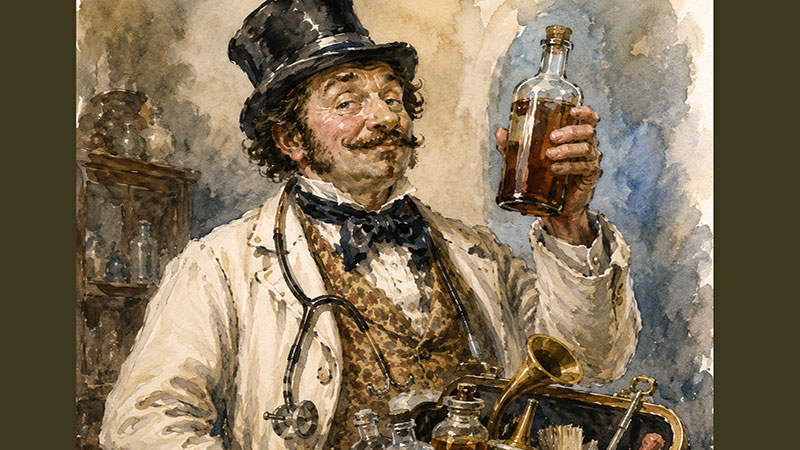
Our Gemara on amud aleph quotes a verse in Iyov in which Iyov accuses his friends of poor advice, comparing them to doctors who peddle quack cures: “But you plaster up your lies; you are quack doctors” (13:4).
Reading about the Fauci diaries and congressional hearings certainly corresponds well with both parts of the verse – plastering up lies and selling quack cures. But enough said on that.
The Hebrew term for these quack doctors is “rof’ei elil,” which literally means useless or false healers. Shem MiShmuel (Re’eh 7) relates this Hebrew word to the month of Elul, since Elul and elil are phonetically similar, and there is some association between emptiness and the month of Elul, which we shall explain.
By way of introduction, he makes a spiritual distinction between Shabbos, on the one hand, and Rosh Chodesh and Rosh Hashanah, on the other. Shabbos is a terminal point. It is the end of Creation and embodies a sense of completion. There is a rabbinic requirement that one must go into Shabbos with the attitude that all his business matters are complete and taken care of (Rashi on Shemos 20:9, quoting Mechilta). The Baal Shem Tov says that even your spiritual work should be seen as complete and fully taken care of on Shabbos. This contrasts with Rosh Chodesh on a small scale and Rosh Hashanah on a large scale. Each new month represents the beginning of a cycle, unlike Shabbos, which is the end of a cycle. In the beginning of a cycle, a person must start fresh and create new goals and achieve new levels. This is why Elul has the same root as emptiness and uselessness. Unlike Shabbos – when a person reflects on their physical and even their spiritual accomplishments and has a sense of satisfaction – as Elul approaches there should be a sense of void and the need to start creating and doing.
Rav Zeira’s Burnout
Daf 122
Rashi on amud aleph explains why Rav Zeira was considered to be among the pious of Bavel, based on two stories about his life.
Bava Metzia (85a) tells us about Rabbi Zeira that when he ascended from Babylonia to Eretz Yisrael, he fasted one hundred fasts so that he would forget the Babylonian method of studying Gemara and it would not hinder him from adapting to the unique style of study prevalent in Eretz Yisrael. He fasted an additional one hundred fasts so that Rabbi Elazar ben Pedat would not die during his lifetime, which would have caused the burden of communal matters to fall upon him. As dean of the Torah academy, Rabbi Elazar ben Pedat was in charge of all public affairs, leaving Rabbi Zeira unencumbered to study Torah. Rabbi Zeira fasted an additional one hundred fasts so that the fire of Gehenna should not affect him.
The Gemara continues: “Every thirty days, he would examine himself to ascertain if he remained on his exalted level. He would ignite an oven, climb in, and sit inside it, and the fire would not affect him. One day, the Sages gave him the evil eye, i.e., they were envious of him, and his legs became singed in the fire. And from then on, they referred to him as “the short one with singed legs.”
According to Rashi, these two stories are the reason why Rav Zeira was considered to be one of the pious of Bavel.
There is another story of Rav Zeira from Eruvin (28b) that I think may be related: “Rabbi Zeira was exhausted from his studies. He would go and sit at the entrance to the academy of Rav Yehuda bar Ami, and say: ‘When the Sages go in and out, I shall stand up before them and receive reward for honoring them, as it is a mitzvah to honor Torah scholars.’ Too tired to engage in actual Torah study, he sought a way to rest while fulfilling a different mitzvah at the same time.”
I wonder what was causing Rav Zeira to be exhausted. I have two possible answers that relate to the two prior stories. Perhaps, after his legs were singed, he suffered some weakness, whether emotional or physical. If that is the reason, it is even more significant that he set out to honor Torah scholars during this weakness. After all, it was their evil eye that caused the mishap in the first place. It was therefore extraordinary that he showed them, so to speak, no hard feelings.
The other possible cause for his weakness could have been his excessive fasting. If so, he might have been blaming himself, holding himself somewhat responsible for being careless with his health, which had led to his inability to study. Thus, he specifically sought out the opportunity to honor Torah scholars as an act of penance. Alternatively, the whole reason he had fasted in the first place was to be able to shed the preconceived notions and biases from his prior studies in Bavel. He may have thought that while it was a noble and worthy goal, there was a degree of irreverence and disrespect in disregarding what he had studied earlier, and his punishment was that he became weak. In that case, perhaps he sought to honor the Torah scholars as a penance for that disrespect.
Clothes Make the Emperor
Daf 123
Our Gemara on amud aleph refers to a bizarre trophy that the Romans kept – the scalp of Rabbi Yishmael Kohen Godol, who was executed by the Romans. Because his face was so unusually beautiful, the daughter of the Caesar had asked that the skin be preserved.
The Gemara (Avodah Zara 11b) relates that the Romans had a ritual performed every seventy years which involved the scalp of Rabbi Yishmael: “Once every seventy years, they bring a man who is whole and free from any defect and have him ride upon a lame man, to symbolize the healthy Esau ruling over Jacob, who walked with a limp after his fight with the angel. And they dress him in the garments of Adam the first man and place on his head the scalp [karkifelo] of Rabbi Yishmael, which the Romans flayed when they executed him. And they hang gold on his neck weighing two hundred dinars, and cover the markets with onyx, and announce before him: ‘The calculation [sach] of the master [kiri] Jacob with regard to the time of the redemption is fraudulent [plaster]; the brother of our master [i.e., Esau], a forger.’ They further announce: ‘One who witnesses this festival witnesses it, and whoever does not witness it will not witness it ever, as it was celebrated only once every seventy years. What purpose does deceit serve for the deceiver, and forgery for the forger?’ And they conclude in this fashion: ‘Woe unto this one, Esau, when that one, Jacob, will arise, as this will cause Esau’s downfall.’”
The Maharal (Netzach Yisrael 16) explains the meaning of this aggadah. Yaakov’s limp came from the angel who wrestled with him. The limp in the thigh is representative of Yaakov’s weak spot: His descendants, offspring from that area of the body, will be susceptible to physical temptations, also represented by that area of the body. The clothes of Adam represent the physical world. Esav was laying claim to the physical world, his birthright, and he has this power. The man on top represented Esav, riding upon Yaakov.
Clothes are externalities that indeed bring honor and status, but they are still externalities. Likewise physical beauty as represented by Rabbi Yishmael’s scalp. Symbolically speaking, treating the material realities of this world as the ultimate truth and beauty is the same as taking the skin off a dead person because you find him attractive. By appropriating it and trying to possess it, as Esav did, one effectively murders it. The nations of the world saw our depth and our beauty and wanted it for themselves. They thought that by killing us and scalping us, they would possess it – but they won’t. Instead, they are left with a grotesque and macabre expression of their desire to have our spiritual beauty, while making a mockery of it by only recognizing its external dimension.
Furthermore, even though the rider is on top of the other person and clearly dominating, this is inherently an unstable situation. At some point, the one who is being ridden upon will throw the rider off. The seventy years in this aggadah represent a generation. It is also notable that King David lived for seventy years. There is an aspect of seventy that represents mastery and ownership of a generation. This dominance has messianic roots, but ultimately is temporary. It is messianic in the sense that for a period of time, Esav possesses a completeness of purpose. But the cycle ends, and the superficial truths and status are overshadowed by the ultimate spiritual truths and depths that are our birthright.