September 11, 2026
 Categories: Headline / Business/Finance / Money Matters
Rice, Wheat, and the Tribes Who Stayed Behind
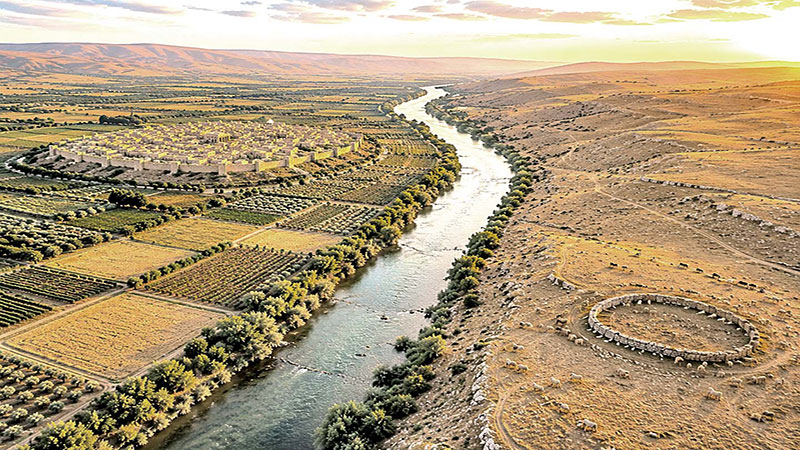


In 2014, psychologist Thomas Talhelm published a study in the journal Science that offered a startling insight into how a society’s economy shapes its values. He studied over a thousand people across China and found a sharp psychological divide. People from rice-growing regions think collectively. People from wheat-growing regions think individually. Same country, same language, same government. Different crops.
The reason is the work itself. Rice demands societal cooperation. Paddies need shared irrigation, coordinated planting, and neighbors who show up for each other, because no family can flood and drain a field alone. Wheat demands almost none of this. A farmer plows, plants, waits for rain, and harvests independently or with a small crew. Over generations, the demands of the type of crop became the character of the people. Talhelm calls it the rice theory of culture: what people do for a living quietly shapes what a society values. And it persists. Descendants of rice farmers who have never touched a paddy still test as more interdependent, and descendants of wheat farmers still test as more individualistic.
Thousands of years earlier, the Torah recorded the same phenomenon in one of the most consequential real estate decisions in Jewish history.
The Request
In last week’s Torah portion, Matot, the tribes of Reuven and Gad approach Moshe with a request. They own vast herds. The land east of the Jordan River is prime grazing country. May they settle there instead of crossing into the Land of Israel?
Listen to how they phrase it: “We will build sheepfolds here for our livestock, and cities for our children” (Numbers 32:16). Livestock first. Children second. Moshe catches it immediately and reverses the order in his reply: “Build cities for your children, and folds for your sheep” (Numbers 32:24). The rebuke is quiet but unmistakable. You have your priorities backwards. You are letting your business interests dictate where your family lives.
We tend to read this episode as a question of geography. It was also a question of profession, and therefore of values, and therefore of destiny.
Two Professions, Two Societies
G-d’s design for the Jewish people in the Land of Israel presumed a nation of farmers. The land was allocated so that every family received its own plot, anticipating America’s Homestead Act of 1862 by roughly three thousand years. The mission was explicit: “Come and take possession of the land that G-d swore to your forefathers” (Devarim 1:8).
An enormous share of the Torah’s commandments only function on cultivated land: Shemittah (the sabbatical year), terumah and maaser (priestly and Levitical tithes), leket, shichecha, and peah (the corners and gleanings left for the poor). Every one of these mitzvot assumes a field, a fixed address, and a poor neighbor close enough to walk into that field. Farming roots you. It forces you to build storage, markets, courts, and community, because a person who cannot move his livelihood must invest in the place where it sits.
Shepherding is the opposite. The shepherd follows the grass. He is away from home for weeks, answerable to no neighbor, building nothing he cannot pack up. Our forefathers were shepherds, and the profession has real virtues: solitude, contemplation, self-reliance. But it does not build society. A nation of shepherds is a collection of tribal families. A nation of farmers is a civilization.
Farming also has a rhythm, and the rhythm has pauses. The harvest ends. The grain is in. Three times a year the farmer could lock his barn, take his family up to Jerusalem for the regel, and stand before G-d with the fruits of his labor. The Torah’s calendar is built around those pauses.
Shepherding never pauses. The flock eats every day, wanders every day, needs you every day. There is no season when the sheep are “done.” A shepherd who wanted to be oleh regel must leave living assets in someone else’s hands. The profession with the greater financial upside came with a spiritual cost baked in: a life with no natural moment to stop, look up, and reconnect.
The Economics Drove the Choice
Why did shepherding appeal to Reuven and Gad? The economics are seductive. A herd grows geometrically; every ewe compounds. Costs are largely fixed, so the upside scales while the workload does not. The shepherd is, in modern terms, an entrepreneur with equity.
The farmer holds the opposite position. His yield is capped by his acreage. To grow it, he must farm more land, and his labor grows with it. Every year he invests months of work before he sees a single stalk, and his downside is hostage to every drought and locust. He works harder for a bounded return: much of the risk of ownership, little of the upside. The farmer is, in modern terms, a bondholder in risky credit.
So Reuven and Gad made a rational financial decision. Better land for herds, better returns on the herds they already owned. What they did not price in was what the profession would do to their children. The entrepreneur’s upside came with the entrepreneur’s cost: fathers who were never home, communities that never thickened, a society held together loosely because nothing in the daily work required it to be held together tightly.
The Bill Comes Due
Software engineers have a term for this: technical debt. Build quickly and messily today and you gain speed now, but you pay interest later in the form of slower, harder work. Short-term gain, deferred price.
The Torah shows us the price Reuven, Gad, and half the tribe of Manasseh paid just one Torah portion later. In Masei, G-d commands six cities of refuge, safe havens for accidental killers. Three are placed west of the Jordan, serving nine and a half tribes. Three are placed east of the Jordan, serving just two and a half tribes.
The Talmud (Makkot 10a) asks the obvious question and gives a chilling answer: killing was common in Gilead. The prophet Hosea describes Gilead as a city of evildoers, tracked with blood (Hosea 6:8). The society that chose grazing land over the ancestral land, herds over neighbors, mobility over roots, produced measurably more violence per capita. Talhelm would recognize the pattern instantly. The profession shaped the culture, and the culture shaped the crime statistics.
And when Assyria invaded, Reuven and Gad were among the first tribes driven into exile (I Chronicles 5:26). Loose societies break first.
Build Cities for Your Children First
We choose jobs, cities, and industries, and the values follow. The consultant who lives on planes, the trader who answers to a screen, the founder who tells himself the family will understand until the exit, the committed Zionist who stays abroad for the income: each is making Reuven and Gad's choice, pricing the herd and ignoring the children.
The question the Torah portion puts to every professional is not “what does this career pay?” It is “what kind of person does this career forge, and what kind of community does it leave behind?” Reuven and Gad got Gilead. Their descendants got galut.
Build cities for your children first. Then worry about the sheep.