 October 9, 2026
 Categories: Torah
Salted Sacrifices & Flowering Fruits From the Tabernacle to our Own Tables


Vayikra – the Book and the Sedra
After Sh’kalim and a hafsaka and Zachor and Para and HaChodesh, from Mishpatim’s 53 mitzvot through the 550 p’sukim and five sedras dealing with Mishkan and everything involved with it, and the tragic episode of the Golden Calf right between the two halves of the Mishkan project, we now begin the Book of Vayikra with Parshat Vayikra. It will be relatively calm the coming Shabbat, before we begin the next busy period with Shabbat HaGadol, Pesach, the Omer, and much more coming up sooner than we realize.
Okay, let’s get down to Vayikra – the sedra and the Book.
Vayikra has two personalities: one for a 12-month, one-Adar year (like this year) and one for a 13-month, two-Adar year (like next year). In a shana p’shuta, Vayikra is usually the Shabbat after all Four Special Parshiyot are done and the Shabbat right before Shabbat HaGadol. That is so for six of the seven year-types of shana p’shuta. The exception happens to be the most common year (18% of all years) when Rosh Chodesh Nissan is on Shabbat and Vayikra is then teamed up with the Rosh Chodesh reading in a second Torah and HaChodesh maftir in a third Torah. In all 12-month years, Vayikra is always read before Shabbat HaGadol because Tzav is always read on Shabbat HaGadol.
In 13-month years, Vayikra is most often partnered with Zachor, and in one of the seven year-types of shana m’uberet, it is a hafsaka between Sh’kalim and Zachor.
Bottom line: Vayikra is read by itself (as it is this year) 47.78% of the time.
Vayikra – the Book and the sedra – begins with Moshe being called forth by Hashem after the period of time when Moshe could not enter the Mishkan because of the Cloud and G-d’s presence. Having just gone through five sedras that deal with the mitzvah of making a Mikdash and everything in and about it, we turn to Vayikra, with the main topic for the coming two-and-a-half sedras being Korbanot, the various offerings in the Mishkan.
* * * * *
Parshat Vayikra is the 24th sedra of the Torah’s 54 and the first of the 10 sedras in Sefer Vayikra. The sedra is written on 215 lines, ranking 19th in the Torah. It has 21 parshiyot – 13 open (p’tuchot) and 8 closed (s’tumot). Only six sedras have more (B’reishit, Mishpatim, Bamidbar, Naso, Pinchas, and Ki Teitzei). This indicates a considerable number of topics. In Vayikra’s case, they all focus on Korbanot. Va’etchanan and Ki Tavo are tied with Vayikra, with 21 parshiyot each. Vayikra has 111 p’sukim, the same number of p’sukim as Eikev, which is slightly above average, as indicated by its rank – 26th. Its rank rises to 20th for words and letters, telling us that it has longer p’sukim than average. Vayikra the sedra has 16 mitzvot – 11 positive (asei) and 5 prohibitions (lo taaseh). Vayikra the Book has the most mitzvot of the five Chumashim – 247, which is 40% of the Torah’s 613 mitzvot. On the other hand, Vayikra is the shortest Book of the Torah, by far – in columns, lines, p’sukim, words, and letters, making its mitzvah-stats all the more impressive. Furthermore, it is the only Book of the Chumash with mitzvot in every one of its sedras. Its ten sedras range from a low of seven to a high of 63 mitzvot. For comparison: B’reishit has 1,533 p’sukim and only three mitzvot. Using a statistic that I created – Mitzvah Density (MD), which is mitzvot per 1,000 p’sukim – B’reishit’s MD is just under 2. Sh’mot has 1,210 p’sukim and 111 mitzvot for a MD of 134. Vayikra’s MD is 288. Bamidbar has 1,288 p’sukim and 52 mitzvot; MD = 40. D’varim has 956 p’sukim and 200 mitzvot for a MD of 209. The MD of the whole Torah is 105.* * * * *
Notice that one of the numbers in the previous paragraph is 111. That’s the number of p’sukim in Parshat Vayikra, as mentioned above. But there is another 111 that I’d like to introduce you to. The regular gematria (numeric value) of the letter Alef is 1. One of the many different gematria systems is called Milui (meaning “filled out”), in which each letter of the Alef-Bet has a value equal to the full spelling of the name of the letter. Alef is spelled Alef-Lamed-Fei, which is 1+30+80 = 111. And why do I bring this up? Because in the very first word of Vayikra, we encounter a scribal custom to write the Alef at the end of the word Vayikra much smaller than regular letters in the Torah. There are a number of letters in the Torah that are written smaller or larger than usual, with different reasons offered for this practice. In the rest of Tanach, the number of small or large letters is greater than in the Torah. The Alef in Vayikra is, perhaps, the best known and most variously explained small letter. Rashi and others say that when G-d dictated the Torah to Moshe Rabbeinu, Moshe, in his humility, wanted to write “Vaykar” (that’s “Vayikra” with the Alef at the end dropped) because he felt unworthy of the great honor of G-d’s calling to him directly, rather than appearing to him in a dream of trance, as Vaykar would imply. (This is based on the use of “Vaykar” when G-d appeared to Bila’am.) Rather than dropping the Alef, G-d allowed Moshe (so to speak) to write the Alef small. So, the Alef of “Vayikra” (and all other Alefs) is 111, the number of p’sukim in Parshat Vayikra.* * * * *
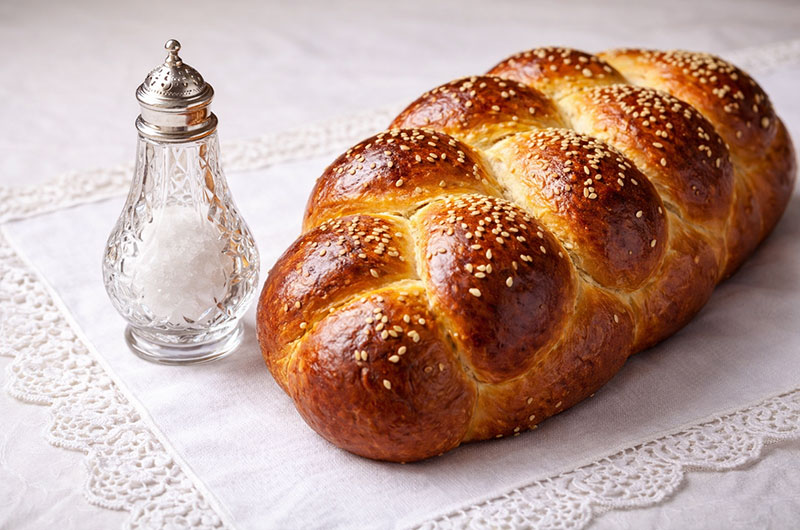
Fourteen of Vayikra’s 16 mitzvot deal with Korbanot. I’d like to mention two of them. The two are both sides of the same coin – salt. One is the prohibition which forbids offering a Korban without salting it first. And the positive mitzvah to add salt to all Korbanot. A pinch is sufficient, but the salt has to be there. In short, the idea is that salt is a preservative and that salt itself never spoils. Korbanot are transitory, but salting them lends a note of permanence. And our takeaway from this mitzvah? We salt our bread when we make HaMotzi. Judaism teaches that even the most physical acts can be elevated. When we wash for bread, say HaMotzi, dip the bread in salt, recite b’rachot before and after eating, and keep our kashrut laws, we transform eating from a biological necessity into an act of gratitude to Hashem and awareness of Him. What could be ordinary becomes sacred. Salt is one of the items that links our dining table to the Mizbei’ach in the Beit HaMikdash. The Gemara in Chagiga (27a) quotes the pasuk in Yechezkel (41:22): “The Altar was wood three cubits high and two cubits long, and its corners and its length and its walls were wood. And he spoke to me, ‘This is the table that is before Hashem.’” The Gemara comments that the pasuk starts with the Mizbei’ach (Altar) and ends with the Shulchan (Table). It was puzzling to refer to the Altar as a Table, until Rabi Yochanan and Reish Lakish both said: “When the Beit HaMikdash is standing, the Altar atones for a person; now that the Mikdash has been destroyed, it is a person’s table that atones for him, for his feeding of needy guests atones for his sins.” The well-known statement, “Shulchan domeh laMizbei’ach,” the (dining) table is like the Altar, is found in the Rama’s note to Shulchan Aruch Orach Chayim 167:5. He bases it on the pasuk about salt in Vayikra and the rule that we are to salt our HaMotzi bread. I often feel guilty (not really) when I share Divrei Torah with you, dear reader, without numbers in this column called Torah by the Numbers. So, here are some numbers for salt. The molecular weight of Sodium Chloride is about 58.5. The gematria of melach is 78 – same gematria as lechem (bread). No surprise there – they are anagrams. Which is interesting because we salt our bread. Melach on lechem. Hmmm. Hayom hazeh (this day) is also 78.* * * * *
Another mitzvah in Parshat Vayikra that stands on its own – even though it is related to a Korban – is testimony. A person who knows something which can have a bearing on a court case is required to testify. Someone who does not testify when he should must bring a Korban Asham, one of the five types of guilt offerings. Society is based on good relations among the members of the society. A crucial aspect of a good society is the accountability of each member. And that means good, honest court systems.* * * * *
And the final mitzva in the sedra is a rare mitzvah that requires one to have previously violated a Torah prohibition. The mitzvah in question is “V’heishiv et ha-g’zeila...” One must return that which he has stolen. Think about it: If a person steals something and would like to repent his deed, he has to return what he stole. T’shuva (repentance) cannot be complete unless there is restitution. The Torah did not have to make it a mitzva to return what was stolen. But it did. Maybe we can see it as G-d’s encouragement to someone who has slipped. Ponder that.* * * * *
Briefly, the Adar that precedes Nissan has 29 days in our fixed calendar. Hence, there is only one day of Rosh Chodesh Nissan. Nisan itself has 30 days, so Rosh Chodesh Iyar will be two days. Although Nissan is the seventh month counting from Rosh Hashanah and Tishrei, it is actually month number one, as announced in Parshat Bo, and in the maftir of HaChodesh this past Shabbat – “This month [Nissan] shall be the first of your months for you [lachem]...”* * * * *
Rosh Chodesh Nissan brings with it a once-a-year b’racha to say anytime during the month: Birkat Ilanot. When one sees fruit trees blossoming during Nisan, he is to recite a b’racha that joyfully acknowledges G-d’s bonus gift. Trees are wonderful creations. The main aspect of a fruit tree is the fruit it gives us to eat. This alone would make the tree special. And yet, before a fruit tree gives us its fruit for the picking, it gives us a beautiful visual and olfactory experience – its flowers. The b’racha expresses that there is nothing lacking in the world that G-d has created – good beings and goodly trees. It is said only on fruit trees. There are other trees with beautiful floral displays, but this b’racha is not for them. And once fruits start to develop, the b’racha is not said. Take a good look at a blossoming apple, peach, cherry tree (or other type of fruit tree). Beautiful to behold. Now go and smell the flowers. Wow! And the best is yet to come. But we recognize G-d’s gifts before the main gift. So as soon as Nissan starts, look around your neighborhood or visit the botanical garden of your choice and say the b’racha (and a couple of chapters of T’hilim selected for the occasion) – and say it with a smile. Chodesh Tov and Shabbat Shalom.