 October 9, 2026
 Categories: Headline / Features / Money Matters
Shavuot and Generational Wealth: What Jewish Tradition Teaches About Leaving a Lasting Legacy


As Shavuot approaches, attention turns to one of Judaism’s central themes: the transmission of values across generations. The giving of the Torah at Har Sinai was not a one‑time event. It marked the beginning of a continuous chain in which knowledge, values, and identity pass from parent to child. Looking through this lens is a powerful way to examine what legacies truly endure over time.
Large financial legacies will not last: Financial research shows that wealth, even when substantial, rarely survives more than three generations. What seems permanent in one era often fades in the next. By the time great‑grandchildren come of age, the financial impact of an inheritance has typically diminished to near zero.
Long‑term data tracking families over many generations confirms this pattern. Unexpected increases in wealth, often called wealth shocks, tend to disappear within roughly a century. Even very large inheritances follow the same trajectory. The reasons are straightforward: arithmetic, behavior, and time.
As families grow, assets are divided among more heirs. Each generation begins with a smaller share than the one before. At the same time, spending tends to rise as lifestyles adjust to available resources. Furthermore, extreme wealth can reduce drive, ambition, and the incentives to develop the skills needed for long‑term success. Taxes, fees, and investment friction further erode capital. For wealth to persist indefinitely, a family would need unusually high investment returns, consistently restrained consumption, and minimal drag from external costs. Over multiple generations, those conditions almost never align.
The result is that financial capital dilutes. A significant fortune becomes a series of smaller inheritances, each less capable of sustaining the same impact. Eventually, the original wealth is absorbed into ordinary economic life.
Giving money to charity can last: There are exceptions to the above research, particularly in the world of philanthropy. Under the right structure, large pools of money can be preserved for very long periods. Foundations avoid the fragmentation that occurs in families because they do not divide assets among heirs. They benefit from favorable tax treatment and are designed to maintain perpetual endowments.
An example is the estate of John D. MacArthur, who passed away in 1978. MacArthur was an American insurance magnate, real estate investor, and philanthropist who established the John D. and Catherine T. MacArthur Foundation, known for the MacArthur Fellowships. The vast majority of his wealth, directed to a foundation, continues to exist and grow. The portion left to heirs followed the familiar path of dissipation. Foundations preserve capital for a mission, not for a lineage. They extend influence, but not family wealth.
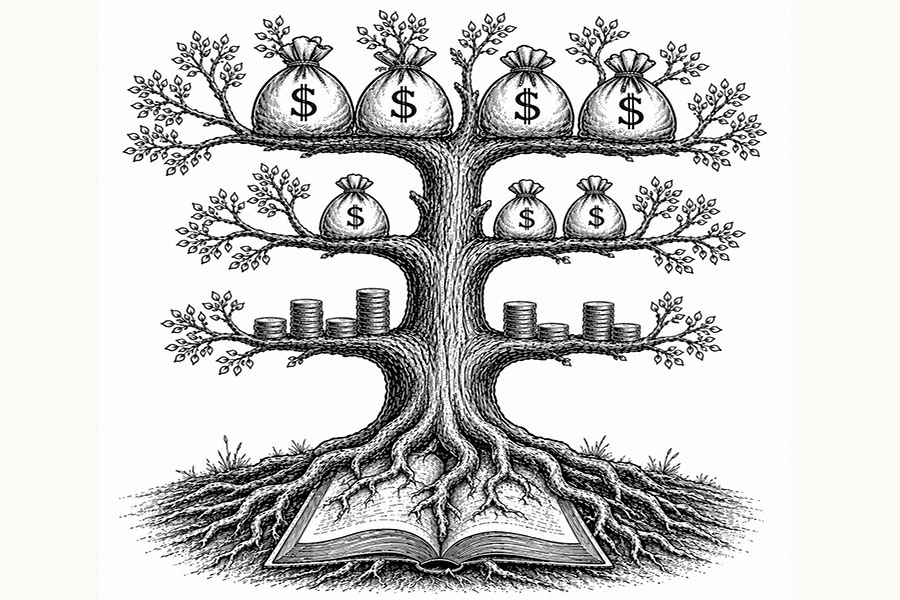
The type of legacy that persists: If financial assets fade when inherited by family members, the question becomes what persists over generations. The answer lies in a different category of inheritance, namely human capital.
Human capital includes education, skills, problem-solving, and social networks. It encompasses the ability to identify opportunities, make sound decisions, and adapt to changing circumstances. Unlike money, these attributes do not diminish when shared. They can strengthen with each generation.
Certain traits are especially important. Judgment enables sound decisions in uncertain situations. Discipline supports long‑term thinking and consistent effort. Curiosity drives learning and adaptation. Ambition fuels the pursuit of opportunity. These qualities are not guaranteed by wealth, but they can be cultivated within families and communities.
When these attributes are emphasized, they create a foundation capable of generating new wealth even if previous fortunes have been lost. Without them, even substantial inheritances may not last.
In the Jewish world, despite millennia of existence and long periods of persecution, Klal Yisrael has managed to thrive because of our focus on developing human capital and passing those values to the next generation. Our emphasis is on education, learning, debating, investing in our community, developing practical skills, and giving to charity.
While financial capital is divided, spent, and eventually dispersed, human capital can grow stronger over time when intentionally cultivated. Families that understand this distinction are better positioned to build legacies that extend beyond any particular fortune. They are a link in a chain of transmitting these values to future generations.
Shavuot and leaving a Torah legacy: These ideas align closely with the themes of Shavuot. The Torah is not a static inheritance to be preserved on a shelf. It is a living body of knowledge that must be studied, internalized, and transmitted. Its endurance depends on active engagement, with each generation taking responsibility to apply its teachings to their own lives.
This perspective reshapes how families think about legacy. The question is not only how much will be passed down, but what will be passed down. Conversations about inheritance should be complemented by discussions about values, expectations, and responsibilities. The objective is to prepare the next generation not only to receive wealth, but to create and manage it effectively.
A narrow focus on financial assets can create the illusion of permanence, yet it overlooks the factors that truly sustain long-term success. A more complete view recognizes that the real family balance sheet includes intellectual, moral, and social capital. Invest in your children and grandchildren while you are alive. Support the development of their human capital through education, Torah learning, business building, and charitable endeavors.
Wealth may fade with time, but the abilities, values, and habits that we transmit that make wealth possible in the first place endure far beyond any bank account. By investing in human capital and Torah ideals, we leave a legacy that strengthens every generation that follows.