 October 23, 2026
 Categories: Headline / Perspectives / Op-Eds
Shining The Light of the Future
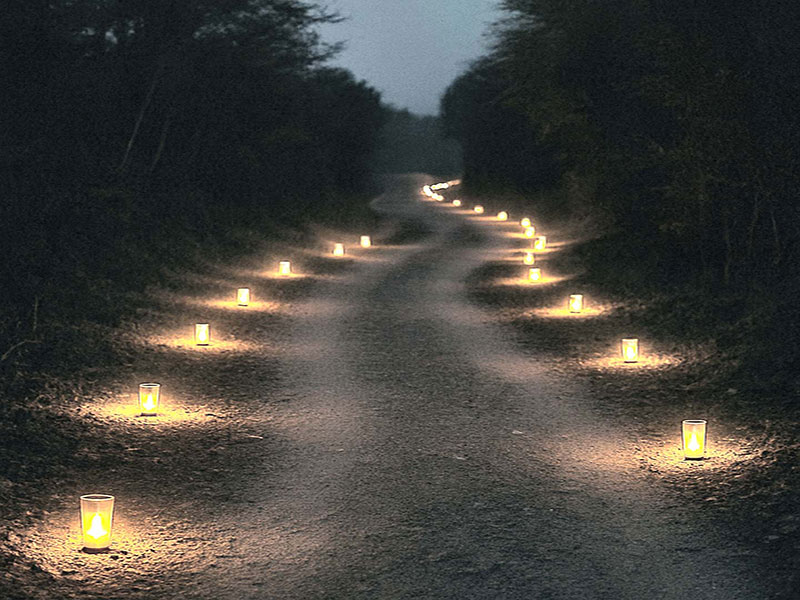


The story of Chanukah is etched in our brains from such a young age: The Syrian-Greeks desecrated the Holy Temple in Jerusalem, trashing her sacred oils and placing a variety of idols inside. After winning the battle – a handful of brothers against a large and mighty army – we cleaned up the Holy Temple and found just enough oil to burn for one day, yet G-d miraculously kept that oil burning for an additional seven days.
As much as Chanukah recalls events of our past, in many ways, it’s also about our future. The Bnei Yissaschar, Rebbe Zvi Elimelech of Dinov, notes that Chanukah comes from the Hebrew word chinuch, meaning education or training.
What are we supposed to be learning from this period in our history? And what messages are we supposed to be teaching?
The Light of Creation
When G-d first created the finite universe, reality consisted of a vast emptiness and darkness, filled with water, with the spirit of G-d hovering over everything in existence. Our Sages explain that this “spirit of G-d” refers to the spirit of Mashiach, who will ultimately emerge once the four empires that seek to destroy the Jewish people have fallen. G-d then said, “Let there be light!” and there was light. Given that G-d didn’t create the sun until the fourth day of Creation, we can assume that this initial light is hinting at something metaphysical. Indeed, our Sages explain that this “light” shone from one end of the universe to the other. However, since G-d knew that we weren’t ready to appreciate its intensity just yet, He hid it away for a later time, when we’d be better able to value its awesomeness.Hence, just as we gradually educate our children in bite-size pieces of knowledge and wisdom as they develop through life and before they come of age, so too did G-d bring this holy “light” into this lower realm before its time.
But where could G-d possibly hide such a holy entity? The Bnei Yissaschar teaches that He hid it within the Torah, and when we learn Torah – however deep or simplistic that learning might be – we tap into this loftiness and further enable its tangible manifestation within this finite realm. This is why our Sages explain that a chacham, an individual steeped in Torah learning, is even more exalted than a navi, a prophet. Indeed, a prophet receives messages from G-d, but those communications are limited to specific ideas or instructions. A chacham, on the other hand, draws his or her inspiration (and “message”) from this inner, initial light, which has no limitations and which can continually reveal new insights.
The week-long festival of Chanukah is so powerful because it’s based on this hidden light.
The Light Beyond Torah
If Chanukah is so exalted, though, why isn’t it mentioned – or even hinted at – in Torah? Regarding Purim, our only other post-Biblical festival, our Sages were at least able to discover subtle hints of its themes scattered throughout the Biblical text. Why wasn’t the festival of Chanukah spoken about at Mt. Sinai along with the rest of the many details and practices of Judaism? The Divrei Chaim, Rebbe Chaim Halberstam of Tzanz, explains that Chanukah comes from a place beyond Torah, so to speak.If someone is ill or in pain, G-d forbid, a qualified doctor is able to distinguish which area(s) of the body is triggering this and prescribe appropriate treatment(s). And since our entire body is interconnected, discomfort in one area will likely generate discomfort in other areas, as well – and vice versa. The Kabbalistic tradition often connects the Torah’s 613 mitzvos to the 613 limbs and sinews in our body, and explains how each mitzvah fortifies a specific one. Just as a remedy in one area can rectify the entire body, so too can one mitzvah, when engaged with fully, bring healing to our total person. The Divrei Chaim explains that, because of how disconnected we would eventually become following our experiences at Mt. Sinai, G-d knew that we’d need something to “heal” and uplift us later on. He gave us the lights of Chanukah as a remedy for that empowerment.
The Light Within
This is why we place our menorah by the entrance of our home, facing the street, instead of inside, where we kindle our Shabbos lights. The Baal HaTanya, Rebbe Schneur Zalman of Liadi, connects the opening of our home (i.e., the front door) to the opening of the gates of righteousness to which King David refers in Tehillim: “Open for me the gates of righteousness and I will enter them and give thanks to G-d” (118:19). Indeed, we should be singing songs of praise and thanks to G-d with total intent, and living the fullest versions of ourselves (and our Jewish selves) daily, but how many of us fall short of this tall order? How many of us make mistakes throughout our days – whether toward ourselves, toward others, or toward G-d – and maybe don’t feel so connected or inspired at all times?Each year, when we kindle our Chanukah lights, we bring that holy, initial light that G-d first revealed when He created the finite universe back into our current reality – specifically at the gates of our homes and facing the street, the marketplace of modern society and the representation of mundane busyness. And we do this because we can – because that holy light was buried within us all along. As such, Zechariah tells us, “Sing and rejoice, O daughter of Zion! For behold, I am coming and will dwell in your midst, says G-d” (2:14). By default, to be human means that we won’t be able to sing as passionately as the angels might in the upper realms, but that doesn’t mean that we shouldn’t be singing at all. G-d dwells amongst us even if we express our gratitude in a volume as low as a whisper. Even though we might not be “of age” yet to experience the Messianic Era, we still kindle the flames regardless, as we prepare ourselves for that ultimate, awesome reality.
The Light That Leads Us Home
Lastly, our Sages inform us that the time to kindle the menorah lasts as late as when the foot traffic of the marketplace ceases for the night. Rabbi Shlomo Carlebach teaches that this means that on Chanukah, we find our way home again. Yes, we might be busy with the happenings of the marketplace outside, following our feet here and there in search of meaning, inspiration, acceptance, purpose – or whatever. But on Chanukah, we realize that we have everything that we need to thrive already within us. We open our doors and position our menorah for all to see as a gesture to anyone walking by that they, too, can come in and discover that the holiness they seek outside is, truly, already inside of them.As much as Chanukah might be a celebration of the light of the past, the hidden, holy light of Creation, it’s doubly about the light of the future – the Messianic light that will shine to its fullest extent once again when those four empires are destroyed and the darkness that they each brought to our reality finally dissolves. This is why we kindle our menorah for a total of eight days, even though the miracle of Chanukah was, in actuality, only seven. Without the initial, hidden light, the entire miracle couldn’t have occurred at all. Without the strength of Torah – and each of our abilities to learn and teach it in our present – there is no way for us to overcome darkness, now or ever. When we kindle our menorah now, we shine an opening for Mashiach to reveal himself, one flame at a time.
A lichtigen and a freilichen Chanukah