 November 13, 2026
Categories: Halacha & Hashkafa / Torah
Spilled Ink
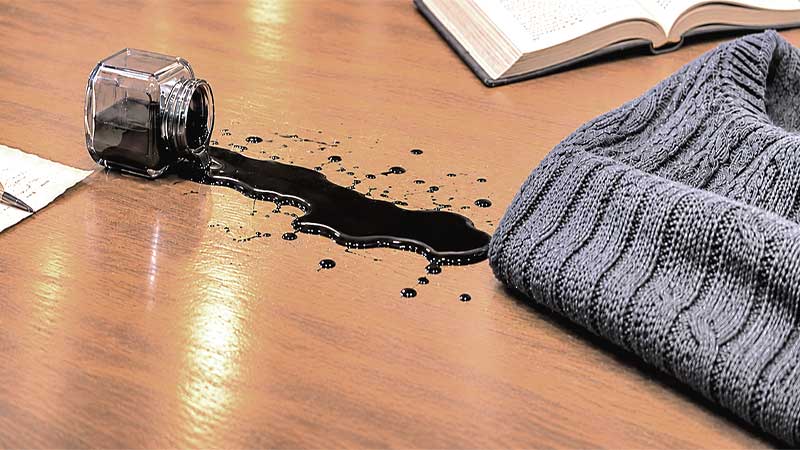


Reuven and Shimon were roommates in yeshiva. One evening, they were both sitting at the table in their room – Reuven was practicing safrus, carefully writing letters with a quill and ink, while Shimon sat across from him, engrossed in his learning.
Reuven reached for a drink and accidentally knocked over his container of ink. It spilled across the table, spreading rapidly toward Shimon’s sweater, which lay nearby. Shimon noticed the spill but continued learning, leaving Reuven to deal with it.
Reuven jumped up and grabbed paper towels to contain the mess. Before he could wipe it up, though, the ink had spread onto Shimon’s sweater, leaving a permanent stain. The sweater was ruined.
Shimon was upset. “You spilled the ink and ruined my sweater!” he said. “You should pay for it.”
“I didn’t mean to spill the ink,” Reuven replied. “It was an accident!”
“That doesn’t make a difference,” Shimon countered. “A person is responsible even for damage caused accidentally. You knocked over the ink, and my sweater was ruined.”
“But you were sitting right there!” Reuven protested. “You saw the ink spreading toward your sweater, yet you didn’t move it. If you had moved it, it wouldn’t have been damaged at all. You could have prevented the damage, but you willingly accepted the loss!”
Shimon shook his head. “No, I didn’t! Why should I have to protect my belongings from your carelessness?” he insisted. “You’re the one who spilled the ink. It’s not my responsibility to cover for your mishaps!”
Neither roommate was willing to concede. Reuven insisted that Shimon could easily have prevented the damage, while Shimon argued that the responsibility rested entirely with Reuven.
The two decided to bring their dispute before Rabbi Dayan. After presenting both sides, they asked:
“Is Reuven liable for Shimon’s ruined sweater?”
“The Gemara (B.K. 27a) teaches that if someone placed a coal on another’s clothing, causing it to catch fire, he is liable, even if the owner was present and stood by passively,” replied Rabbi Dayan. “We do not infer that the owner agreed to the action or was willing to forgo the damage due to his inaction in removing the coal, since he knew that he could claim the loss from the perpetrator (C.M. 418:18).
“Nonetheless, several Acharonim limit this rule to a case in which the perpetrator willfully caused the damage in a direct manner. However, if the perpetrator did so by accident – even though a person is usually also liable for accidental damage – he is exempt here, since the owner, too, should have taken action to remove the coal and prevent the damage (Aruch HaShulchan C.M. 418:35).
Some explain that this is because when the damage was unintentional, the owner also had an obligation of hashavas aveidah to remove the coal and thereby spare the other person the liability for the damage. However, when the perpetrator damaged intentionally, the owner has no responsibility to spare him from the liability that he intentionally brought upon himself (Chiddushei Harim C.M. #25; see C.M. 261:4).
Similarly, if the damage was not inflicted directly by the perpetrator himself but rather by property that he failed to control properly – e.g., his pet chewed someone’s shoes in the owner’s presence – some suggest that he is not liable when he was absent but the shoe owner was present and did not act to restrain the animal and save his shoes (Pischei Choshen Nezikin 1:16[45], 3:[3]).
Moreover, some suggest that if the damage is incidental (grama) and the owner did not take precautions to prevent it – such as if someone moved another’s item from a secure location to somewhere outside and the owner saw but said nothing, and it was later stolen – the perpetrator is exempt. In this case, in addition to the damage being grama, the owner’s silence and failure to re-secure the item constitute tacit acceptance of the action (Pa’amonei Zahav 380:1).
“Thus, in our case,” concluded Rabbi Dayan, “since Reuven knocked over the ink accidentally, and Shimon saw the spill but took no action to protect his sweater, Reuven is exempt.”
Verdict: If a person intentionally damages another’s property, he is liable, even if the owner was present and did not act to avert the damage. However, if he damaged accidentally or through grama, or his animals caused damage, the perpetrator is exempt if the owner could have spared himself the loss but did not bother to do so.