 October 16, 2026
 Story In a Postcard: Three Bundles, a String, and a Cholent Pot


Around the year 1910, the Hebrew Publishing Company, located on the Lower East Side of Manhattan, released a variety of Rosh Hashanah postcards featuring a myriad of themes (I estimate around 150 different types), ranging from Zionism to American patriotism to prayer excerpts from High Holiday synagogue services, and more. While there are collectors who passionately seek to obtain as many 19th- and early 20th-century-produced Rosh Hashanah cards from Europe and America they can find, I am not one of them. However, I am not immune to the charming effect some of these cards have, so over the past 30 years, there have been a handful of examples that I could not say no to acquiring. Presented here is the card I enjoy most.
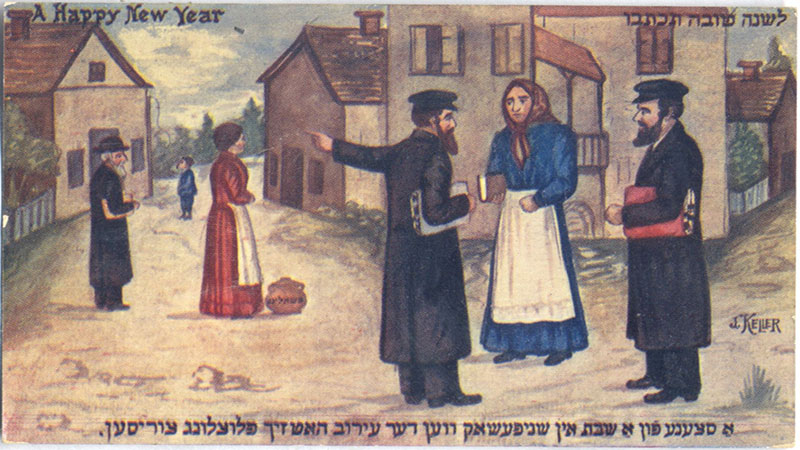
This postcard has a number of people featured on it, apparently connected by some event. In the background, a boy is looking up at a wispy piece of string or wire blowing in the wind, attached to a pole. Then, closer to the foreground, are two figures. The first is an elderly man carrying something under his arm. Near him is a woman staring straight ahead, and at her feet on the ground is a lidded brown pot, which is labeled in Yiddish “cholent.” Finally, we see a man pointing in the direction of the string that the boy is looking at while speaking to another man and woman. Whatever he is saying to the woman and man must be of some concern, as the woman has a downcast expression on her face. Like the elderly man, these two other men are carrying similar bundles under their arms, while the woman is carrying a book. What is happening here?
At the top of the postcard are the words “A Happy New Year,” and in Hebrew, “L’Shana Tovah Tikatevu” (May you be inscribed for a good year). At the very bottom, in Yiddish: “A scene of a Shabbos in Shnippishok, when the eruv was suddenly torn apart.” Now that this has been revealed, there are clues in the illustration to let us know exactly when on the Sabbath this event occurred.
An eruv is, of course, what enables religious Jews to carry items in the street on Shabbos; poles are erected around an area and connected by a piece of wire (or in this case from 115-plus years ago, string), so that a neighborhood is thus transformed into one large private domain. In the scene depicted here, the young boy is looking up at the detached string, and the man in front is pointing to the downed eruv, letting the woman and man know what has happened. What ties this scene together is the woman with a pot of cholent laid on the ground by her feet. This puzzling element can only be interpreted if the viewer is familiar with both the history of cholent in Europe and with halacha.
An early mention of cholent can be traced back to the 13th century, where it is found in the writings of Rabbi Issac ben Moses of Vienna, better known as the Riaz. He described seeing cholent pots in France at the home of his teacher, Rabbi Judah Sir Leon of Paris. This fits with the etymology of cholent, which is believed to have originated from the medieval French words chaud (hot) and lent (slow). Many Jewish households would have their own pot, made out of metal or earthenware, and on Friday afternoon before sundown, they would take it with the mixed raw ingredients of meat, grains, and vegetables inside, to the community oven, which was usually located in the town’s bakery. After Shabbos morning synagogue services concluded, the now fully cooked cholent would be retrieved from the communal oven and taken home, to be served at the forthcoming meal.
Of course, the cholent pot may only be carried to a person’s home if the eruv is up and operational. If not, then it cannot be retrieved during Shabbos. But what happens if a person finds out that the eruv is down while in the midst of carrying the cholent? Halacha states that upon hearing this news, any food that is being held must immediately be set down on the ground wherever the person happens to be and left there, and only after Shabbos has ended can someone be sent to pick it up.
But the three other people seen on the postcard are carrying items as well – why are they still holding them? If you look very closely at what the men are carrying, you can just make out alternating black-and-white stripes in the center of their bundles. That pattern is found on taleisim, which men carry to and from the synagogue if there is an intact eruv. When these men are told that the eruv is no longer functioning, halacha states that they should take the tallis out of the bag and wear it as an article of clothing. put the bag they are carrying down on the ground, and retrieve it later, after Shabbos.
Women in Europe would tend to have their own personal siddur which they would bring to synagogue; that is what the woman on the postcard is carrying. Halacha would require her to find a safe surface or a spot on the ground on which to set the siddur down, from which it can be retrieved it after Shabbos. Since the man and woman are in the middle of being informed that the eruv is down, they are still holding their items. As for the elderly man who is staring straight ahead with his tallis still under his arm, perhaps he needed a moment to gather his strength for what he was about to do: unfold the tallis, place it upon himself, and attempt to find a clean spot nearby to put the tallis bag down.
I applaud the artist of this illustration, Jacob Keller, as through his “clues,” he lets the viewer know precisely when this “crisis” is occurring: specifically, the cholent pot, which would only have been picked up from the communal oven after morning synagogue services have ended, means the men and women are walking home from synagogue.
Finally, while Shnippishok is an actual place – a Jewish suburb of Vilnius, Lithuania – that area is not what is being depicted here. In Yiddish folktales and jokes, whenever the author or orator wanted to describe a place that was “in the middle of nowhere” – that is, very far away – or even “backward,” they would say that the story was happening in “Shnippishok.” (In a similar vein in Yiddish literature of the era, all of the inhabitants of the town of Chelm are portrayed as fools.)
The target audience of this Rosh Hashanah postcard was not the long-settled and successfully assimilated German Jews of New York, most of whom came to the United States during the early and mid 19th century. This card was for the more recently arrived immigrants of Eastern Europe, many of whom were living in tenements (today it would be accurate to call such housing a slum). This postcard was for them – and presumably, most would understand the humorous depiction of a cholent pot on the ground due to a broken eruv... a wistful remembrance of the shtetl-world they left behind.