 July 3, 2026
 Categories: Features
Teen Perspective: Everyone Should Be a Zionist


"Zionism" is one of those words that sparks debate, confusion, and emotion. But at its core, it is simple. Zionism is the support of the State of Israel, and the belief that the Jewish people have the right to self-determination in their ancestral homeland, as a Jewish and democratic state rooted in its founding values.
Being a Zionist does not mean blind allegiance. It does not require agreeing with every policy, law, or decision. Like any nation, Israel is imperfect. But there is a difference between criticism that seeks to dismantle a state and criticism that seeks to strengthen it. Constructive criticism, pointing out where Israel may have strayed from its own values and how it can better uphold them, is not betrayal. It is a responsibility.
The Jewish connection to the land of Israel is not just historical. It is continuous. While many peoples have lived in the region, Jewish identity remained tied to this land for thousands of years, even in exile. In language, in prayer, and in culture, the connection endured. Modern Zionism is not the creation of something new, but the realization of something ancient.
But connection alone is not the whole story.
For centuries, Jewish life without sovereignty meant vulnerability. Expelled from Spain in 1492, targeted in pogroms across Eastern Europe, and ultimately subjected to the horrors of the Holocaust, the Jewish people experienced what it meant to live without the power to protect themselves. The lesson was not theoretical. It was lived, again and again, across generations.
A Jewish state changes that reality.
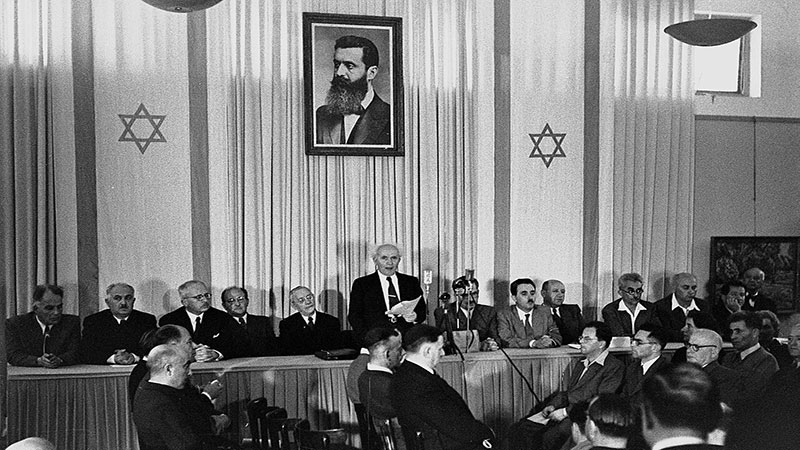
Israel's founding values are enshrined in its Declaration of Independence: the right to self-determination, democracy, equality, freedom of religion and conscience, and the ingathering of exiles. Its national anthem, Hatikvah, captures the spirit of these ideals: "to be a free nation in our land." The enduring belief that the Jewish people can live freely in their own land and shape their own future.
A.B. Yehoshua described Zionism as a big boat with many currents. That is exactly what it has always been, and is. Borders, security, and political decisions are complex, and people can disagree on them. But those debates do not define Zionism. At its core, Zionism is about ensuring that the Jewish people are not once again a minority dependent on the protection of others, but a nation capable of determining its own destiny.
Criticism, debate, and engagement are essential. But they must rest on a clear foundation. Jewish history has shown the cost of statelessness. To recognize that is not to ignore complexity. It is to acknowledge reality. The existence of a Jewish state has not erased threats, but it has fundamentally changed the Jewish condition. For the first time in centuries, Jews are not powerless in the face of them. The proof has shown up time and again, with the State of Israel rising to protect its people, just as it is doing now in the war against Hamas, Hezbollah, and Iran.
And that is why Zionism, at its core, is not merely a Jewish position. It is a humane one.