 October 9, 2026
 Categories: Features On The Jewish World
The 1574 Printing Of R. Karo’s Kesef Mishneh
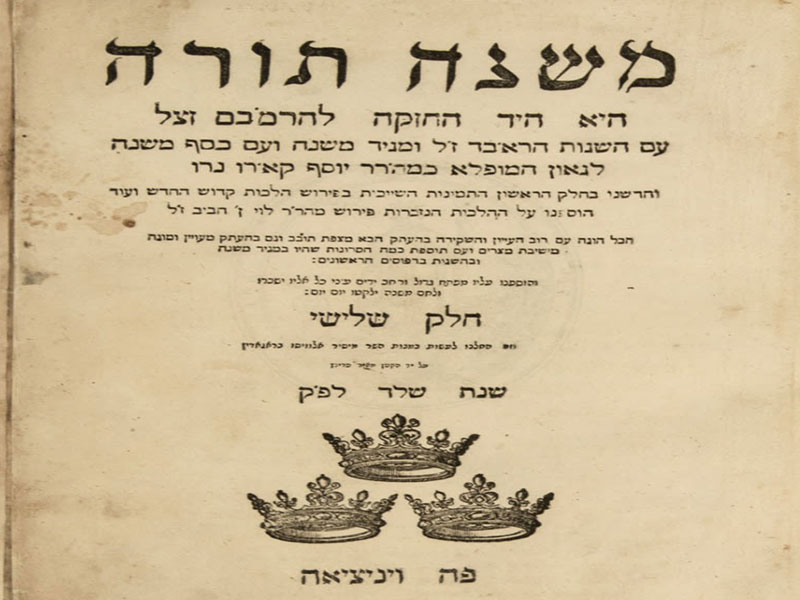


Every so often, in the quiet shuffle of auctions and dealer lists, an item surfaces that makes the collector’s pulse quicken in a way only fellow bibliophiles truly understand. Recently, I was fortunate enough to secure just such a treasure: a handsome and decidedly scarce set of the very first printed edition of the Kesef Mishneh – Rabbeinu Yosef Karo’s celebrated commentary on Rambam’s Mishneh Torah. Though the work had long circulated in manuscript, its debut in print did not occur until Venice, 1574, and holding these volumes is nothing short of stepping into a defining moment in the history of halachic literature.
The edition was overseen by the noted Venetian printer Meir Parenzo, who drew upon manuscripts brought from the holy city of Safed as well as a copy refined in the Egyptian academy. Issued in four elegantly arranged volumes, beautifully printed on quality Venetian paper, the set introduced to the broader Torah world a “new commentary” from the “Gaon Hamufla,” the wondrous scholar R. Yosef Karo. According to the introduction, it was none other than Moses Provencal of Mantua who quietly pushed events forward, urging and encouraging R. Karo to bring the work to completion for the press. R. Karo, for his part, availed himself of the discerning eye of the famed kabbalist R. Menahem Azariah of Fano, who examined the work to ensure its exactitude.
There is also a subtle historical irony here that has not been lost on scholars: these volumes, produced during R. Karo’s own lifetime, unite on a single printed page Rambam – author of the first great code of Jewish law – with R. Karo, whose own Shulchan Aruch would ultimately become the authoritative halachic code for world Jewry. One could say that in this Venetian print shop, the baton was passed.
Each of the four volumes carries its own title page: Bragadin’s device of the Three Crowns graces the front, while on the verso appears Parenzo’s emblem of Venus and the Dragon – an image that later generations of more modest-minded owners often found objectionable. As a result, many copies lost their title pages or had the offending illustration defaced, making complete, clean examples such as this one uncommon and all the more valuable.
Collectors and scholars alike will appreciate the additional significance of this edition. It marks the first publication of a comprehensive alphabetical subject index, prepared from the writings of the school of “ha-Rav ha-Zaken, gadol be-doro,” R. Baruch Uziel. It also represents the first time the glosses of the Raavad – R. Avraham ben David of Posquieres – were presented as an independent unit. In previous printings they had been folded into the Maggid Mishneh, blurring the distinct voices that animated the medieval debate over Rambam’s rulings.
R. Karo composed the Kesef Mishneh with several goals in mind: to identify Rambam’s Talmudic and Geonic sources, many of them subtle or only hinted at, to defend Rambam from the sharp critiques of the Raavad by demonstrating the solid halachic foundations behind his decisions, and to reconcile the occasional internal contradictions within the Mishneh Torah. When these volumes finally emerged from the Venetian presses in 1574, they immediately reshaped the study of Maimonidean law and became the standard companion to every subsequent printing of the Mishneh Torah.
For the collector, the first edition stands not only as a bibliographic milestone but as a vital witness to the textual history of two foundational works of halacha. And for those of us who cherish the physical traces of Torah’s transmission, acquiring such a set is nothing short of a privilege – a small window into the great scholarly enterprise that continues to shape Jewish learning to this very day.