 October 9, 2026
 Categories: Collecting / Arts
The Antisemitism and Anti-Zionism of H.G. Wells
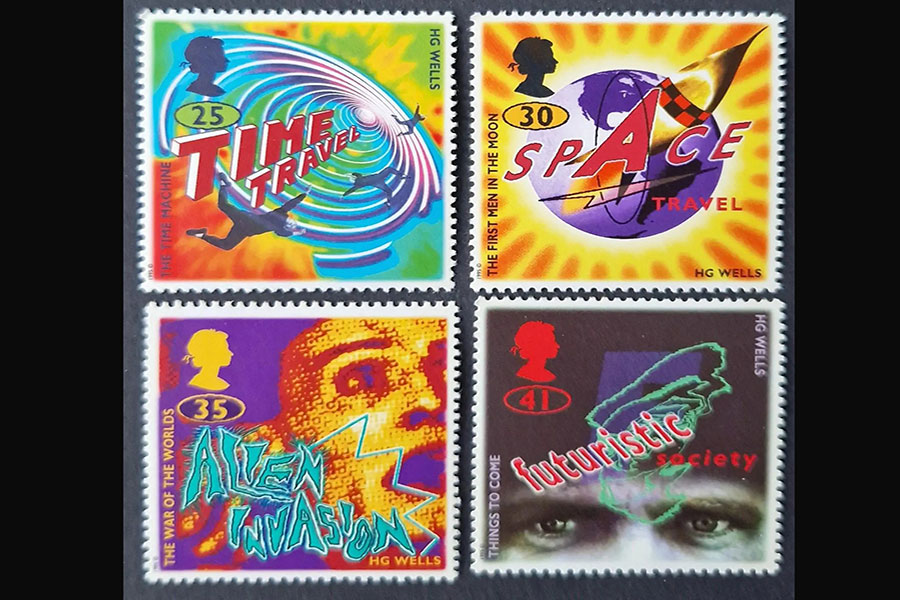


Born in Bromley, Kent, Herbert George Wells (1866-1946), the “Father of Science Fiction,” rose from modest and often precarious beginnings to become one of the most influential writers and public intellectuals of the late nineteenth and early twentieth centuries.
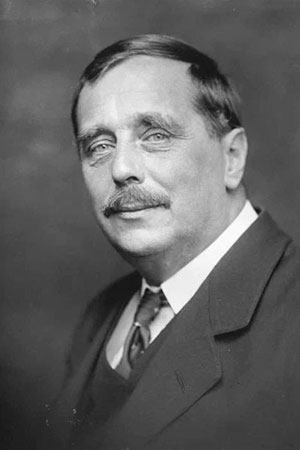
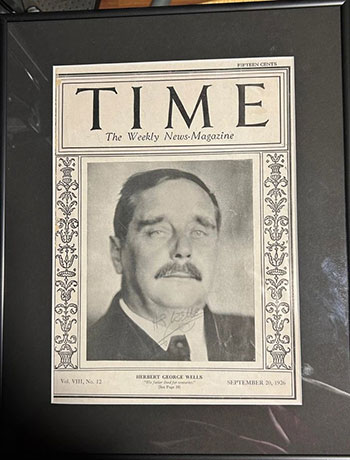
The son of a failed shopkeeper and a domestic servant, he experienced early hardship that shaped both his fierce ambition and his lifelong sensitivity to social inequality. A childhood accident that left him bedridden for an extended period fostered his love of reading, while later apprenticeships as a draper exposed him to the grinding constraints of lower-middle-class life, experiences he would later fictionalize with unsparing clarity. He escaped this narrow world through education, winning a scholarship to the Normal School of Science in South Kensington, where he studied biology under Thomas Huxley, whose emphasis on scientific materialism, evolutionary theory, and skepticism toward religious dogma left a lasting imprint on Wells’s worldview, equipping him with both intellectual confidence and a deep faith in rational planning as a means to social progress.
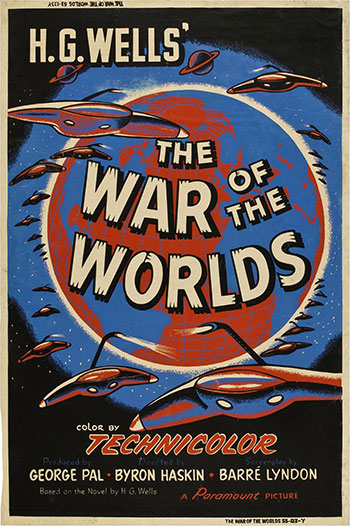
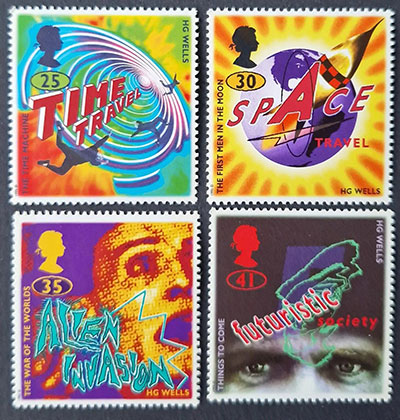
Wells first achieved fame in the 1890s with a remarkable series of scientific romances that effectively founded modern science fiction as a serious literary genre, including works such as The Time Machine (1895), The Island of Doctor Moreau (1896), The Invisible Man (1897), and The War of the Worlds (1898), which combined imaginative speculation with sharp social critique, exploring themes of class struggle, imperialism, evolutionary degeneration, and the ethical limits of science. These novels were no mere escapist fantasies, but thought experiments designed to provoke moral and political reflection. At the same time, he produced a large body of realistic, albeit lesser-known novels, including Kipps (1905), Tono-Bungay (1909), and The History of Mr. Polly (1910), which dissected English society with satirical acuity. Beyond writing fiction, he emerged as a prolific essayist, historian, and political commentator, and his Outline of History (1920) achieved extraordinary global circulation and helped popularize a secular, evolutionary account of human civilization for a mass audience.
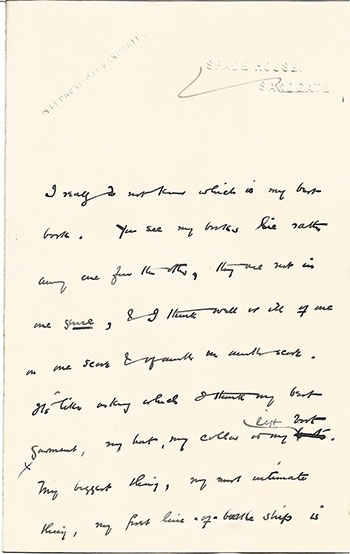
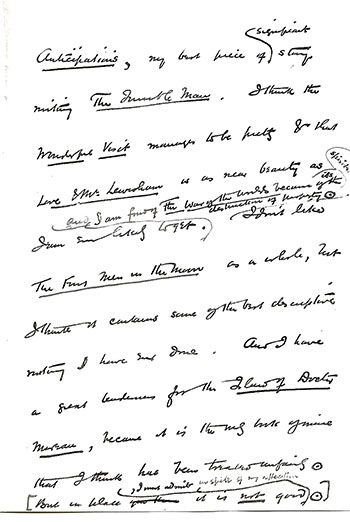
In this rare undated correspondence, Wells presents his personal views on some of his greatest works:
I really do not know which is my best book... It's like asking which I think my best garment, my hat, my collar or my left boot. My biggest thing, my most intimate thing, my first line-of-battle ship is Anticipations, my best piece of significant story writing The Invisible Man. I think the Wonderful Visit manages to be pretty & that Love & Mr. Lewisham is as near beauty as I am likely to get, and I am fond of The War of the Worlds because of its destruction of property. I don't like The First Men in the Moon as a whole, but I think it contains some of the best descriptive writing I have ever done. And I have a great tenderness for The Island of Dr. Moreau, because it is the only book of mine that I think has been treated unfairly.
When The Island of Dr. Moreau appeared in 1896, it was widely regarded as repellent, cruel, and grotesque, and many reviewers focused almost entirely on its surface horrors – vivisection, mutilated animals, moral regression – rather than on what Wells thought was its philosophical core. In particular, Victorian critics often treated the book as sensational and morbid, ethically offensive, and lacking “uplift” or moral reassurance. Wells saw the work as a parable about scientific hubris, especially the misuse of evolutionary theory; as a meditation on the fragility of civilization, showing how thin the veneer of morality really is; and as a challenge to complacent Victorian optimism about progress. He felt that Moreau was among his most intellectually serious works, closer in spirit to Swift or Voltaire than to popular horror; hence, his “great tenderness” for it: he saw it as a misunderstood work that suffered for being too bleak, too uncompromising, and too ahead of its time.
Modern critics largely vindicate Wells; today, Moreau is often read as one of his deepest and most disturbing philosophical novels, anticipating later concerns about bioethics, totalitarian control, and dehumanization.

Anticipations (1901), Wells’ “biggest thing, my most intimate thing,” is not a novel at all, but a work of futurology and social prophecy. Wells himself called it his “first line-of-battle ship” because it represented a decisive shift in his career from imaginative fiction to direct social and political intervention. The book is a speculative analysis of the future, covering technological change (particularly automobiles and mechanized transport), the decline of traditional cities and the rise of suburbs, the transformation of warfare, the emergence of a scientifically trained governing elite, and the gradual replacement of nation-states by larger technocratic systems. Rather than telling a story, Wells extrapolates from existing trends, arguing that science and engineering would reshape society far more radically than people realized. The book reflected his belief that it was his most serious and purposeful work; that writers should shape the future, not merely describe it; and that the book fused imagination with political responsibility.
Most critics today would not call Anticipations his “best” writing in aesthetic terms, but they generally agree that it is one of his most significant and revealing works, historically and ideologically. While the book helped to establish Wells as a major public intellectual and it influenced later futurists and planners, it was criticized by many for promoting elitist and authoritarian ideas, including advocacy of rule by a scientific elite, and for some passages that endorsed eugenic thinking.
The Wonderful Visit and Love and Mr. Lewisham, which Wells characterizes as “pretty” and “near beauty” are two novels that reflect a very different side of Wells: gentler, emotional, and autobiographical. In The Wonderful Visit (1895), a clergyman accidentally shoots an angel, who survives and stays in an English village and whose presence quietly exposes the pettiness, hypocrisy, and spiritual emptiness of respectable society. The religious vocabulary of the work, which is satirical, but tender, and lightly comic, is exclusively Christian, as he discusses vicars, parsons, sermons, and hymns; churchgoing village life; and Anglican moral conventions. The angel figure is not framed in Jewish terms (biblical Hebrew angelology) but, rather, through Victorian Christian iconography, popularized sentimental angel imagery, and Anglican theological assumptions. Thus, Wells critiques Christian society judging itself by its own professed ideals, not by comparison to Judaism or any non-Christian tradition.
Love and Mr. Lewisham (1900) is a semi-autobiographical work about a young schoolteacher torn between ambition, self-discipline, and social advancement and romantic love and emotional vulnerability, as the novel traces Lewisham’s painful education in compromise and maturity. Many critics consider it to be one of Wells’ finest character studies and among his most emotionally sincere novels.
Throughout his career, Wells positioned himself as a prophet of modernity, advocating for social reform, scientific education, internationalism, and the replacement of traditional political structures with rationally organized systems. He identified at various points with Fabian socialism – a reformist strand of socialism that advocates achieving social justice and public ownership through gradual, democratic, and legislative means rather than revolution, emphasizing expert planning, incremental reform, and working within existing political institutions. Wells’s faith in a scientifically trained elite capable of managing society in the collective interest hardened over time into a technocratic vision that left little room for cultural or religious particularism, and it was within a framework of aggressive universalism that prized homogeneity, efficiency, and forward momentum that his views on Jews, Judaism, and Zionism took shape.
Wells’s attitudes toward Jews were complex, irregular, and often contradictory, yet they were unmistakably marked by recurring antisemitic assumptions common among educated Europeans of his era. Unlike crude racial antisemites, however, Wells did not consistently depict Jews as biologically inferior or conspiratorial by nature; instead, his hostility was rooted in what might be termed “progressive antisemitism,” a belief that Jewish distinctiveness, whether religious, cultural, or national, represented an anachronistic obstacle to the rational unification of humanity. He viewed Judaism not as a living moral tradition but as a fossilized survivor from an earlier stage of human development, and he frequently characterized Jewish identity as inward-looking, tribal, and resistant to assimilation into the universal civilization that he envisioned.
These views found expression both in Wells’s nonfiction and in his fictional works. In essays and journalistic writings, he sometimes spoke admiringly of individual Jews who, in his estimation, transcended their communal origins, while simultaneously condemning Jewish collective life as retrograde; this pattern of praising Jews who shed their Jewishness while disparaging Jews who retained it was consistent throughout his life. He repeatedly suggested that the “Jewish problem,” a term he used uncritically, would resolve itself only through cultural dissolution and intermarriage, a stance that aligned him with assimilationist currents and placed him squarely at odds with Jewish self-understanding and historical experience.
Wells’s engagement with Jewish themes intensified in the aftermath of World War I, as questions of nationalism, minority rights, and international governance moved to the center of global politics. The Balfour Declaration of 1917, which expressed British support for the establishment of a Jewish national home in Eretz Yisrael, drew his particular ire; he regarded Zionism as a reactionary and dangerous movement, one that, in his view, contradicted the universalist ideals that should govern the postwar world. He rejected the notion that Jews constituted a legitimate nation deserving of territorial sovereignty, arguing instead that Jewish nationalism merely replicated the same ethnic exclusivism that had fueled European conflicts.
Wells’s attitudes toward Jews and Judaism, particularly as expressed in The Outline of History (1920) and The Shape of Things to Come (1933), form one of the most troubling and internally revealing aspects of his intellectual legacy. While Wells repeatedly insisted that he opposed racial antisemitism and rejected biological theories of Jewish inferiority, his writing nonetheless exhibits a persistent, deeply ingrained hostility toward Judaism as a religion and toward Jews as a historically continuous collective. This hostility is not incidental or marginal; it is woven into his philosophy of history, his conception of progress, and his vision of a future world order. In both works, Jews appear as a problem to be explained, corrected, or dissolved, rather than as a legitimate historical or cultural presence.
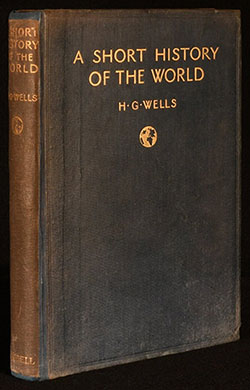
In A Short History of the World, Wells devoted significant attention to the ancient Israelites and the development of Judaism, portraying them as a people whose religious genius lay in ethical monotheism but whose historical trajectory had become frozen by adherence to obsolete laws and customs. He presents himself as a rational, scientific historian stripping away myth, superstition, and tribal particularism to narrate humanity’s march toward global unity and, within this framework, he treats Judaism with unusual severity. He reduces ancient Israelite religion to a narrow, legalistic system obsessed with ritual, exclusion, and divine favoritism, and he repeatedly characterizes Jewish monotheism as harsh, jealous, and morally retrograde when compared to later ethical universalism. While Christianity and Buddhism are criticized for their dogmas, they are also credited with moral evolution and spiritual expansiveness; Judaism, by contrast, is portrayed as having stagnated early and remained frozen in an antiquated moral and social worldview.
What is especially striking is Wells’s insistence on Jewish separateness as a historical vice. He depicts Jews not merely as a religious community, but also as an obstinately self-isolating group whose survival into modernity represents a kind of historical anomaly. The Jewish commitment to law, tradition, and communal boundaries is framed as resistance to progress itself and, in his narrative, Judaism becomes synonymous with legalism without ethical growth, memory without creativity, survival without contribution. This depiction echoes long-standing Christian and Enlightenment antisemitic tropes, even as Wells claims to reject religious prejudice.
Wells is particularly hostile to the idea of Jewish chosenness, which he treats as both morally offensive and socially corrosive, and he portrays the Jewish sense of election not as a theological metaphor or historical survival strategy, but as a literal belief in superiority that fosters arrogance and alienation. This reading allows Wells to blame Jews themselves for antisemitism, suggesting, sometimes explicitly, that Jewish distinctiveness provokes hostility by refusing assimilation. The moral burden, in his account, rests disproportionately on Jews to dissolve themselves into the broader human stream.
This hostility intensifies when Wells turns from ancient history to modern society. In The Outline of History, Jews are frequently described as overrepresented in commerce, finance, and urban professions, observations that Wells frames as sociological but that echo classic antisemitic stereotypes. Although he avoids crude racial language, his repeated emphasis on Jewish economic visibility contributes to a narrative in which Jews appear as disruptive agents within national societies and, while he is careful to deny racial hatred, the cumulative effect of his descriptions reinforces suspicion and resentment.
The Shape of Things to Come carries these assumptions into Wells’s speculative future. Subtitled “The Ultimate Revolution,” the dystopian-to-utopian book presents itself as a future history, tracing the collapse of existing political systems, a prolonged period of chaos, and the eventual emergence of a technocratic world state governed by scientifically trained elites and where rational planners and religions, including Judaism, have no legitimate future. Within this imagined future, he addresses the fate of Jews in stark and unsettling terms and he depicts Jewish communities as particularly resistant to the homogenizing forces of the new world order, clinging stubbornly to religious and cultural separateness marked by a conspicuous failure to evolve. This resistance, in Wells’s narrative, provokes hostility and violence, culminating in widespread persecution and, in some passages, language that chillingly anticipates later historical events. Jewish identity is expected to evaporate once superstition, nationalism, and religious law are swept away, and the fact that he regards this outcome as both desirable and morally neutral is itself revealing. Thus, Jewish survival, in his view, lacks intrinsic value; it is tolerated only insofar as it dissolves.
Although Wells did not advocate genocide in explicit terms, his portrayal of Jews in The Shape of Things to Come is marked by moral indifference to their suffering and by an implicit justification of their marginalization. He suggests that Jewish distinctiveness would inevitably provoke repression and that the disappearance of Jewish communal identity would be both necessary and desirable for global harmony. The book’s tone toward Jews is not one of empathy but of cold inevitability, as if their destruction were a regrettable but unavoidable byproduct of historical progress; in retrospect, especially post-Holocaust, these passages have been widely criticized for their blindness and moral failure.
Underlying both works is Wells’s profound discomfort with historical memory and tradition when they resist his vision of progress. In particular, Judaism, with its emphasis on law, continuity, collective memory, and covenant, stands as a rebuke to Wells’s evolutionary optimism; Jewish history does not culminate in the abandonment of its core commitments but, instead, it persists, adapts, and remembers. For Wells, this persistence appears almost pathological, and he interprets Jewish survival not as resilience but as obstinacy, not as creativity but as refusal.
It is important to emphasize that Wells’s antisemitism is not the genocidal or racial antisemitism of the Nazis, which he explicitly opposed. Yet, though his hostility is ideological and civilizational rather than biological, it is no less corrosive; by framing Judaism as morally inferior, historically obsolete, and socially disruptive, he provides intellectual cover for exclusion, even as he disavows hatred, and his insistence that Jews must abandon their distinctiveness in order to be acceptable places the burden of harmony entirely on the minority, a classic feature of liberal antisemitism.
Moreover, Wells’s tone when writing about Jews often betrays a lack of empathy absent from his treatment of other marginalized groups. Although he can sometimes be critical of Christianity and nationalism, he does not suggest that Christians or national peoples should disappear as such while Judaism alone is repeatedly singled out as uniquely incompatible with the future, a stark asymmetry that suggests that his hostility was not merely philosophical but emotional, rooted in irritation at a people who refused to conform to his historical script.
In the end, Wells’s treatment of Jews in The Outline of History and The Shape of Things to Come reveals a deep tension at the heart of his humanism. His commitment to universalism could not tolerate durable particularity; his faith in progress could not accommodate a tradition that defined itself through memory rather than novelty; and Jews and Judaism became, for him, the embodiment of everything he wished humanity to outgrow. That this judgment was rendered with confidence, elegance, and moral certainty makes it all the more troubling and all the more significant for understanding the limits of liberal, secular visions of progress in the twentieth century.


Wells later attempted to distance himself from charges of antisemitism, particularly after the rise of Nazism made racial hatred impossible to ignore. He publicly condemned Hitler and the Nazi regime, meeting with Hitler in 1932 and emerging deeply alarmed by his fanaticism. He wrote essays denouncing Nazi antisemitism as barbaric and irrational, and he expressed horror at the persecution of Jews in Germany; yet these condemnations did not fully repudiate his earlier assumptions because even as he criticized Nazi violence, he continued to frame Jewish identity as problematic and transitional, something that would ultimately need to dissolve into a unified world culture.
Jewish characters appear only sporadically in Wells’ fiction but, when they do, they often serve as embodiments of his ambivalence; they are frequently depicted as clever, energetic, and intellectually agile, yet also as morally suspect, socially disruptive, or excessively self-interested. These portrayals rarely delve into Jewish religious life or inner experience; instead, Jewishness functions as a marker of otherness, shorthand for traits that Wells found unsettling in modern society and the absence of sympathetic, fully realized Jewish protagonists in his work is telling, particularly given his professed humanism and concern for marginalized groups.
Despite these failings, Wells’ relationship to Jewish intellectuals and individuals was not uniformly hostile. He maintained cordial relationships with some Jewish contemporaries and admired Jewish contributions to science, literature, and political thought when they aligned with his universalist ideals, but his admiration was always conditional, predicated on the abandonment of particularist loyalties. For Wells, the ideal Jew was one who ceased to be recognizably Jewish, a stance that rendered his alleged philosemitism inseparable from antisemitism.
Wells’s hostility toward Zionism was not a marginal or incidental aspect of his thought but a direct extension of his broader philosophy of history and politics. To him, the twentieth century demanded the dissolution of national and religious particularisms in favor of supranational structures governed by scientific rationality, and he believed that nationalism, whether European or colonial, was the principal engine of war and human suffering. Within this framework, Jewish nationalism appeared to him not as a movement of liberation but as an anachronistic revival of precisely those forces he wished to abolish. He consistently rejected the argument that Jewish statelessness constituted a unique historical injustice that required redress through territorial sovereignty; instead, he insisted that Jews, like all peoples, must abandon national aspirations in favor of integration into a future world state.
This position placed Wells at odds not only with Zionists but also with many liberal defenders of minority rights. He dismissed the idea that Jewish history, marked by exile, persecution, and legal exclusion, justified exceptional political solutions; to him, such claims represented special pleading rooted in religious mythology rather than rational politics. He viewed the attachment of Jews to Eretz Yisrael as a regression to biblical primitivism, an indulgence in sacred geography that he believed modern humanity should have outgrown, and in private correspondence and public commentary, he described Zionism as sentimental, irrational, and ultimately destabilizing, predicting that it would generate conflict rather than resolve it.
Wells’s objections to Zionism were also shaped by his perception of Judaism as a closed moral system. He argued that Judaism, unlike universalist ethical philosophies, derived its authority from divine election and covenant, concepts he found incompatible with egalitarian modernity, which led him to interpret Jewish nationalism as inherently exclusionary, a movement that sought self-preservation rather than universal progress. In this respect, his critique echoed long-standing Christian polemics against Judaism, even as he presented himself as a secular rationalist and, by treating Jewish collective identity as uniquely resistant to moral evolution, he reproduced theological prejudices in ostensibly scientific language.
Even before the Holocaust, some commentators noted that Wells’ language about inevitability and historical necessity bore uncomfortable similarities to the rhetoric of antisemites who framed Jewish suffering as self-inflicted or unavoidable. After the rise of Nazism, these concerns intensified; although Wells publicly condemned Hitler and warned of the catastrophic consequences of fascism, his earlier writings were revisited with growing unease. Passages in The Shape of Things to Come that depicted Jews as victims of mass violence elicited particular scrutiny, as readers struggled to reconcile Wells’ claimed humanism with his apparent detachment from Jewish suffering.
Wells himself responded defensively to accusations of antisemitism, insisting that his critique was directed not at Jews as individuals but at what he regarded as the sociological problem of Jewish separateness. He argued that any group clinging to archaic identities would face similar consequences in a world moving toward unity, yet this defense failed to acknowledge the asymmetry of power and vulnerability that characterized Jewish existence in Europe. By treating Jewish identity as a voluntary affectation rather than a historically imposed condition, he minimized the coercive forces that shaped Jewish life and ignored the persistence of antisemitism even among highly assimilated Jews.
Judaism functioned in Wells’s work as a symbol, a static category against which he could define his vision of modernity, an abstraction that allowed him to critique “the Jews” without encountering actual Jewish voices. This abstraction translated into character types rather than individuals. Jewish figures, when present, were rarely afforded interiority or moral complexity, and they tended to appear as social operators, financiers, or intellectual schemers, figures whose talents were undeniable but whose loyalties were suspect. Such portrayals drew on long-standing stereotypes while avoiding explicit racial invective, enabling Wells to maintain a veneer of liberal respectability, but the cumulative effect reinforced cultural assumptions that cast Jews as perpetual outsiders, incapable of full participation in the moral community Wells imagined.
At the same time, Wells’s treatment of Jewish suffering under Nazism reveals the limits of his moral imagination. He condemned persecution but framed it primarily as evidence of fascism’s irrationality rather than as a catastrophe demanding radical ethical reckoning; he did not revise his opposition to Zionism in light of escalating violence; and he did not seriously consider whether Jewish self-defense or sovereignty might constitute a rational response to persistent hostility. Even as reports of mass murder emerged during World War II, he remained committed to the belief that nationalism, including Jewish nationalism, was the root cause of global conflict.
In the final years of his life, Wells’s reputation as a visionary thinker remained largely intact, even as the moral certainties that had underpinned his worldview were shaken by the realities of global war and genocide. He lived long enough to witness the near-total destruction of European Jewry, an event that exposed the catastrophic inadequacy of theories that treated cultural disappearance as a benign or inevitable feature of progress. Yet, he did not substantially revise his published views on Jews, Judaism, or Zionism in response to these events, and his later writings continued to emphasize the necessity of global governance and the dangers of nationalism without explicitly confronting the implications of Jewish annihilation for his long-standing opposition to Jewish collective self-assertion.
This silence has drawn sustained critical attention in the decades since his death in 1946. Jewish scholars and historians have noted that Wells’s framework left no conceptual space for a people whose history demonstrated that assimilation did not guarantee safety, nor for a tradition that had survived precisely because of its resistance to dissolution, and his insistence that Jewish identity was an anachronism rendered him incapable of recognizing the Holocaust as anything more than an extreme manifestation of political barbarism, rather than as a decisive refutation of the idea that Jewish particularism was the cause of Jewish suffering. In this respect, Wells exemplifies a strain of liberal thought that underestimated the resilience of antisemitism and overestimated the protective power of universal ideals.
Postwar reassessments of Wells’s legacy have tended to compartmentalize his achievements and his prejudices. Literary critics continue to celebrate his role in shaping science fiction, his narrative imagination, and his prophetic engagement with the technological transformations of modern life, and political theorists acknowledge his early warnings about fascism and his advocacy for international cooperation, even as they recognize the authoritarian tendencies implicit in his vision of elite rule. His views on Jews, however, occupy a more uncomfortable position, often relegated to footnotes or treated as unfortunate but peripheral misjudgments; such treatments risk minimizing the centrality of these views to his understanding of history and progress.
Wells’s antisemitism may perhaps best be characterized as “enlightened hostility” that proved no less damaging in practice. By framing Jewish survival as a problem and Jewish nationalism as an error, he lent intellectual legitimacy to policies and attitudes that marginalized Jewish voices, and even his later condemnation of Nazi antisemitism did not translate into support for Jewish agency or self-defense.
In the broader sweep of intellectual history, Wells’s case illustrates the ethical risks inherent in grand narratives of progress. His confidence in historical inevitability dulled his sensitivity to moral contingency, enabling him to treat human suffering as collateral damage in the march toward an abstract future. The Jews, in his writings, became symbols of resistance to change rather than human beings with legitimate claims to dignity and security and, that this symbolism later intersected with real-world catastrophe underscores the danger of subordinating ethical judgment to theoretical coherence.

At the end of the day, Wells remains a somewhat paradoxical figure: a visionary who foresaw many of the technological and political dangers of the modern world, yet failed to recognize the moral significance of one of its most enduring peoples. His life and work testify to both the promise and the peril of secular universalism, reminding us that a future imagined without room for historical memory and collective identity may be neither as rational nor as humane as its architects intended.