 September 25, 2026
 Categories: Collecting / Arts
The Biblical Hebrew of Noah Webster
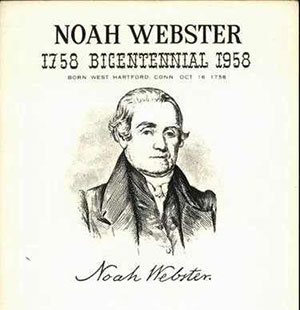


Noah Webster (1758-1843) was born in West Hartford, Connecticut into a family deeply embedded in New England’s Congregationalist and Puritan legacy. His father, also named Noah Webster, was a farmer and local civic figure, and the household environment combined religious seriousness with a strong sense of moral discipline and communal obligation. Webster’s early education reflected the classical and biblical curriculum typical of colonial New England, emphasizing Latin, Greek, rhetoric, and Scripture, a foundation that shaped both his intellectual ambitions and his conviction that language, morality, and national character were inseparable.
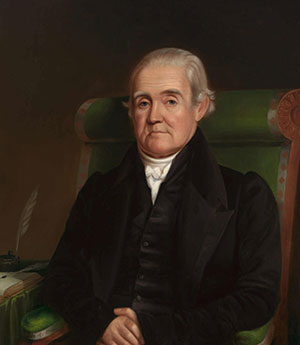
Webster entered Yale College in 1774, just as the American colonies were sliding into open rebellion against Britain. His undergraduate years coincided with the Revolution’s early and most uncertain phase, and although his direct military service was brief and largely symbolic, the ideological force of the Revolution profoundly affected him. He graduated in 1778 convinced that political independence demanded cultural and intellectual independence as well; in his view, the continued reliance on British textbooks, grammars, and dictionaries undermined the development of a cohesive American identity, a belief that would become the animating principle of his life’s work.
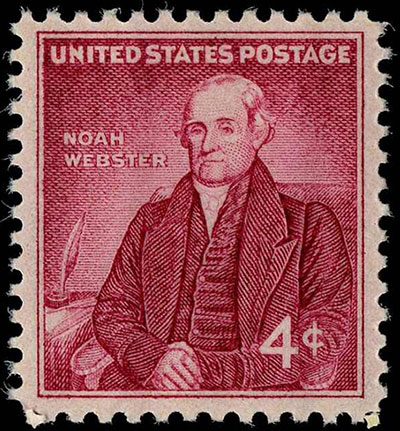
After Yale, Webster struggled financially and professionally. He taught school in several towns, studied law intermittently, and found the existing educational materials ill-suited to American conditions. British spelling conventions, pronunciation guides, and examples struck him as aristocratic, outdated, and inconsistent with republican values, and this dissatisfaction led directly to his first major publication, A Grammatical Institute of the English Language, issued in parts between 1783 and 1785. The first volume, later known simply as The American Spelling Book, proved extraordinarily successful and eventually sold tens of millions of copies. Its importance cannot be overstated: it standardized American spelling, pronunciation, and basic literacy for generations of children and provided Webster with the financial stability necessary to pursue larger intellectual projects.
Webster’s ambitions, however, extended far beyond pedagogy. He believed that language itself was the vessel of national character and moral order and that to shape language was therefore to shape the republic, a conviction that propelled him into political journalism in the 1780s and 1790s. As editor of newspapers such as The American Minerva, he became a prominent Federalist voice, advocating a strong national government, constitutional stability, and moral discipline. His political writings reveal a man deeply concerned with social cohesion and suspicious of radical egalitarianism untethered from moral and religious restraint.
Religion, initially a background influence, assumed increasing importance in Webster’s life as he aged and, although raised within the Congregationalist tradition, his early adulthood shows signs of religious ambivalence typical of post-Enlightenment intellectuals. By the first decade of the nineteenth century, however, he experienced a pronounced evangelical reorientation, as he came to believe that Christianity, specifically Protestant Christianity, was indispensable to republican government. This shift was neither superficial nor rhetorical; rather, it shaped his scholarship, his educational philosophy, and ultimately his lexicographical work.
Webster’s philosophy of language rested on the conviction that words were not arbitrary signs but historical vessels carrying moral, intellectual, and spiritual meaning across generations, a belief that shaped his approach to etymology and explains his persistent attention to ancient languages, particularly Hebrew. He rejected the emerging Enlightenment tendency to treat language as a purely conventional system evolving through social usage alone; instead, he argued that the earliest languages preserved a closer relationship between words and things, a relationship he believed was most fully realized in the language of the Hebrew Bible. Although modern linguistics would later abandon this theory, it was widely held in Webster’s time and grounded in the long tradition of Christian Hebraism.
Within the longer arc of Christian Hebraism, Webster occupies a distinctive and transitional position. Christian Hebraism in the English-speaking world had deep roots stretching back to the Reformation, when Protestant scholars, rejecting reliance on the Latin Vulgate, turned directly to the Hebrew Bible as the authoritative text of the so-called Old Testament. Figures such as William Tyndale, John Calvin, and later seventeenth-century scholars like Johannes Buxtorf and John Lightfoot established a model of Christian engagement with Hebrew that combined reverence for the language and text but with a theological framework that subordinated Judaism to Christianity. By the eighteenth century, this tradition persisted but increasingly intersected with Enlightenment philology and historical criticism.
Webster inherited this tradition at a moment when it was undergoing transformation. Unlike the early Christian Hebraists, whose work was primarily theological, Webster approached Hebrew through the lens of lexicography and national culture; his interest was not merely to interpret Scripture correctly, but to anchor the English language itself in what he regarded as its deepest historical and moral sources. For him, Hebrew was not only the language of revelation but also a key to understanding the genealogy of meaning in English, an approach that placed him at the intersection of religious scholarship and secular linguistic science, even as his conclusions remained religiously inflected.
What distinguishes Webster from earlier Christian Hebraists is the absence of polemical engagement with living Judaism. Seventeenth-century Hebraists often studied rabbinic literature explicitly in order to refute it, mining the Talmud and medieval commentaries for arguments against Jewish interpretation. Significantly, Webster did not do this; his Hebrew engagement was almost entirely confined to the biblical text and to comparative etymology; he showed little interest in post-biblical Judaism as a religious system; and he did not engage rabbinic authorities as interlocutors. This limitation arguably reflected the intellectual environment of early America, where Jewish communities were small and rabbinic scholarship was largely inaccessible to Protestant intellectuals.
The origins of Webster’s dictionary project lie in this synthesis of nationalism, linguistics, and religion. Dissatisfied with existing dictionaries, particularly Samuel Johnson’s – as he criticized their British bias, limited vocabulary, and insufficient attention to scientific and technical terms and also objected to what he regarded as moral deficiencies, including definitions that ignored or obscured biblical meanings – he began serious work on lexicography around 1806, publishing A Compendious Dictionary of the English Language that year as a preliminary effort.
Webster resolved to produce a dictionary that would be at once comprehensive, American, and morally grounded, a task that ended up taking more than two decades. He learned or deepened his knowledge of numerous languages, including Anglo-Saxon, Gothic, German, Dutch, French, Italian, Spanish, Latin, Greek, and Hebrew, but his study of Hebrew was undertaken specifically to improve his understanding of biblical etymologies and to refine definitions of words derived directly or indirectly from Scripture. While modern linguistics has surpassed many of his etymological theories, his multilingual approach was unusually ambitious for an American scholar of his era.

The result was An American Dictionary of the English Language, published in 1828 in two large volumes, which contained some 70,000 entries, far surpassing any previous English dictionary in scope. Webster included thousands of Americanisms, scientific terms, legal expressions, and biblical usages, and he also embedded moral judgments within definitions where he believed ethical clarity was essential, a practice that later lexicographers would increasingly abandon but which reflected his philosophical commitments.
Webster regarded Hebrew as uniquely significant because it was, in his view, the language in which divine revelation had first been communicated in written form. This belief did not lead him to romanticize Jewish life or practice, but it did compel him to take Jewish textual transmission seriously, and he repeatedly acknowledged that Jews had preserved the Hebrew Scriptures with remarkable fidelity, a fact he contrasted with what he saw as doctrinal corruption or linguistic decay in later religious traditions. In this respect, his attitude toward Jews resembles that of earlier Protestant Hebraists such as John Lightfoot and Johannes Buxtorf, who combined theological supersessionism with genuine respect for Jewish textual scholarship.
This orientation is visible in Webster’s lexicographical treatment of biblical and moral vocabulary. For example, words such as “law,” “covenant,” “atonement,” “sacrifice,” and “prophet” are defined not merely in secular or abstract terms but with explicit reference to their scriptural origins. When these terms are rooted in the Hebrew Bible, Webster often traced their meanings back to Mosaic law or Israelite practice before discussing later Christian interpretations. Although he ultimately framed these concepts within a Christian moral universe, the structure of his definitions implicitly acknowledged the priority of Jewish Scripture in the development of religious language.
Webster’s insistence on moral clarity in definitions has sometimes been criticized as didactic, but it reflects his belief that language education was inseparable from ethical formation. He feared that moral relativism would follow linguistic relativism, and he believed that detaching words from their biblical roots would erode social virtue. From a Jewish perspective, this approach had an unintended but lasting effect: it reinforced the centrality of Hebrew-derived moral concepts in American public discourse, even as Jews themselves remained a small minority within the population.
Within this dictionary, Jewish-related terms appear neither marginal nor polemical. Entries for “Jew,” “Jewish,” “Judaism,” “Hebrew,” “Israelite,” “Mosaic,” and related concepts are presented in sober, descriptive language, and they define Jews as a people historically descended from the Hebrews, adherents of the Mosaic law, and custodians of the Hebrew Scriptures. The tone is factual rather than hostile and notably absent are the stereotypical accusations – economic, theological, or conspiratorial – that pervaded much European and some American discourse of the period. This absence is particularly striking precisely because he did not hesitate to moralize elsewhere.
Webster’s definitions reflect what might best be described as Protestant Hebraism: a tradition that revered the Hebrew Bible, respected the antiquity and textual fidelity of Jewish transmission, yet interpreted Jewish history through a Christian theological lens. He accepted the conventional Protestant belief that Christianity fulfilled the Hebrew Scriptures, but he did not portray Judaism as morally corrupt or Jews as socially dangerous; instead, Jews appear primarily as historical and religious actors essential to the transmission of divine law.
The 1833 Bible revision further illuminates Webster’s stance. While firmly committed to Protestant Christianity, he sought to eliminate what he regarded as linguistic obscurities rather than theological differences between Judaism and Christianity, and he modernized vocabulary, adjusted grammar, and removed archaisms that, in his view, hindered comprehension. Importantly, he did not introduce new Christological readings into the Hebrew Bible where they were not already explicit in the King James version, a restraint that distinguishes his revision from earlier polemical translations that had deliberately reshaped the Hebrew text to emphasize Christian doctrine.
Thus, from a Jewish standpoint, the significance of this work lies less in its theology than in its method. Webster treated the Hebrew text with seriousness, acknowledging its grammatical structure and semantic nuance, and he resisted allegorical distortions that forced Christian readings into every verse and avoided inflammatory anti-Jewish glosses. While he remained firmly and unambiguously Christian and did not challenge supersessionist doctrine, his approach stands apart from more aggressively polemical biblical editors of earlier centuries.
Jewish scholars who later examined Webster’s Bible have noted that, although it remains a Christian document, it pointedly avoids overtly anti-Jewish commentary. Its reliance on the Hebrew text and avoidance of inflammatory glosses made it, if not sympathetic, at least respectful by the standards of the period. In the context of early nineteenth-century America, where theological discourse frequently included hostile depictions of Jews as obstinate or spiritually blind, his relative moderation is notable.
Webster’s religious worldview also shaped his views on civic equality, and he supported religious liberty as a constitutional principle and opposed religious tests for public office. Jews, in his understanding, were entitled to full civil rights as citizens, a position that aligned him with figures such as George Washington and John Adams and distinguished him from later nineteenth-century nativists who targeted Jews alongside Catholics.
At the same time, Webster did not engage directly with Jewish communities, leaders, or political concerns, nor did he leave any record of close Jewish friendships, correspondence with Jewish intellectuals, or involvement in Jewish philanthropic or educational efforts. His engagement with Judaism remained textual rather than communal, a limitation that likely reflects both the relatively small size of American Jewry during his lifetime and the inward-looking nature of his intellectual pursuits.
Equally important is what Webster did not do. He did not comment on contemporary Jewish emancipation debates in Europe and he did not address early Jewish settlement in Eretz Yisrael or speculate about Jewish national restoration in political terms. Although he occasionally echoed the Protestant belief that the Jews retained a providential role in history, this belief was theological rather than programmatic; modern Zionism lay decades beyond his horizon, and he expressed no views on Ottoman-controlled Eretz Yisrael or Jewish sovereignty.
Webster’s views on education further contextualize his Jewish relevance. He believed that public education should be universal and morally grounded, and he supported the use of the Bible in schools as a source of ethical instruction rather than sectarian indoctrination. While this position would later raise concerns among religious minorities, including Jews, in Webster’s own time it was widely understood as compatible with religious liberty. On the other hand, he did not advocate coercive conversion or exclusion of non-Christians from civic life; rather, he assumed that shared moral instruction would promote social harmony.
This assumption reflected both the strengths and limitations of early American pluralism. Jews were included as citizens, but their distinct religious identity was largely invisible in public institutions. Webster’s work exemplifies this paradox; by grounding American English in biblical language, he helped create a cultural framework in which Jewish Scripture was foundational, even as living Jewish communities remained peripheral to him and to the general national imagination. This dynamic helps explain in part why later Jewish intellectuals would approach him with a mixture of appreciation and critical distance.
The reception of Webster’s work among Jewish scholars in the nineteenth and early twentieth centuries was generally cautious but respectful. Historians of American education and Jewish life have noted that his dictionary familiarized non-Jewish Americans with Hebrew-derived terms without attaching stigma to Jewish identity, but for Jewish educators, this was a double-edged sword: on the one hand, it affirmed the antiquity and seriousness of Jewish tradition but, on the other hand, it reinforced a Christian interpretive framework that subsumed Judaism within a broader biblical narrative.
Later Jewish scholars, writing retrospectively in the nineteenth and early twentieth centuries, tended to situate Webster within a broader pattern of Protestant biblical engagement rather than singling him out as uniquely sympathetic or hostile. Historians of American Jewish life have noted that Webster’s dictionary helped normalize Jewish biblical terminology within American education, ensuring that terms derived from Hebrew Scripture entered common usage without distortion. This normalization had ambiguous consequences: it affirmed the centrality of Jewish Scripture to Western culture while simultaneously filtering it through a Christian interpretive lens; nevertheless, his legacy stands in contrast to later figures who explicitly weaponized language against Jews. His dictionary contains no racialized definitions of Jewishness and no insinuations of moral or civic inferiority, an absence that is significant, particularly given the rise of scientific racism and ethnic stereotyping in the decades following his death. Webster’s work reflects an earlier moment in American intellectual history, when religious difference was more salient than racial classification and when Jews were viewed primarily through a biblical rather than biological lens.
From the standpoint of Hebrew scholarship, Webster’s etymologies were eventually superseded, but his seriousness of purpose was acknowledged. Jewish philologists trained in the Wissenschaft des Judentums (“Science of Judaism”) tradition – an approach that applied modern academic methods to the study of Jewish history, texts, religion, and culture – recognized that Webster belonged to an earlier generation whose tools were limited but whose respect for ancient languages was genuine. His attempt to trace English words back to Hebrew roots was often speculative, but it reflected a belief, shared by many Jewish scholars of the period, that Hebrew occupied a foundational place in the history of moral language.
In this sense, Webster can be seen as an unwitting ally in the preservation of Hebraic consciousness within American culture. While he did not advocate Jewish religious autonomy or challenge Christian supersessionism, he did resist the erasure of Hebrew and Jewish antiquity from the intellectual life of the nation. At a critical time when American identity was being defined, he insisted that the moral vocabulary of the republic could not be understood apart from its biblical –and therefore Hebrew – origins.
Situating Webster within the history of Christian Hebraism thus reveals both continuity and constraint, as he continued a tradition of reverence for the Hebrew Bible while narrowing its scope to linguistic and moral foundations rather than theological debate. For early American Jews, his work offered neither validation nor attack, but something rarer: a scholarly environment in which Jewish terms could appear without polemic. That achievement, modest as it may seem at first blush, helps to explain why his legacy has remained largely uncontroversial within Jewish historiography and why his work continues to be cited as an example of early American intellectual engagement with Hebrew that was serious, disciplined, and comparatively fair-minded.
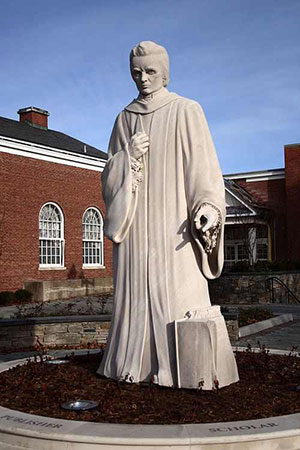

By the time of his death in 1843, Webster had become a symbol of American intellectual independence. His dictionary did not immediately displace British works, and its sales were initially disappointing, but its long-term influence proved immense. More importantly for the purposes of this essay, his work exemplifies a distinctive early American engagement with Judaism: reverent toward Scripture, respectful toward Jewish textual transmission, civically inclusive, yet firmly situated within a Christian interpretive framework. For Jewish readers and scholars, his work offers a complex legacy: one of recognition without reciprocity, respect without full understanding, and inclusion without intimacy.