 September 25, 2026
 The Chassid and the Professor


In this week’s parsha, Avraham and Sarah travel to Canaan bringing with them the “Nefesh Asher Asu BeCharan – The souls that they made in Charan” (Bereishis 12:5). What does this mean? Avraham and Sarah were the first “kiruv couple.” They brought idolaters into their home, gave them a meal and talked to them about the oneness of Hashem. Avraham would convert the men and Sarah would convert the women. As the Midrash says: “Anyone who takes an idol worshipper near and converts him, it is as though he has created him” (Bereishis Rabbah 39:14).
The above passage speaks to the power of the Jewish people: we are a force to be reckoned with yet we are private individuals. Avraham and Sarah did not let themselves be influenced by outside forces. Their home was a fortress. However, they elevated outsiders by inviting them in and teaching them the truth.
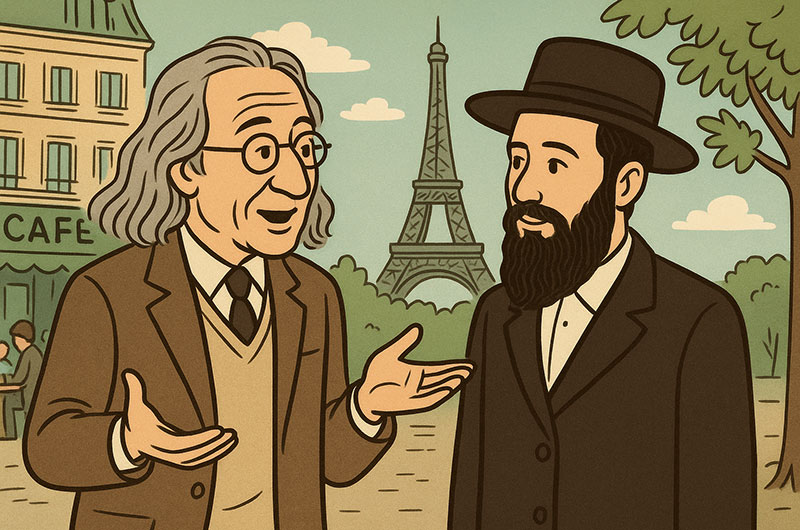
Rabbi Eli Silberstein, Chabad rabbi at Cornell University, relates on his Klimovitch podcast that a young chassid visiting France in the late 1970s was having trouble falling asleep one night. He went for a walk and encountered an elderly gentleman with long hair outside a café lecturing to a group of students. The students listened attentively as the professor spoke with fire and passion. The chassid went back to his hotel and went to sleep. The next night, the chassid has trouble falling asleep once again. He went back outside and saw the old man talking to the students in another late night “class.” The professor finished his speech and saw the Yerushalmi chassid looking at him. The professor walked over and said, “Vus macht a Yid?” The chassid was shocked! They got to talking. This professor revealed that he was a Polish Jew whose father was a rabbi, but that after the war he stripped himself of all vestiges of Judaism. However, he wanted this chassid to deliver a letter to Rabbi Menachem Mendel Schneerson, Lubavitcher Rebbe. “Why do you want me to send the letter to the Rebbe? Surely you have Polish rebbes you can send letters to.” The professor was insistent: “I want you to deliver this letter to the Rebbe personally. No one else is to see its contents. If you cannot do this, then don’t go.” The chassid agreed.
The Rebbe had recently suffered a heart attack; he was weak and recovering. When the chassid showed up at 770 with his request, the Rebbe’s secretary, Rabbi Leib Groner, said that that he would take the letter to the Rebbe. “I’m sorry, but I was told to bring it to the Rebbe personally.” “That is not possible as the Rebbe needs his rest and is not accepting individual petitioners.” The chassid thought to himself, “Was my trip for naught?”
A few days later, letter still in hand, the chassid had an idea. It was 17 Taamuz (when the Rebbe would usually daven Mincha in the main shul). If the Rebbe would come down, the chassid was going to approach him with the professor’s letter. After davening, the chassid, along with the throngs of mispallelim, surrounded the Rebbe. Rabbi Groner gave the chassid a warning glance as if to say: “Don’t even think about giving the Rebbe the letter.”
In an act of ruach hakodesh, the Rebbe approached the chassid and asked him for the letter. The Rebbe took the letter to his study and the chassid didn’t think anything more of it. Mission accomplished?
The chassid called the professor to inform him that he had delivered the letter to the Rebbe personally. The professor revealed that the Rebbe had called him from his home. This was an unusual move as the Rebbe’s secretaries would usually call people from the office. The professor did not reveal to the Chassid what the letter said or what he and the Rebbe spoke about, but it appeared that the professor was yearning to do teshuvah. The professor and the chassid continued to speak periodically over the phone. When the chassid called the professor after Sukkos and got no answer, he began to worry. He called the college where the professor taught and was informed that the professor died on Simchas Torah. Not only that, he was buried in a non-Jewish cemetery.
The chassid thought to himself: Here was a man of rabbinical lineage who had lived in darkness for decades and who saw the light at the end of his days. How could he not get a proper kevurah? The chassid called the Amshinover Rebbe, who always greatly respected the Lubavitcher Rebbe. The Amshinover Rebbe told him not to worry: if the Lubavitcher Rebbe knew about the letter, he would know about a solution to the kavod ha’mes issue. Sure enough, the chassid called the college shortly thereafter and was informed that the professor was reinterred in a Jewish cemetery.
There was great siyata dishmaya and outside forces in play in the above story. But it all started with a chassid who greeted a long-haired professor warmly and took an interest in his well-being. And because of this, a soul was taken from France to Olam Haba.
We have to build the world without losing our souls. Avraham used his quality of chessed to improve the world. Too often, “tikun olam” is used as a tool for people to save the world without thinking about their own homes. Rabbi Pini Dunner has lamented that the Western world thinks that one can be a “good person” and cast aside their Yiddishkeit, rachmana letzlan.
Today, various Jewish social justice groups protest against their own best interests to gain favoritism from the outside world. It’s nice to try and repair the world, but you need a Torah foundation. As Rabbi Dunner states: I have seen this all too often over the years – clever ideologues cherry picking laws and concepts from the Torah and Talmud, and using them to demonstrate that their doctrine alone is the one that is founded in Judaism.
Avraham and Sarah understood that one can improve the world without giving up one’s values. They didn’t lower themselves to base society values. Rather, they loved their lives in accordance with Jewish values. When outsiders saw this, they praised Hashem.
We cannot and should not try to convert people. Of course, we can give to outside organizations and volunteer. However, we have to listen to our rabbonim, live moral lives, and be a light unto the nations. This doesn’t involve marching with Hamas. We need to learn Torah, do mitzvos, and act in a way that Kol goyim asher asisah yavo’u v’yishtachavu lifanecha Hashem v’yichvado Lishmecha: All the nations that You made will come and prostrate themselves before You, Hashem, and glorify Your name (Tehillim 86:9).
The nations of the world see how the Jewish people take care of our own but also value human life in general. In his speech before the Knesset on Hoshana Rabbah, President Trump gave “thanks to the almighty G-d of Abraham, Isaac, and Jacob.” It is hoped that the day will come soon when more people will see the truth.
Good Shabbos!