 September 18, 2026
 Categories: Headline / Perspectives / Op-Eds
The Courage to Let Go: What Ruth Teaches Us About Identity


In a culture obsessed with planning, control, and carefully curated identity, an ancient teaching offers a strikingly different vision of what it means to live well. A Midrash on a verse from the prophet Isaiah suggests that the very structure of our world invites uncertainty, failure – and ultimately, transformation.
The Midrash Rabbah, commenting on “For the L-rd G-d is the Creator of worlds” (Isaiah 26:4), teaches that G-d created existence through the letters yud and hei. This world, it says, was created with the letter hei – a shape that is closed on three sides but open at the bottom, with a small opening on the side. That seemingly technical detail becomes a profound metaphor: the world is inherently unstable. Things “fall out” from beneath us. The ground we assume to be solid can suddenly disappear. Yet there is also a side entrance – a way back in. Not the same path we fell through, but a new one that requires rediscovery, reinvention, and growth.
This metaphor reframes how we understand failure. Falling is not an aberration; it is built into the structure of existence. The open bottom of the hei suggests that loss, disruption, and unexpected change are not signs that life has gone wrong, but evidence that we are living in the kind of world G-d intended – one that unfolds, evolves, and refuses to be fully controlled.
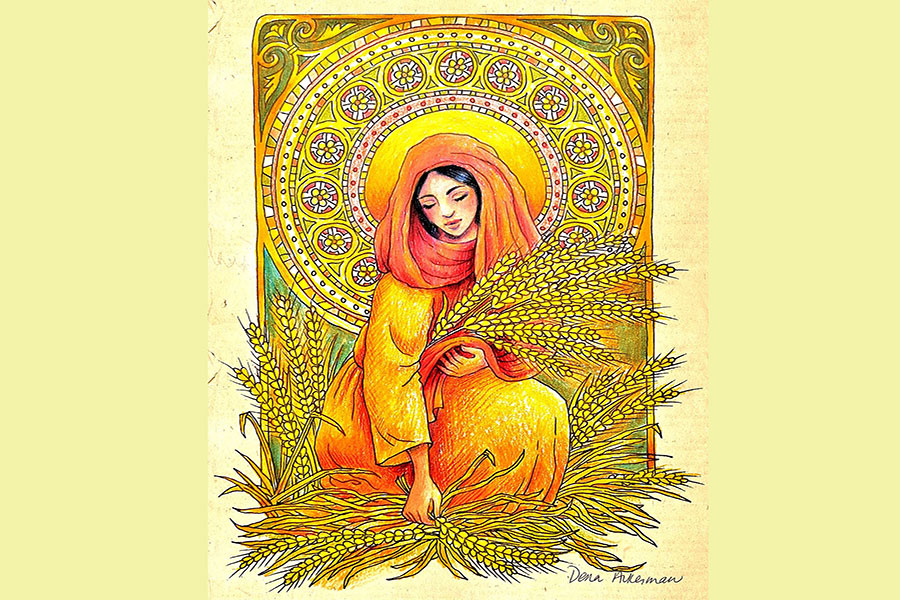
Nowhere is this idea more vividly embodied than in Megillat Ruth. Ruth begins her story with every advantage: a princess of Moab, married into a prominent family. Her life appears predictable, even secure. Then everything collapses. She loses her husband, her status, her future. The floor falls out from beneath her.
At that moment, Ruth faces a choice that defines her legacy. She can cling to what remains of her former identity, or she can step into the unknown. She chooses the latter. Guided not by a clear plan but by an intuition of deeper meaning, she follows Naomi into a foreign land, a foreign people, and a radically uncertain future. She finds the “window on the side.”
Ruth’s story is not just one of resilience; it is a redefinition of identity itself. Identity, in her case, is not something preserved through careful self-protection. It is something discovered through openness – through relationships, risks, and responsiveness to the unexpected.
The Book of Ruth sharpens this lesson through a striking contrast. There is another figure in the story, often overlooked: a closer relative who has the first right to redeem Naomi’s land and marry Ruth. He declines. His reasoning is simple and, on its face, rational: “I cannot redeem it for myself, lest I damage my own inheritance.”
This man – known in the text as Ploni Almoni, essentially “Mr. Anonymous” – is governed by caution. He recognizes the moral and spiritual significance of the opportunity before him, but he cannot act. He fears social consequences, reputational risk, and the disruption of his carefully constructed future. In trying to preserve his identity, he forfeits it entirely. He becomes anonymous – a man remembered only for what he would not do.
Ruth, by contrast, relinquishes control and gains everything. She becomes the ancestor of kings, the progenitor of the Davidic line. Her identity is not diminished by her openness; it is created by it.
This contrast exposes a deeply counterintuitive truth: identity is not secured by control. It is formed through engagement. Ploni Almoni’s fixation on protecting his “inheritance” leads to a kind of existential paralysis. Ruth’s willingness to step into uncertainty allows her to become something far greater than she – or anyone – could have planned.
Modern life pushes us toward the Ploni Almoni model. We are encouraged to define our goals early, optimize our paths, and minimize risk. We build lives around control – career trajectories, financial planning, carefully managed relationships. There is wisdom in planning, of course. But when planning becomes the essence of identity, it can also become a prison.
As one songwriter famously put it, “Life is what happens while you are busy making other plans.” The more rigidly we cling to those plans, the less able we are to respond when life inevitably deviates from them. Opportunities appear that were not on the map. Relationships emerge that do not fit our criteria. Transformations beckon from directions we never considered.
The Midrash’s image of the hei reminds us that this unpredictability is not a flaw in the system. It is the system. The open bottom ensures that we will, at times, fall. The side opening ensures that we can return – but only by discovering a new way in.
That process of rediscovery is where identity is forged. Not in the execution of a prewritten script, but in the creative, often uncomfortable work of responding to what actually happens.
There is, of course, a cost to this openness. It requires letting go of the illusion of control. It demands vulnerability – the willingness to enter relationships and commitments without guarantees. It asks us to replace the language of “What will I gain?” with the more radical question “What is being asked of me now?”
In the language of Jewish tradition, this is the posture of “na’aseh v’nishma” – we will do, and then we will understand. It is a commitment to action and engagement even before the full picture is clear.
Ruth lives by this principle. Ploni Almoni rejects it. Their divergent fates suggest that the stakes are not merely narrative but existential.
In a world that increasingly rewards control and predictability, the lesson of Ruth feels almost subversive. True identity is not something we defend against the world. It is something we discover through it. The path to becoming ourselves may well begin with losing the version of ourselves we thought we had to protect.
The floor may fall out. That is not the end. It may be the beginning – the moment when we are finally forced to look for the window on the side.