 October 16, 2026
 Two-Day Technicalities & ET (the Halachic Kind)


Eruv Tavshilin & Shavuot
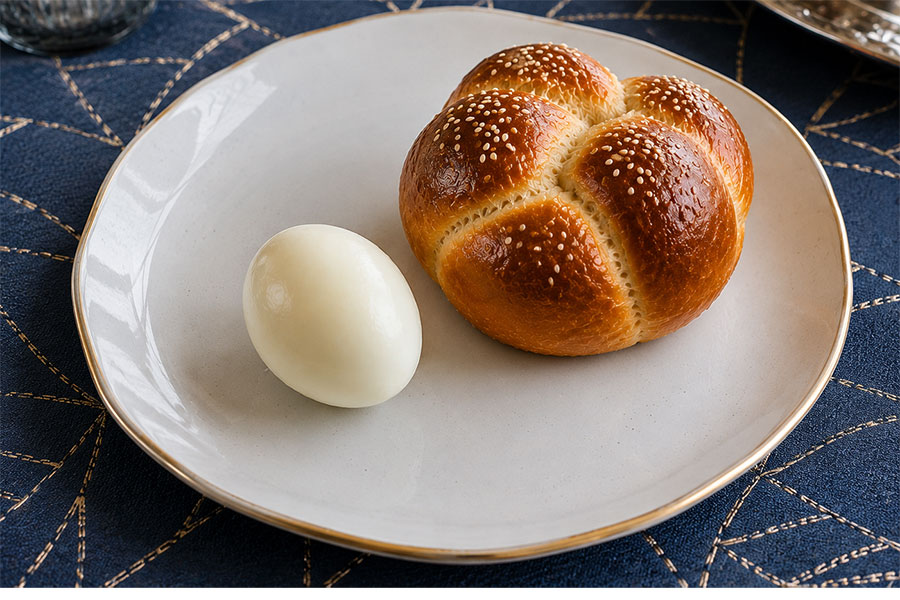
When Yom Tov falls on Friday or Thursday-Friday (or Friday-Shabbat), there is a mitzvah – and practical reason – to make an Eiruv Tavshilin on Erev Yom Tov. This coming Thursday, May 21, is erev Shavuot, and therefore we should make an Eiruv Tavshilin (let’s call it ET).
First, the numbers:
When Rosh Hashanah is Thursday-Friday (32% of years), we make an ET on Wednesday, erev Rosh Hashanah. Outside of Israel, the ET situation comes up again both two and three weeks later – for the first days of Sukkot and for Sh’mini Atzeret and Simchat Torah. That’s three ETs in a four-week period. In Israel, we never have an ET situation for Sukkot or Sh’mini Atzeret.
When the first days of Pesach are Thursday-Friday (28.5%), outside of Israel an ET is made on erev Pesach. In Israel, this situation does not exist. In these year-types, our Friday is Chol HaMoed, and cooking for Shabbat is permitted without the need for an ET.
But Shavuot in these years (including this year, 5786) is Friday-Shabbat outside of Israel and just Friday in Israel, and we all make an ET on Thursday, erev Shavuot.
When the last days of Pesach are Friday-Shabbat – only Friday in Israel (28%) – we all make an ET on Thursday, the last day of Chol HaMoed, Erev Yom Tov Acharon.
* * * * *
Okay, stats aside... What’s the Eiruv Tavshilin story? It’s not as simple as most of us think. Here is one of the two ET stories: The Torah gives us permission to cook food on Yom Tov, but only for Yom Tov day itself. We may not cook on Yom Tov for the next day. Even if the next day is Shabbat? Well, Torah Law does not forbid cooking on Yom Tov for the next day if it is Shabbat; however, our Sages came along and forbade (by Rabbinic decree) cooking on Yom Tov for the next day – even if the next day is Shabbat. But then they instituted a procedure to return to the Torah’s permission to cook on Yom Tov when the following day is Shabbat. That procedure is Eiruv Tavshilin. And it is not just a procedure – it is designated as a mitzva d’Rabbanan, a rabbinic mitzvah, with a b’racha that declares it as one of the mitzvot by which G-d sanctifies us. That’s more significant than a procedure to accomplish a particular goal. A mitzvah. Let that sink in. So, our Sages forbid something that the Torah permits and then permitted it. Why go back and forth on this issue? Why not leave it alone and we would be allowed to cook for Shabbat, just as the Torah permitted in the first place? The answer is a combination of honoring Yom Tov and of honoring Shabbat. The ET is a flag that reminds us that 25.75 is not to be misused and that Shabbat is not to be compromised by our eating of unfresh food. This is one perspective on ET. With an Eiruv, one can cook on 25.75 for Shabbat practically right up to Shabbat candle-lighting. But there is another understanding of the situation of Yom Tov preceding Shabbat. This second school of thought says that the Torah’s restriction on cooking on Yom Tov for the following day applies even if that next day is Shabbat. If this is so, our Sages cannot permit something that the Torah forbids. So what does an ET accomplish? The answer this time is that it allows one to cook in the afternoon of Yom Tov because of the possibility that unexpected guests might show up later in the day and you need to have what to feed them. And if no guests show up, that which you cooked for Yom Tov can be used for Shabbat meals. According to this understanding, one’s cooking should end not so close to Shabbat that there would be no time to feed these hypothetical unexpected guests. According to the first way of looking at ET, one can finish cooking close to 7 p.m. (in Jerusalem, this year), but according to the second opinion, one should finish cooking, let’s say, by about 6 p.m. That’s just a rough guess as to what would take into account the second opinion. There’s more on the subject, but that’s enough for now, in this column. A good rule of thumb is to ask your LOR when in doubt about any halachic detail. I want to illustrate an important point about the whole idea of Eiruv Tavshilin. Many years ago, my cousin’s son was in cheider and he learned about ET that was happening that year three times in the four opening weeks of the year. Approaching Shabbat after the Yom Tovim were over, he asked his father if he could make another ET for Shabbat so he’d be able to color in a coloring book on Shabbat. I guess that was a reasonable question from a six-year-old. The point is that an Eiruv (any of the three kinds) cannot and does not permit something that is forbidden by Torah Law. It redefines a situation so that which was technically forbidden turns out not to be forbidden. An Eiruv Chatzeirot that permits carrying in a specific area does not permit something that is forbidden. It redefines the area from public to private, where carrying was always permitted. Admittedly, the above does not cover all the details and qualifications involved, but hopefully it presents the ideas at issue in a simple to understand way.* * * * *
Being the 50th day following the second day of Pesach will result in Shavuot being one day later in the week than the first day of Pesach. For example, this year, Pesach began on Thursday (Wednesday night was what we call “the Seder” and what Jews outside of Israel call “the first Seder”). With Pesach beginning on Thursday, Shavuot is Friday (or, if you insist, Friday and Shabbat). The days of the week rule for Pesach is LO B’DU. That means that in our current calendar, Pesach cannot begin on Yom Bet (Monday), Yom Dalet (Wednesday), or Yom Vav (Friday). Shavuot, then, is LO G’HaZ – not on Yom Gimel (Tuesday), Yom Hei (Thursday), or Yom Zayin (Shabbat). Machzorim printed for Israel for Shavuot do not have Shabbat texts in parentheses to be said when Yom Tov is on Shabbat – because it doesn’t happen. Outside of Israel, Shavuot can be (and is, this year) Friday and Shabbat, so the parentheses for Shabbat are found in Machzorim for Chutz LaAretz. Two things that are crammed into the one day of Shavuot in Israel are moved to the second day in Chutz LaAretz – namely, the reading of Megillat Ruth and Yizkor. An oleh is sometimes overwhelmed by the double-duty that our one day of Shavuot or our one day of Sh’mini Atzeret-Simchat Torah takes on. Then again, many olim do not miss having to do a Seder two nights in a row. Depends on one’s personality and perspective. Speaking of two days of Yom Tov in Chutz LaAretz vs. the one-day observances as ordained in the Torah in Israel, the origin, as most people are aware, is a doubt as to what exact day a holiday began, if the day of Rosh Chodesh of the specific month was not yet known. Generally speaking, communities in Eretz Yisrael were able to be notified when, for example, Rosh Chodesh Nisan was declared, sometime within two weeks, so the exact date of the first day of Pesach would be known. Hence, one day of Yom Tov. Communities outside Israel generally did not find out within the first two weeks of the month, and so they had to observe two days of Yom Tov because of s’feika d’yoma, a doubt concerning the exact day. Since the current calendar went into effect when the Sanhedrin ceased, there is no longer a doubt as to exactly when to observe Yom Tov, but the Yom Tov Sheini Shel Galuyot, the second day in the Diaspora, remains in effect because Minhag Avoteinu b’yadeinu – the practice of our predecessors is “in our hands” and we do not have the authority to undo the rulings concerning the second day of Yom Tov outside of Israel. A question that follows from the above is whether the rule of two days of Yom Tov remains a function of location (Israel or Chutz LaAretz) or has shifted to be a chiyuv gavra (a personal obligation – incumbent upon a person living in Israel vs. a person living elsewhere). This impacts greatly on those people from abroad who come to Israel for the chagim or students who are here for yeshiva, seminary, or university. Opposing opinions exist concerning this issue, as does the famous “day-and-a-half” middle ground which says that in Israel, a visitor should treat the second day as a weekday (or Chol HaMoed), but should not do any melacha that is forbidden on Yom Tov. No second Seder; havdala after day one and day seven; t’filin on day eight; but no chametz or melacha... and so on. But there is a special question about Shavuot. This day of Yom Tov does not depend upon Rosh Chodesh Sivan or when one would find out about it. Shavuot is the 50th day after the second day of Pesach. Plenty of time back in the days of Sanhedrin for Chutz LaAretz communities to have found out when Rosh Chodesh Nisan was and count from then. Why was there ever a second day of Shavuot? The answer is LO PLUG (read as ploog). Chazal chose not to distinguish one Yom Tov from the others. Shavuot has two days because Pesach has two days at the beginning and at the end and because Sukkot does and Sh’mini Atzeret does. Rosh Hashanah and Yom Kippur need more discussion – but we’ll save that for another time.* * * * *
The highlight of the Torah reading of Shavuot morning (first day) is the account of the Revelation at Sinai, Matan Torah – the Giving of the Torah. We refer to Shavuot repeatedly in davening and Kiddush as Z’man Matan Torateinu. We often speak of receiving the Torah, but that’s not the same thing as giving. Hashem gave us the Torah. It is our sacred task and lifelong challenge to receive the Torah. Let’s look at the Aseret haDibrot, the Ten Commandments, also known as the Decalogue. The Torah refers to the Big Ten as “Aseret HaD’varim.” The English term is misleading because to us, “commandments” is the usual translation of mitzvot, and the Aseret HaDibrot contain 14 mitzvot, not just 10. And there is a 15th mitzvah counted in Parshat Va’etchanan, where the Aseret HaDibrot are repeated – with some textual differences – by Moshe Rabbeinu when he speaks to the “new generation,” poised on the threshold of Eretz Yisrael. The Aseret HaDibrot in Parshat Yitro – which is the Torah reading of Shavuot morning – is 13 p’sukim with 14 mitzvot, containing 172 words and 620 letters. I don’t have a significant comment for 172, but the 620 letters are pointed to as representing 613 + 7, the number of mitzvot in the whole Torah plus the seven Rabbinic mitzvot. Also, the gematria of the word keter (crown of the Torah) is 620. FYI, although there are countless Rabbinic laws, we speak of seven specific rabbinic enactments as mitzvot. They are: Shabbat and Yom Tov candles, Megillat Esther, Chanukah candles, Hallel, Netilat Yadayim, Eiruv (three kinds: T’chum, Chatzeirot, Tavshilin), and B’rachot. As they are considered on the level of mitzvot, they (the first six of them, anyway) carry with them the b’racha “...asher kid’shanu b’mitvotav, v’tzivanu…” Our saying that G-d has sanctified us with His mitzvot, and commanded us in them indicates the elevated status of the Rabbinic mitzvot. When we say the b’racha for eating matzah on the first night of Pesach, saying “...and commanded us on the eating of matzah,” we can point to the pasuk in the Torah that contains the command. Same for dwelling in the sukkah, counting of the Omer, and so on. Every mitzvah from the Torah upon which we say a b’racha has a chapter and verse we can point to. But what about the Rabbinic mitzvot? “V’tzivanu l’hadlik ner…” Where does it say in the Torah that we must light candles for Shabbat, Yom Tov, Chanukah? Where does it say that we must ritually wash our hands each morning and for HaMotzi? The answer is also a chapter and verse. Specifically, D’varim 17:11: “Al pi haTorah…” – According to the law they instruct you and according to the judgment they say to you, you shall do (this is the mitzvat asei to heed the dictates of the Sages); you shall not divert from the word they tell you (this is the accompanying lo taasei), either right or left. In case you noticed that the seventh Rabbinic mitzvah – B’rachot – was not included in the part about the b’racha (ironic, no?), this is because the Sages purposely did not command a b’racha for a b’racha. Imagine if you wanted to eat an apple and before you would say Borei Pri HaEitz, you’d have to say a mitzvah b’racha stating that G-d sanctifies us with His mitzvot and commands us to say a b’racha. Then you’d make a b’racha for that b’racha, and so on. You’d never get to eat the apple! So, even though taking the Four Species on Sukkot gets a b’racha, as does eating matzah at the Seder, as does learning Torah every day... Birkat HaMazon, which is no less a mitzvah than taking challah from dough or putting a mezuzah on your doorpost, doesn’t get a b’racha – because it is part of the mitzvah of B’rachot. A final word (for now) on the above. Do not, dear reader, think that this was all a digression from the Shavuot story of Matan Torah. Do not think that all that was given at Sinai was the Aseret HaDibrot. The Torah makes it clear (at the end of Parshat Mishpatim) that G-d gave us the Aseret HaDibrot and the Torah and the mitzvot – all at Sinai. The Big Ten were the down payment, so to speak. All the rest were given by G-d to Moshe during the 40 days and 40 nights that continued after the Revelation at Sinai. And Moshe Rabbeinu spent the rest of his life teaching Torah to us, the Jewish People. And all the teachers of every generation ever since have been doing the same. Torah is the lifelong project of all Jews in every generation forever.* * * * *
One last topic for this week’s column. When Shavuot is Friday and Shabbat outside of Israel and only Friday in Israel, there is a Yom Tov Torah reading on the second day of Shavuot in Chutz LaAretz, while those of us in Israel will be reading Parshat HaShavua this Shabbat – Naso. We get out of sync for the weekly Torah readings until Chukat and Balak are combined in Chutz LaAretz and read separately in Israel. Are Chukat and Balak combined to allow Chutz LaAretz to catch up, or do we read them separately so we can get back in sync, having jumped the gun for Naso? Sounds like “six of one, half a dozen of the other,” but it isn’t. The system of weekly readings so that the Torah is completed in a one-year cycle originated in Chutz LaAretz. Way back then, there was a different sedra breakdown and reading cycle – more than three years long – in Eretz Yisrael. When the one-year cycle was adopted in Eretz Yisrael, it required a number of tweaks because we don’t have two days of Yom Tov (except for Rosh Hashanah, which is a different story). Turns out that we never read Chukat and Balak together. We separate them when Shavuot is Friday – regardless of whether the year is plain (12 months) or m’uberet (13 months). We also have tweaks for when Pesach begins on a Shabbat, different for one- or two-Adar years. Details in another column. For now, I wish you all a Chag Samei’ach and a Shabbat Shalom.