October 2, 2026
 Categories: Collecting / Features On The Jewish World
The Cultural Judaism of Lise Meitner
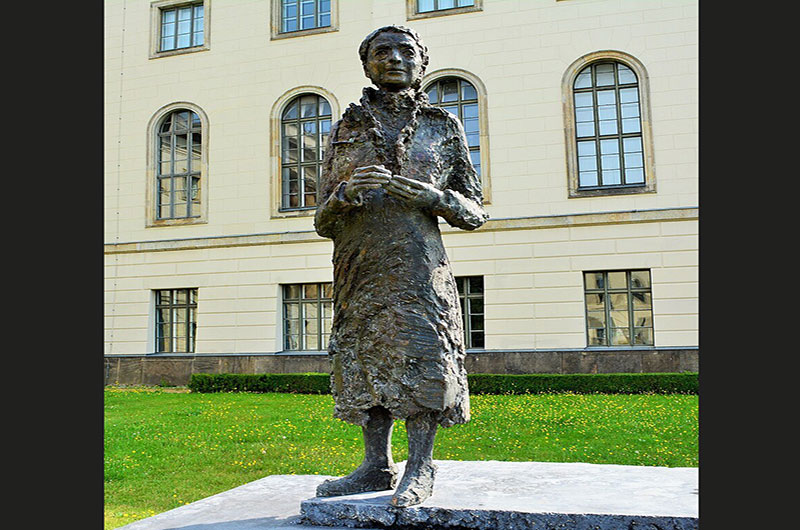


Though the dramatic splitting of the atom – nuclear fission – was a discovery which vastly changed the world, few know that it was Elise (“Lise”) Meitner (1878-1968), a Jewish female physicist, who discovered the power of nuclear energy just after her dramatic escape from Nazi Germany; she was among the last Jewish scientists to escape (1938). The sad irony of her life is that her laboratory partner of thirty years, the non-Jewish Otto Hahn, remained in Berlin throughout the Third Reich and, even after she continued to collaborate with him from outside Germany, he alone was awarded the Nobel Prize for Physics (1944). Hahn continually refused to acknowledge that it was Meitner – whom Einstein called “The Madame Curie of Physics – who had discovered fusion, and this fiction was perpetrated in Germany; even recently, apparatus designed and used by Meitner in her laboratory was displayed in the Deutsches Museum, Munich, as “the worktable of Otto Hahn.”
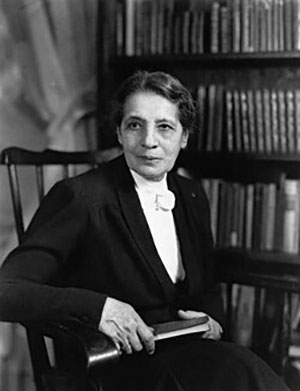
Meitner, one of the most significant physicists of the twentieth century, achieved immortality in the history of science through her role in the discovery of nuclear fission, a finding that altered the trajectory of physics, world politics, and the modern age, as well as her pathbreaking work in radioactivity, nuclear physics, and the theoretical interpretation of experimental data. After being forced to flee Nazi Germany to Stockholm (1938), she expanded on Enrico Fermi's previous attempts to fission uranium, thought until then to be impossible. However, her most significant accomplishment, published in 1939, was the discovery of nuclear fission, and her prediction of the existence of chain reaction – she was the first to apply Einstein’s E=MC2 equation to predict the massive amounts of energy released by nuclear fission – proved critical to the creation of the atomic bomb. Though dubbed by many “the mother of the atomic bomb,” she took no part in the actual process of development; she declined an offer to work on the Manhattan Project; and she expressed grave concerns about its use.

Yet, her story is equally defined by her origins, experiences, and identity as a person born into a Jewish family in Vienna at a time when Jewish emancipation was still culturally fragile and social acceptance insecure. She was nominated nineteen times for the Nobel Prize in Chemistry between 1924-1948, and an additional thirty times for the Nobel Prize in Physics between 1937-1967 without ever winning because, according to most commentators and historians, of antisemitism (with a dash of sexism added). Scientific American reports that Meitner herself believed antisemitism contributed to her being passed over. She did, however, receive some measure of formal recognition for her contributions to physics when she was awarded the United States Enrico Fermi Prize (1966) ... and when element 109 was posthumously named “meitnerium.”
Meitner was descended from a long line of pious Orthodox Jews. Her great-grandfather was renowned for creeping through the town after dark every Friday night and “anonymously” laying a loaf of challah at the door of every poor Jew. Sadly, though the Meitner children were all registered with the Jewish community at birth, many were baptized as adults, Lola and Gisela as Catholics (1908) and Lise as a Protestant (Lutheran) (1909). Though she converted to Protestantism as a young woman and lived her adult life outside organized Judaism, she was nonetheless indelibly shaped by the world’s reaction to her Jewishness, as she was rejected, displaced, and denied opportunities because of her birth, even as she persisted in her work and rose to prominence through extraordinary intellectual force and quiet personal integrity. Her life intersects in important ways with the broader history of European Jews in the era of Nazism, a period when the line between religious and racial identity was forcibly redrawn, when the self-definition of assimilated Jews collided with the state’s redefinition of them, and when individuals like Meitner discovered that conversion would not shield them from the consequences of being designated Jews by those in power.
Born in Vienna the third of eight children of Philipp and Hedwig Meitner, Lise’s father, a successful lawyer, came from a family that had experienced the slow upward mobility characteristic of many Central European Jewish families following the formal emancipation of the mid-nineteenth century. Philipp’s parents and grandparents had lived under legal restrictions earlier in their lives, but by his adulthood, Jews in Vienna could enter the legal profession, and he became one of the first Jewish lawyers in the city permitted to practice without special exemptions. The Meitners were a thoroughly assimilated family, part of Vienna’s growing Jewish middle class, which valued education, refinement, and civic participation, and they raised their children in an atmosphere that encouraged intellectual curiosity, cultural attainment, and social integration within the broader Viennese bourgeoisie.
Thus, although the family was ethnically and genealogically Jewish and recognized as such by the state, the home was largely secular, and there is no evidence that Hebrew, Jewish liturgy, or religious observance played any significant role in the Meitner household. Biographers consistently note that while the family was proud of its heritage in a broad, cultural sense, they did not regularly attend synagogue, did not observe traditional Jewish dietary laws, and did not structure their home life around Sabbath observance; this was far from unusual among Viennese Jews of the era, many of whom embraced German-speaking culture and saw themselves as part of a modern, cosmopolitan world rather than a traditional Jewish one. Meitner’s early childhood contained few markers of Jewish religious life, and when she later spoke or wrote about her origins, she portrayed her upbringing as culturally Jewish but not religiously defined. Thus, while she was “Jewish by birth,” she did not grow up in a household that emphasized ritual identity, and she would not later rely on religious memories or practices in shaping her adult life.
Nevertheless, Vienna’s social environment ensured that her Jewishness would never be wholly invisible. Late nineteenth-century Viennese society was rife with antisemitism from both political movements and social elites; for example, Karl Lueger, the mayor of Vienna and a central figure in modern antisemitism, came to power during her adolescence and helped normalize exclusionary attitudes. Growing up in such an environment meant that Meitner learned early, even if she did not articulate it, that Jewish birth could provoke prejudice, and, though her school records do not preserve specific instances of antisemitic incidents, her later reflections suggest that she was aware of being seen as different and that this contributed to her quest for intellectual achievement and stability outside the volatile currents of politics.
Her formal education began at a time when women in Vienna were barred from attending the university, with Jewish girls facing the same restrictions as others. Meitner pursued private study to prepare for the Matura examination, which she passed in 1901 at age twenty-two, enabling her to enroll at the University of Vienna. That she was among the first women allowed to attend courses in physics is remarkable in itself; that she was also a Jewess added an additional layer of difficulty, given departmental prejudices. Yet, she flourished academically, especially under the mentorship of Ludwig Boltzmann, whose encouragement, respect, and theoretical clarity and intellectual honesty profoundly shaped her scientific outlook.
At the same time, it was during this early period that Meitner, soon after being awarded her doctorate, converted to Protestantism in 1908, a conversion that was sadly not unusual among assimilated Viennese Jews pursuing academic careers. As with many such academically accomplished Jews at the time, her motives were complex and likely a combination of private inclination, cultural assimilation, and pragmatic adaptation to the environment of European universities, where Jewish identity could be an obstacle to advancement. Scholars of Meitner’s life emphasize that there is no evidence of spiritual yearning or theological investment in the conversion; rather, it appears to have been an earnest, but culturally oriented, step toward full integration into the German-speaking academic world. When she reflected later in life on the conversion, she did not disavow it, but neither did she describe it as spiritually transformative. What became clear only decades later, and with tragic irony, was that the conversion would offer no protection once racial antisemitism overtook Europe.
In 1907, Meitner moved to Berlin, where she would perform her most significant scientific work after she began collaborating with the chemist Otto Hahn, forming one of the most important partnerships in twentieth-century science. From the beginning, she faced institutional barriers that were heightened by her gender, though not officially by her Jewish origin at that early date, as Berlin’s universities did not yet permit women to serve as paid staff, let alone physicians or professors. She initially worked without pay in a basement workshop of the Chemical Institute and had to enter the building each day through a back door because women were still barred from the main entrance. Her collaboration with Hahn, however, proved productive, and the two eventually developed a well-functioning research partnership that lasted nearly three decades.
Though Meitner’s Jewish origins did not initially impede her Berlin career, the rise of Nazism changed everything. With the Nazi ascension in 1933, Jewish academics were systematically removed from their positions, but Meitner was initially protected because of her Austrian citizenship and the somewhat ambiguous position she held at the Kaiser Wilhelm Institute, which allowed her to continue her research temporarily even as German Jews were expelled from universities and scientific institutions. During these years, she witnessed the transformation of Berlin’s scientific community and understood that her own position was precarious; her colleagues were forced into exile or silenced; Jewish students disappeared; and Jewish professors were fired and publicly degraded. Meitner wrote in letters that she felt horrified by what she observed and, though she was not politically outspoken, she made no secret in her private correspondence that she found the regime morally repugnant.
By 1938, after the Anschluss united Austria with Nazi Germany, Meitner lost her Austrian citizenship and became a racial Jew under Nazi law with no rights or protections; not surprisingly, as we know, her Protestant conversion was irrelevant under the Nuremberg racial laws. Now in immediate danger, her escape from Berlin in July 1938 was a narrow one: German border guards initially refused to allow her to leave, and she was saved only by the intervention of Dutch physicists who had arranged a clandestine rescue and she was lucky to escape with only a small suitcase, forcibly abandoning a career of thirty years. She rarely discussed her own suffering, but her later remarks about this period reveal a quiet grief at the realization that she had been rejected “not for what I had done, but for what I was born.”
Her escape brought her first to The Netherlands, then to Sweden, where she took a position at the Nobel Institute for Physics in Stockholm. The transition was difficult, and she often felt isolated and overlooked as, notwithstanding her reputation, she did not receive laboratory space or research assistance commensurate with her abilities, part of a broader pattern in which exiled Jewish scientists struggled to reestablish their careers in new and unfamiliar environments.
Throughout her years in Sweden, Meitner continued to reflect on her Jewish origins, though, again, not in religious terms. She remained a Protestant in formal affiliation, and her correspondence makes clear that she felt herself culturally outside Judaism, while also recognizing that the world treated her as Jewish regardless of her self-definition. The Nazis had placed her in the category of Jews to be persecuted; this fact alone forced her to reconsider the meaning of Jewishness in a world where religious choice had no bearing on racial categorization. In later life, she spoke with compassion and indignation about the suffering of European Jews and remained deeply connected to the tragedy of the Holocaust, though she never spoke of renewing Jewish religious identity in response.

Meitner’s scientific work during the late 1930s was momentous. In December 1938, after receiving experimental data from Hahn and Strassmann that they could not interpret, she (and her nephew, Otto Frisch) produced the theoretical explanation for nuclear fission. It was Meitner, drawing on her knowledge of nuclear physics, who recognized that the uranium nucleus had split into smaller parts, releasing enormous amounts of energy, and she and Frisch published their interpretation in early 1939, coining the term “fission.” The discovery would later be central to the development of nuclear weapons, though Meitner refused to participate in weapons research and declined all invitations to join the Manhattan Project and she condemned the atomic bombing of Hiroshima and Nagasaki, arguing that the scientific community must take responsibility for the ethical implications of its discoveries. Her moral stance, particularly significant for someone whom the Nazis had driven into exile and surely would have murdered, was widely admired after the war.
Antisemitism continued to shape Meitner’s life even after she escaped. She remained deeply distressed by the persecution of German and Austrian Jews and by the murder of several members of her (mostly extended) family who perished in concentration camps, including her brother Walter, who was deported to Theresienstadt and died there in 1942. These losses left a permanent mark on her, and while she did not express her grief in explicitly Jewish religious terms, she understood these events as part of the fate of her people, defined now not by her own religious choices but by historical forces beyond her control. In private correspondence she sometimes referred to “our tragic people” or “our Jewish fate,” demonstrating an emotional identification with the Jewish victims of Nazism.
The extent to which Meitner experienced antisemitism outside Nazi Germany is also a sad part of her story. During her early years in Berlin and Vienna, she faced mostly gender-based discrimination rather than overt antisemitism in professional contexts, though it existed in broader society. But in Sweden she encountered subtler forms of prejudice: she was sometimes treated as an outsider, and a few Swedish physicists privately expressed doubts about employing a “non-Aryan” foreigner, though this did not become official policy. More broadly, many historians argue that Meitner’s failure to receive her rightful share of the Nobel Prize for the discovery of fission was influenced in part by antisemitism and in part by sexism. The Nobel Committee, dominated by Swedish scientists who were protective of Hahn and uninterested in recognizing an exiled Jewish woman, failed to credit her contributions, and the result was one of the most widely criticized omissions in the history of the prize.
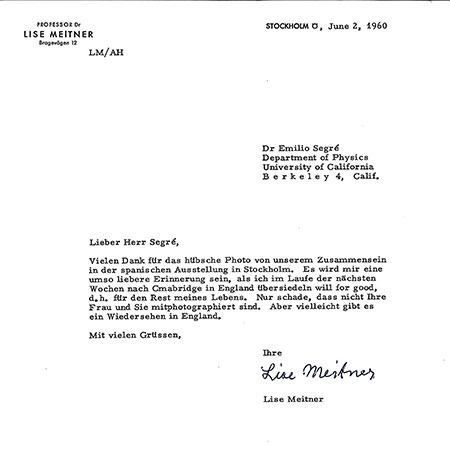
In the June 2, 1960 correspondence in German exhibited here, Meitner poignantly looks past her own nineteen nominations for the Nobel Prize in Chemistry and thirty times for the Nobel Prize in Physics – none of which she ever won – to congratulate Jewish Italian-American physicist Emilio Segrè, who had just been awarded the Nobel Prize in Physics (along with Owen Chamberlain) in 1959 in recognition of their collaborative discovery of antiprotons, a subatomic antiparticle.
Dear Mr. SegrèMany thanks for the pretty photo of our encounter at the Spanish exhibit in Stockholm. It will be a treasured remembrance for me, especially since I will be moving for good to Cambridge in England in the course of the coming weeks, i.e., for the rest of my life. It is regrettable that your wife and you are not part of the photograph. But perhaps we will meet again in England.
With warmest regards
Segrè (1905-1989) was a physicist and radiochemist who discovered technetium, astatine and the antiproton, the latter for which he was awarded the 1959 Nobel Prize in Physics together with Owen Chamberlain. Born into a prosperous Italian Jewish family (parents Giuseppe Segrè and Amelia Treves), he married Elfriede Spiro, a German Jew who had emigrated to Italy, at the Great Synagogue of Rome; contemporary biographies and Segrè’s own autobiographical material recount the wedding and the couple’s decision to keep the ceremony modest and to redirect funds to Jewish refugees. In general, however, sources describing his Jewish identity do so in social, cultural and family terms rather than by describing religious practice.
A remembrance by A. Pais in Physics Today summarizing Segrè’s life states that in his youth, Zionism “became his bond to his Jewish tradition,” though there is no evidence that he ever pursued Zionism or political activism, for that matter. Nonetheless, archive inventories for his papers and related collections document travel and correspondence connected to Israeli institutions in the late 1950s; his correspondence archives include material linking him with the Hebrew University, the Technion, and the Weizmann Institute; and they list a visit to Israel in 1958.
The Mussolini regime’s 1938 racial laws directly affected Italian Jews in academic posts, and Segrè was serving as a professor/director in Palermo when the Fascist racial laws were enacted. While he was visiting Berkeley in the summer of 1938, he learned he had been dismissed in Italy under the racial laws, and he remained in the United States, which saved his life – but, sadly, not the life of his mother, who was captured by the Nazis and was murdered in the Holocaust.
Segrè’s archival holdings and his correspondence inventories include material from and about Meitner. These institutional records make clear that the two outstanding scientists had friendly professional contact and exchanged letters and photographs.
Unlike some Jewish émigré scientists of the time, Meitner did not become involved in Zionist circles and is not known to have expressed sympathy for Zionism as a political movement. Her letters, diaries, and interviews contain no references to visits to Eretz Yisrael or later Israel, nor is there any record of her expressing opinions about Zionism or involvement with Jewish settlement efforts. Rather, her Holocaust-era writings focus on the moral catastrophe of Nazism rather than national or political solutions for Jews and, while she felt pain over the suffering of Jews in Europe, she did not frame that suffering in terms of Jewish nationhood or homeland, remaining consistent with the highly assimilated identity of her youth.
During the war and in its aftermath, Meitner corresponded with a number of Jewish organizations, mostly in connection with their efforts to trace missing persons or understand the fates of scientific colleagues. She provided information when she could about those she had known in Berlin, including Jewish scientists who had disappeared, but these interactions were not expressions of communal membership but rather acts of humanitarian concern.
In 1945 she visited the United States, where she was received warmly by the scientific community, and she used the visit to speak about the dangers of nuclear weapons and the moral responsibilities of scientists. She was praised by American Jewish scientists, including some who had worked on the Manhattan Project, and they often referred to her Jewish origin when honoring her. Some Jewish organizations invited her to events because they viewed her as a symbol of Jewish achievement and resilience, and her presence was noted in Jewish newspapers, which highlighted the irony that a Jewish woman scientist, expelled by the Nazis, had played a central role in the scientific discovery that had ended the war. Meitner did not object to being honored as a Jewish scientist, though she never framed her own identity in those terms.
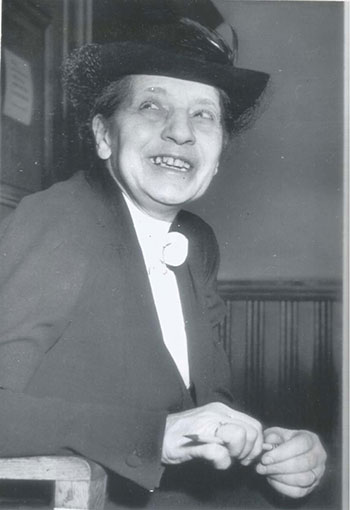
After the war, Meitner moved to Cambridge, England, where she spent the last decades of her life and remained active as a lecturer and mentor, especially encouraging young women to pursue careers in science. During the 1946 spring term, she served as a Visiting Professor of Physics at Catholic University as part of her extended U.S. lecture tour following her first arrival in the United States in January 1946. She taught a short course/seminar series on nuclear physics and gave several public and departmental lectures, including at Harvard, Princeton, Johns Hopkins, Columbia.
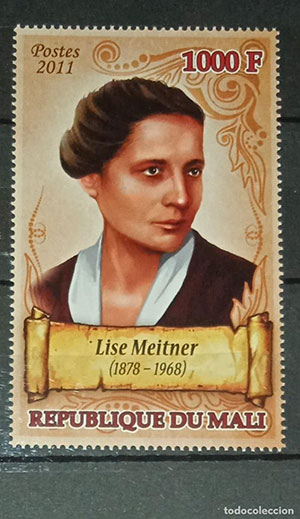
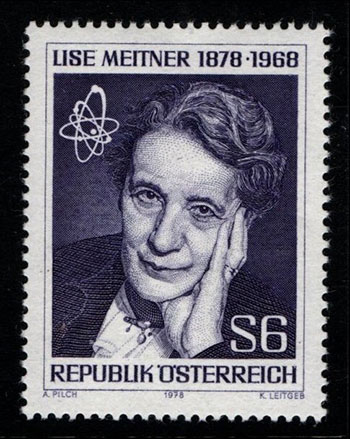
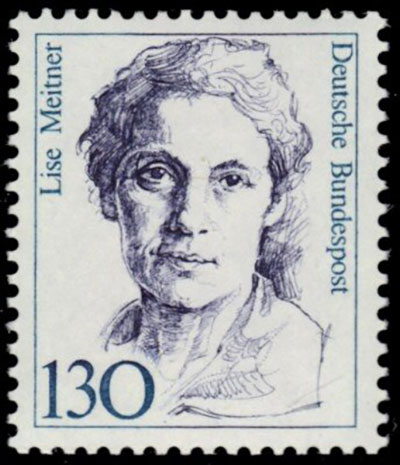
After her death in Cambridge, she was laid to rest in a Protestant cemetery, St. James Parish Church in Bramley, Hampshire, consistent with the religious identity she had maintained since her conversion in 1908. Her nephew Otto Frisch chose the epitaph for her tombstone: “A physicist who never lost her humanity,” an inscription that honored her scientific and moral integrity rather than religious affiliation, but Jewish newspapers and organizations marked her death with considerable respect, noting her Vienna Jewish origins and framing her as one of the great Jewish scientists of the modern age. In the United States, several Jewish newspapers labeled her “the Jewish scientist who unlocked the atom,” emphasizing the tragedy that Hahn had received the Nobel Prize while she, the Jewish collaborator, had been overlooked. In Europe, particularly in Austria, Jewish cultural institutions acknowledged her as part of the lost world of Viennese Jewry, and Israel’s scientific community also paid tribute.