 October 16, 2026
 Categories: Headline / Book Reviews / Arts
The Five Megillot Beyond Easy Answers
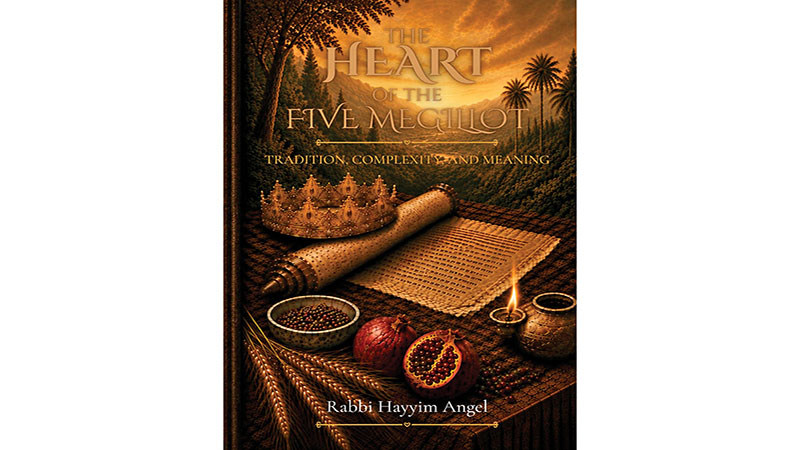


Title: The Heart of the Five Megillot: Tradition, Complexity, and Meaning
By: Rabbi Hayyim Angel
(158 pages)
The Five Megillot are read annually. One could easily mistake these books for being germane only to the time of year in which they are read. In The Heart of the Five Megillot: Tradition, Complexity, and Meaning, Rabbi Hayyim Angel quickly puts that erroneous notion to rest.
The Five Megillot – Song of Songs, Ruth, Lamentations, Ecclesiastes, and Esther – are among the more challenging books of Tanach. Rabbi Angel demonstrates that they are not merely timeless literary and religious classics, but texts that continue to speak powerfully throughout the year. Their themes – love, loyalty, identity, suffering, mortality, meaning, evil, and Divine Providence – are as relevant today as they were when these works were first composed.
Although many of the essays in this volume have appeared previously, readers encountering them for the first time will find Angel to be a writer of considerable depth, sophistication, and clarity. More importantly, he does not treat these Biblical books simply as repositories of inspirational lessons. He takes their literary and theological complexity seriously. That is one of the book’s greatest strengths – rather than forcing difficult passages into convenient answers, Angel allows the texts to challenge the reader.
Song of Songs provides perhaps the clearest example. On its surface, it is intensely sensual love poetry. Yet Rabbi Akiva famously described it as “Holy of Holies,” recognizing a profound theological dimension beneath its apparent surface meaning. Angel explores the longstanding difficulty of determining how the book should be understood. Is it literal love poetry? Figurative language? An allegory of the relationship between G-d and Israel? Rather than dismissing the tension, Angel uses it as an opportunity to explore the text’s remarkable interpretive richness.
Ruth presents a different set of challenges. Angel examines its stories of loyalty, kindness, identity, conversion, acceptance, and belonging, showing how much lies beneath its deceptively simple narrative. His literary approach draws attention to word choice, repetition, characterization, and narrative structure, revealing layers of meaning that can easily be overlooked on a straightforward reading.
He applies the same approach to the remaining three Megillot. In Lamentations, he confronts the agonizing question of how to relate to a G-d who has seemingly abandoned His people. Ecclesiastes wrestles with some of the most fundamental questions of human existence: What is the meaning of life? What ultimately remains after the pursuit of wealth, achievement, and physical pleasure? And in Esther, Angel examines a book in which G-d is never explicitly mentioned, yet Divine Providence can be discerned even when He appears to be absent.
Perhaps the most remarkable aspect of the book is Angel’s ability to bring together two approaches that are sometimes portrayed as incompatible: traditional Jewish interpretation and modern literary scholarship. Rather than viewing them as competing methodologies, he demonstrates how they can complement one another and produce a deeper understanding of the Biblical text. The result is an approach that allows readers to benefit from contemporary scholarship without sacrificing traditional Jewish perspectives or religious integrity.
The word “Complexity” in the subtitle is particularly appropriate. One of the dangers of religious commentary is the temptation to make Biblical texts seem simpler than they really are. A difficult passage becomes a straightforward moral lesson; an ambiguity becomes a certainty; a profound theological problem becomes little more than a sermon. Angel generally resists these temptations.
Indeed, one of the book’s most important insights is that ambiguity is not necessarily a flaw in a Biblical text. Sometimes ambiguity is precisely what gives a work its enduring power. Esther’s hidden G-d, Ecclesiastes’ apparent pessimism, Lamentations’ confrontation with suffering, Ruth’s complicated questions of identity and belonging, and Song of Songs’ blending of human and Divine love all become richer when we allow the texts to remain complicated rather than insisting on easy resolutions.
This leads to what is perhaps the most important lesson of the book: The purpose of studying Tanach is not always to eliminate questions. Sometimes it is to learn how to ask better questions. That is an especially valuable lesson in an age in which complex religious and literary texts are often reduced to easily digestible messages.
Despite Angel’s considerable scholarly expertise, the essays are accessible to readers who are not specialists in academic Bible scholarship. He succeeds in maintaining intellectual rigor without making the material unnecessarily difficult or inaccessible.
The Heart of the Five Megillot is ultimately a reminder that these five books deserve to be read not merely as holiday texts or sources of familiar religious lessons, but as works of extraordinary literary, intellectual, and theological sophistication. Rabbi Hayyim Angel brings that complexity back into focus. The result is a thoughtful and illuminating collection that encourages readers not only to understand the Five Megillot more deeply, but to appreciate why these ancient texts continue to speak so powerfully to modern readers.