 November 6, 2026
Categories: Collecting / Arts
The Good Brother Who Wouldn’t Let Injustice Prevail: Mathieu Dreyfus and the Afterlife of a Scandal
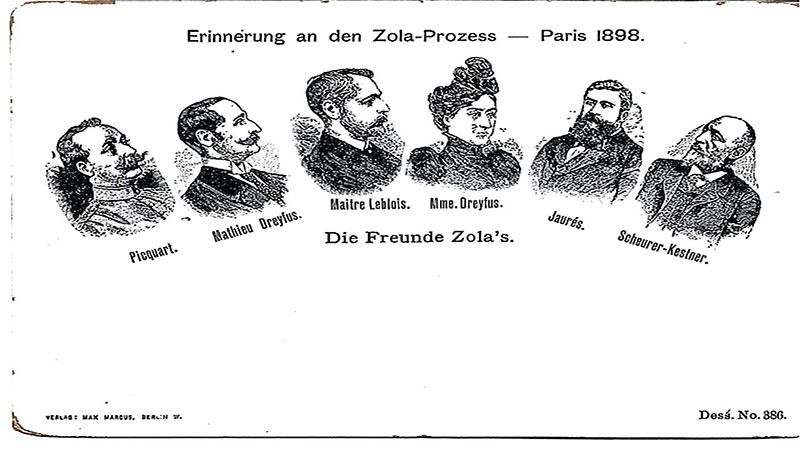


The Dreyfus Affair began in 1894 as a seemingly narrow military case that rapidly expanded into one of the most explosive political and moral crises of modern France. At its center was Alfred Dreyfus, a young Jewish captain in the French Army’s General Staff who was arrested on suspicion of passing military secrets to Germany. Although the evidence against him was fraudulently built around a handwritten document that he did not write (the so-called “bordereau”), he was convicted of treason in a closed military trial marked by secrecy and manifest procedural irregularities, publicly stripped of his rank in a humiliating ceremony in Paris, and deported to live under inhuman conditions at Devil’s Island in French Guiana.
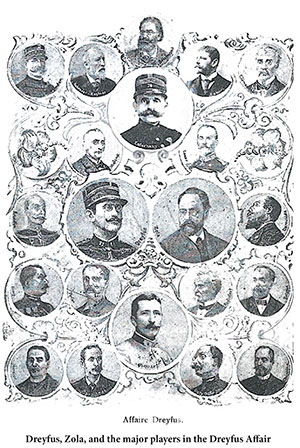
The “official” version of events held for several years, but doubts began to emerge within sections of the military itself, most importantly through the work of Lieutenant Colonel Georges Picquart, who discovered evidence that another officer, Major Ferdinand Walsin Esterhazy, was in fact the likely author of the incriminating document. Instead of correcting the error, however, the French military establishment moved to protect its earlier judgment, transferring Picquart and attempting to suppress the emerging evidence. But this reprehensible decision only deepened the crisis, transforming what might otherwise have been a quiet judicial correction into a national confrontation over truth, authority, institutional integrity . . . and antisemitism.
By the late 1890s, the Affair had moved far beyond the courtroom. Intellectuals, journalists, politicians, and ordinary citizens split into opposing camps – Dreyfusards and anti-Dreyfusards – divided not only over the question of one man’s guilt or innocence, but over the nature of the French Republic itself: whether the army was beyond public scrutiny, whether judicial error could be acknowledged without undermining national honor, and what place Jews occupied within the republic. The publication of Émile Zola’s legendary open letter, J’Accuse!, in 1898 marked the turning point in public consciousness, forcing the Affair into full national and international visibility and accelerating the political crisis.
Even after Esterhazy’s exposure, Zola’s prosecution, and the eventual retrial of Dreyfus at Rennes in 1899, resolution of the Affair remained partial and unstable. Dreyfus was again convicted, but he was immediately granted a pardon, a compromise that satisfied neither side and left fundamental questions unresolved. Full legal exoneration would only come in 1906, long after the most dramatic phase of the struggle had passed but, in the meantime, France was left to grapple with the consequences: damaged institutions, intensified political polarization, and a profound reckoning with antisemitism, nationalism, and the limits of republican justice.
It is within this turbulent and prolonged aftermath, when documents were still circulating, reputations were still being contested, and the meaning of the Affair was still actively being written, that Alfred’s younger brother, Mathieu, continued to operate. His work proved seminal not only to the moment of crisis itself, but to the extended struggle over evidence, memory, and narrative that followed it.
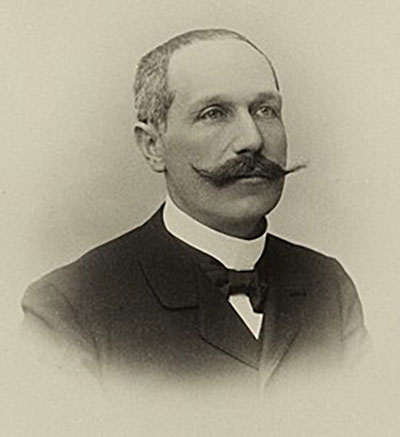
Mathieu Dreyfus (1857-1930) was born into a comfortable, well-established Jewish family in mid-19th-century Alsace, a region whose shifting national identity between France and Germany would shadow the family’s sense of belonging long before the political storm that would make the Dreyfus name synonymous with one of the most consequential miscarriages of justice in modern European history. He was born in Mulhouse, in the Haut-Rhin region of Alsace, into the same bourgeois milieu that produced his younger brother Alfred, and their parents, Raphaël and Jeannette Dreyfus, belonged to that generation of Alsatian Jews who had benefited from the civic emancipation granted under the French Revolution and Napoleon and who therefore tended to be culturally French, economically integrated, and religiously moderate or assimilated. In such families, Judaism often functioned less as a strictly observed religious system and more as a heritage identity layered into a strong sense of Frenchness, civic loyalty, and professional ambition.

Mathieu’s schooling was interrupted by the Franco-Prussian War of 1870, a stinging French defeat which led to the loss of Alsace to Germany. His father, the director of a cotton factory, chose to retain French nationality and moved the Dreyfus family to Paris, where Mathieu continued his studies. At age 18, he joined the 9th regiment of Hussars at Belfort, but, unlike his older brother Alfred, who devoted his life to the military, he followed the family tradition of working in the cotton business in Mulhouse, later becoming its director in 1885.
In May 1889, he married Suzanne Marguerite Schwob, the Jewish daughter of a wealthy family of textile manufacturers. The Schwobs belonged to the same social milieu as the Dreyfus family, highly educated, patriotic French Jews who had largely embraced French culture while retaining a Jewish identity, and the family continued to be publicly identified as Jewish well into the twentieth century. During the Nazi era, members of the family were persecuted because they were Jews, and Jacques Schwob d'Héricourt, Suzanne’s brother, was deported to Auschwitz and murdered there in 1943.
Mathieu established himself in the world of commerce and industry, becoming involved in the textile dyeing industry, a major sector in Alsace and later in Parisian industrial circles. Like many bourgeois Jewish professionals of his generation, he moved between regional business networks and the expanding industrial economy of the French capital. By the 1880s and early 1890s, he was well established in Paris, where he maintained both professional standing and the kind of social connections that would later prove crucial when his family became engulfed in one of the great crisis of the era.
Mathieu’s role in what became known as the Dreyfus Affair began not as a public campaigner but as a devoted brother trying to understand an inexplicable catastrophe. Like many members of the immediate family, he initially struggled to believe that the French military justice system could have committed such an error. Although the army’s authority in the 1890s was immense and its judgments were rarely questioned by civilians, Mathieu quickly began to sense inconsistencies in the case, particularly with respect to the secrecy surrounding the evidence and the refusal of French authorities to permit proper legal review.
In October 1894, Mathieu received a telegram from Lucie, Alfred's wife, asking him to come to Paris and, upon his arrival on November 1, he was shocked to learn that his brother had been arrested for treason. Certain that a mistake had been made, he arranged a meeting with Armand du Paty de Clam, one of the great villains of the Dreyfus Affair and the commandant who had arrested Alfred, who assured Mathieu that the charges against Alfred were overwhelming and that he would soon confess. Mathieu retained lawyer Edgar Demange to represent his brother; tried to meet with Colonel Jean Sandherr, the head of the intelligence service, who hid behind “military secrecy;” contacted the pro-Dreyfus journalist and member of parliament Joseph Reinach; and, while knowing that it was a lost cause, requested President Jean Casimir-Perier to order that the trial not take place in camera (but privately, outside the presence of the public).

Mathieu followed all possible leads to get help, even going so far to seek out a clairvoyant. He saw himself as threatened with arrest as an accomplice; indeed, Paty de Clam suspected him of having written the bordereau.
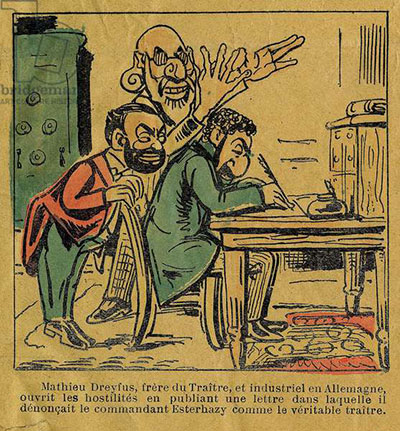
By this point, Mathieu understood that he had to lead a real campaign and take daily action to establish the truth of the case. In February 1895, just after Alfred’s deportation, Mathieu met the Jewish anarchist journalist Bernard Lazare, who had just published Antisemitism, its History and Causes, and gave him all the documents necessary to compose the first exposé dedicated to the Affair, which inspired Zola to write J’Accuse! Lazare’s exposé, although far less known than J’Accuse!, compiled and published A Miscarriage of Justice: The Truth about the Dreyfus Affair (November 1896), a pamphlet in which he thoroughly dismantled the case against Dreyfus point by point and demanded a review of the case, but the pamphlet proved to be of little consequence.
For Mathieu’s efforts, Joseph Reinach described him as the "admirable brother;" Zola as the "heroic brother;" and Clemenceau as the "noble Mathieu." What distinguished Mathieu from many others in the early stages of the Affair was not only his emotional loyalty but also his intellectual persistence, as he refused to accept the finality of the conviction and began a methodical effort to reconstruct the case, including approaching individuals with access to military information, seeking out sympathetic political figures, and attempting to get to the bottom of the bordereau. At a time when official channels were closed, he became one of the earliest actors to suspect that Alfred had been framed.
His investigation brought him into contact with a network of figures who would later become central to the revisionist movement, among them Picquart, whose discovery of evidence pointing to Esterhazy would ultimately transform the Affair. He also sought assistance from political allies, including Senator Auguste Scheurer-Kestner, whose growing doubts about the conviction helped to legitimize the idea that judicial error had occurred. Mathieu’s persistence was instrumental in ensuring that these doubts did not remain private hesitations but developed into public controversy.
One of Mathieu’s most significant contributions was his identification of Esterhazy as the likely author of the bordereau. This was not a simple matter of intuition; it involved the careful comparison of handwriting samples and the cultivation of informants within military and intelligence circles. Mathieu gathered documents, arranged for expert comparisons, and persistently pressed for scrutiny of Esterhazy’s conduct and, while later historical scholarship emphasizes the role of Picquart in officially uncovering Esterhazy’s involvement, Mathieu’s earlier efforts helped create the conditions in which such revelations became unavoidable.
In addition to investigative work, Mathieu played a crucial logistical and financial role in sustaining his brother’s defense. The legal team that would later include prominent figures such as Edgar Demange and Fernand Labori required coordination, funding, and constant communication with the family, and Mathieu acted as a central organizer within this informal structure, ensuring that information flowed between lawyers, journalists, and political allies. In an era before modern media systems, such coordination depended heavily on personal initiative, and Mathieu became perhaps the singular indispensable node in the Dreyfus family network.
Mathieu was deeply involved in the environment that made possible the publication of Zola’s J’Accuse in January 1898, which marked a seminal turning point in the Affair, transforming it from a legal controversy into a national political crisis. He had maintained contact with journalists and intellectuals sympathetic to the Dreyfus cause, including figures around Georges Clemenceau and the newspaper L’Aurore, which published Zola’s letter. His relationship with Zola was characterized by mutual respect grounded in shared conviction rather than close personal friendship; Zola became, in effect, the moral voice of the Dreyfusard movement, while Mathieu remained its practical organizer.
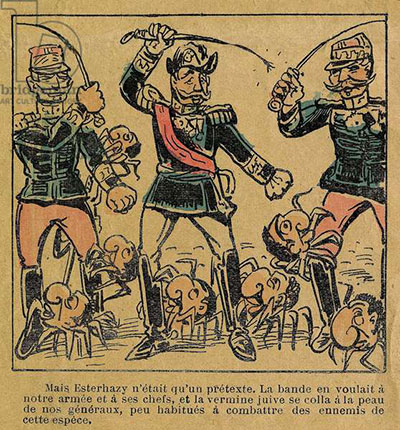
With the Affair deeply polarizing French society, Mathieu, as a visible leader of the Dreyfus family, inevitably became a target of extreme antisemitic hostility much like his brother. Newspapers aligned with anti-Dreyfusard factions often portrayed him and the family as part of a wider conspiracy, drawing on long-standing antisemitic tropes about Jewish loyalty and influence, and Mathieu was also subjected to public vilification in certain press outlets. His experience reinforced the truth of the proposition that the case was not merely about one officer’s guilt or innocence, but about the position of Jews within the French nation-state. Despite this hostility, Mathieu never retreated in the least from public life or from the defense of his brother.
In contrast, the broader Jewish establishment in France tended to adopt a restrained public posture during much of the Affair, prioritizing civic integration and avoiding overt political confrontation, and Mathieu himself operated primarily within secular legal, journalistic, and political networks rather than rabbinic ones. This reflects a broader characteristic of the Dreyfus family’s Jewish identity; the Dreyfuses were not a religiously observant family in the traditional sense and, like many Alsatian Jewish bourgeois families of the 19th century, they were culturally Jewish but largely secular in practice.

After Alfred’s eventual retrial in 1899 and partial pardon by President Émile Loubet, followed by full exoneration in 1906, the brothers were reunited in a France that had been profoundly altered by the crisis. The post-Affair relationship between the brothers was, by most accounts, one of mutual respect and shared trauma; Alfred returned to military service, though at a reduced rank and with lingering stigma that only gradually dissipated, and Mathieu returned to his business activities. However, the Affair had permanently altered his public identity; having become one of the central figures in a national struggle over justice, identity, and republican legitimacy, he was no longer seen as merely an industrialist.
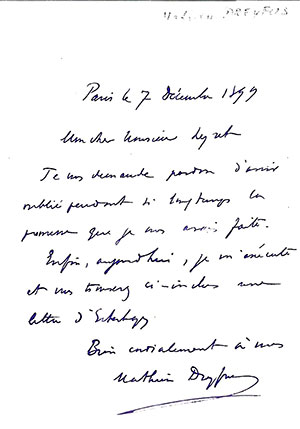
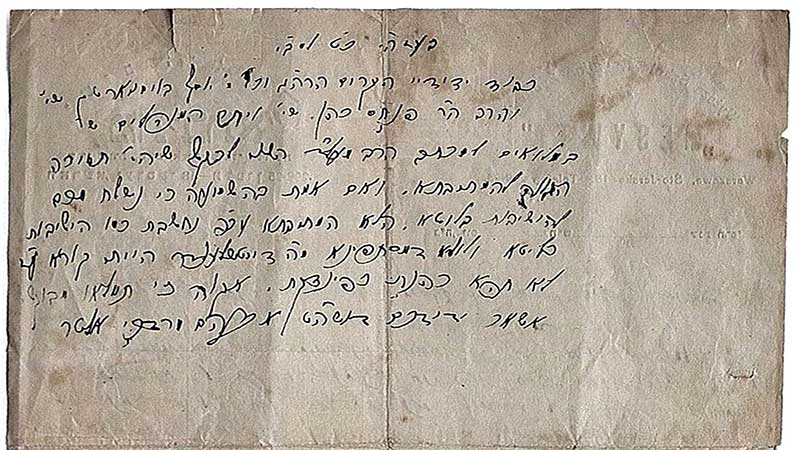
In the December 7, 1899 letter exhibited here, Mathieu writes to journalist Henri Leyret in French:
I apologize for having forgotten for so long the promise I had made to you. Finally, today, I am carrying it out and you will find included a letter from Esterhazy . . .
This brief, almost casual note – written in the exhausted aftermath of Alfred’s 1899 retrial at Rennes and during the delicate political phase in which the French state was attempting, with uneven sincerity, to stabilize the consequences of its own crisis – opens a remarkably revealing window into Mathieu’s continuing role in the Affair even after the most dramatic public battles had ostensibly concluded.
We cannot identify with certainty which specific Esterhazy letter Mathieu enclosed in this correspondence to Henri Leyret, but we can narrow it down fairly tightly by triangulating three things that are actually firm in the chronology: (1) Esterhazy’s movements and known correspondence after the collapse of his credibility in 1898; (2) the documentary “traffic” Mathieu was handling in late 1899; and (3) what journalists like Leyret were actively working on at that moment in the post-Rennes phase of the Affair.
By late 1899, the Affair was no longer the explosive revelation it had been in 1898, when Zola’s J’Accuse tore through French political life, but it had not yet settled into the formal closure of Alfred’s partial rehabilitation and eventual full exoneration in 1906. The Affair remained a living conflict, populated by documents still surfacing, reputations still contested, and networks of journalists and informants still actively shaping public understanding.
For his part, Mathieu had by late 1899 shifted from “primary investigator” mode into what might be called “archival broker” mode. After the Rennes trial in summer 1899 and Alfred’s pardon in September 1899, Mathieu was still receiving, organizing, and distributing documents to journalists who were trying to reconstruct the full evidentiary history of the Affair. By this point, journalists like Henri Leyret were then interested in publishing retrospective analyses, serialized accounts, or documentary reconstructions, often relying on private archives held by Dreyfusard insiders.
Mathieu’s reference in this letter to “a letter from Esterhazy” is especially significant because it underscores something that is sometimes obscured in retrospective narratives of the Affair: even after Esterhazy had been publicly exposed as the probable author of the bordereau and had effectively fled France in disgrace (living in England under an assumed or semi-retired identity), his name continued to function as a kind of unstable documentary currency. Any surviving or newly surfaced communication from him – whether authentic, opportunistic, or strategically leaked – carried potential evidentiary weight in the ongoing struggle over historical truth. Mathieu’s decision to transmit such a document to a journalist demonstrates that he was still actively engaged in shaping the informational aftermath of the Affair, still acting as a conduit between private archives and public interpretation.
The tone of the letter is also revealing. There is no sense of triumph, nor even of urgency; instead, there is a bureaucratic apology for delay followed by a quiet fulfillment of obligation. This is the voice of a man who, by 1899, has been living for five years inside an extraordinary historical vortex and is now attempting to normalize the rhythms of communication that had been disrupted by it. Yet the content itself belies any real return to normalcy; even in a moment of administrative courtesy, Mathieu is still handling material tied to one of the most explosive figures in the Affair, still participating in the circulation of contested evidence.

Leyret (1864-1944) belonged to the complex and highly politicized ecosystem of French journalism at the turn of the century. He became a journalist and writer active in Parisian literary and political circles during the Third Republic and, while not as internationally prominent as figures such as Zola or Clemenceau, he operated within the dense network of republican and literary journalism that played a crucial role in shaping public opinion during the Affair. He was associated with the kind of reporting and commentary that bridged the gap between daily press and political intellectualism, a space where journalists were not merely observers but active participants in ideological battles.
As one of Dreyfus’s great supporters, Leyret collected Esterhazy’s letters and published them in 1898 as Lettres d’un Coupable (“Letters of a Guilty Man”), writing in the preface:
Let them now read the Letters of a Guilty Man, let them read them to their wives, to their sons . . . Ah! I defy them not to be indignant, not to catch a flash of anger, an expression of disgust in the eyes of their listeners, and not cry out: “No! This acquitted man is not innocent!”
As a journalist, Leyret facilitated the dissemination of documents, conducted interviews, and provided platforms for voices aligned with Dreyfus supporters. In this sense, Mathieu’s correspondence with him is entirely consistent with Mathieu’s broader strategy during and after the Affair, which involved cultivating multiple channels of communication with journalists who could help keep key evidentiary materials in circulation.
The inclusion of a letter from Esterhazy in this exchange underscores the continued fragmentation of truth even after the major judicial reversals in Alfred’s favor. Esterhazy himself had become a symbol of both military dishonor and institutional protection but, despite being widely believed to be the true author of the bordereau, he had initially been acquitted in a closed military proceeding in 1898, a decision that further inflamed public outrage. His later marginalization did not erase the ambiguity surrounding his written traces, which could still be mobilized in debates over forgery, military conspiracy, or evidentiary manipulation. Mathieu’s transmission of such material to Leyret suggests that he understood the press not merely as a reporting mechanism but, equally importantly, as an active arena in which fragments of documentation could be reinterpreted and redeployed.
It is important to situate this within Mathieu’s broader post-1898 role. After Zola’s intervention and the explosive public phase of the Affair, Mathieu did not retreat into private life. Instead, he continued to act as a custodian of documents and a facilitator of journalistic access, which proved particularly important during the Rennes retrial in 1899, when the French state, under intense domestic and international pressure, was forced to revisit Alfred’s conviction. Although Alfred was again found guilty with “extenuating circumstances” before receiving a presidential pardon, the proceedings exposed deep fractures in the original case and individuals like Mathieu, who could provide documentary context and private correspondence, remained essential to the press’s ability to interpret the evolving legal theater.
The relationship between Mathieu and journalists such as Henri Leyret thus reflects a structural feature of the Dreyfus Affair: the collapse of strict boundaries between private citizen, family advocate, and informal political actor. Mathieu was not a lawyer, nor a politician, nor a journalist himself, but he effectively operated in all three spheres simultaneously. His authority derived not from institutional position but from proximity to the central injustice of the case and from his access to materials that others could not easily obtain.
Seen in this light, our correspondence is no mere marginal archival curiosity but, rather, a representative artifact of the Dreyfus Affair’s long afterlife. Even after the courtroom drama had largely concluded, even after the major political confrontations had peaked, Mathieu and others continued to manage the slow diffusion of documents that kept the Affair alive in public memory and historical debate. The letter shows that Mathieu’s role was not confined to the years of crisis alone but extended into the period of interpretation and stabilization that followed, when France was still attempting to reconcile its republican ideals with the institutional failures that had been so publicly exposed.
It also reinforces a broader truth about Mathieu Dreyfus’s life: that his contribution cannot be reduced to a single phase of activism or a single dramatic intervention; instead, it was sustained, administrative, and deeply embedded in the circulation of evidence over time. Even something as apparently modest as an apology for a delayed promise becomes, in this context, part of the larger machinery through which truth struggled to assert itself against institutional inertia and public controversy.
In the aftermath of the Affair, Mathieu continued to live in France and to maintain his business activities, though the social landscape had changed. The Affair had exposed deep fissures within French society, and while his brother’s eventual exoneration was a victory for the Dreyfusard cause, it did not eliminate antisemitism or erase the memory of the crisis. Mathieu remained a symbol of familial loyalty and civic resistance, though he never sought public office or a position of political leadership.
Later reflections on Mathieu Dreyfus’s role often emphasize his function as a “behind-the-scenes” actor, neither the legal face of the defense nor the intellectual voice of the movement, but an indispensable organizer, investigator, and connector. Without his early efforts to challenge the official narrative and his persistence in gathering evidence, it is possible that the revision of Alfred’s conviction would never have happened.
Mathieu died in 1930, having lived long enough to see the Dreyfus Affair recede into historical memory while remaining a defining moment in modern French political consciousness. By that time, Alfred Dreyfus had been fully rehabilitated and even awarded the Legion of Honour, symbolically restoring his place within the Republic he had once been accused of betraying.
Mathieu’s legacy is therefore inseparable from that of his brother, but it is also distinct. Where Alfred is remembered as the wronged officer at the center of the Affair, Mathieu is remembered as the persistent civilian who refused to accept injustice and helped transform private conviction into public reckoning. His life illustrates how historical change often depends not only on famous figures and dramatic declarations, but also on sustained, methodical labor carried out in the uncertain space between truth and power and between loyalty and law.