October 2, 2026
 Categories: In Print / Featured / Collecting / Features On The Jewish World
The Jewish Art of Samuel Hirszenberg


Samuel Hirszenberg (1865-1908), a Polish-Jewish painter whose works occupy a unique place in the history of Jewish art, stood at the crossroads of European academic painting and the profound spiritual legacy of the Jewish people, crafting a body of work that is both intensely personal and deeply rooted in the communal Jewish experience. From his upbringing in a traditional Jewish household in Łódź, to his artistic training in Kraków and Munich, to his final years in Jerusalem as a teacher at the Bezalel School of Art, his trajectory mirrors the broader journey of Eastern European Jewry at the dawn of modernity, from rootedness and oppression to searching and, finally, Zionist aspiration. His Judaism was not merely a background detail but the core from which he drew his inspiration, his sense of identity, and the emotional gravity of his most famous works.
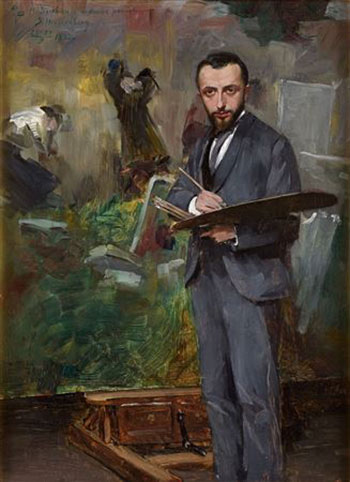
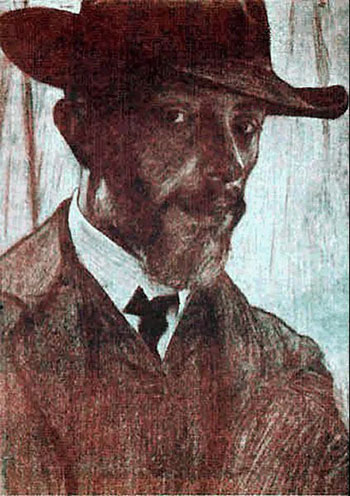

Hirszenberg was born in Łódź, in the Russian partition of Poland, the eldest son of a poor Jewish weaver, who was initially opposed to Samuel's artistic ambitions, which were viewed as incompatible with the values of traditional Jewish life. However, with the support of a local physician who recognized his talent, Samuel was able to study at the Academy of Fine Arts in Kraków at the age of fifteen where, under the tutelage of Jan Matejko, one of Poland's most famous historical painters, he absorbed a meticulous academic style and an appreciation for grand historical themes. While many of his contemporaries were turning to secular or nationalist themes, he remained committed to exploring the Jewish world of his youth, and his works from this early period already manifest a deep emotional attachment to Jewish religious life, often depicting scenes of prayer, study, and mourning with remarkable psychological insight.
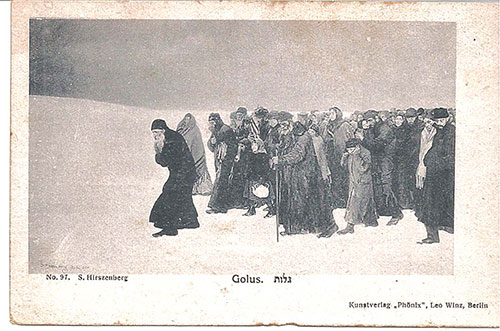
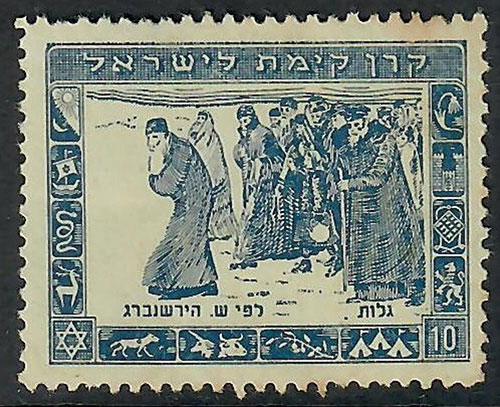
Golus (“Exile,” 1899) is perhaps his most seminal and haunting work, a large-scale symbolist canvas depicting a group of Jews trudging forward through a barren, desolate landscape. The figures are gaunt, their eyes vacant or downcast, clutching children, a Torah scroll, and sacred books, a teapot held limply at one man's side; the central figure, an old man with a white beard, seems to represent the wandering Jew archetype, not in the Christian mythological sense, but as a symbol of the Jewish people's historical suffering and displacement. Behind them stretches a lifeless plane; ahead, only more uncertainty. The painting is not just a historical commentary, but also a spiritual lament, a visual expression of the trauma of exile that had marked Jewish life for two millennia. It is also intensely personal, capturing the anxieties of Jewish existence in Russia and Poland at the end of the 19th century amid pogroms and rising antisemitism.

In The Talmudists – also sometimes called Jeschibah (or “The Yeshiva”) – Hirszenberg offers a mood of scholarly struggle, melancholy, and sacred endurance set in the interior of a modest beit midrash rendered in rich earth tones and filtered daylight. Five Jewish men sit around a long, sturdy wooden table clad in traditional dress: long black coats, fur or cloth hats, and long beards, all indicators of Eastern European rabbinic types in the late 19th century. Books are scattered across the table, with thick bindings and careful detail, and the walls are bare, reinforcing the asceticism of the space; this is a room of the mind and soul, not of material comfort. The light streaming through the window at the far right does more than illuminate; it sanctifies – the light is a metaphor for Torah itself, as in the verse: "For the commandment is a lamp and the Torah is light" (Proverbs 6:23).
Each man is depicted in a different posture and mental state, as if representing various stages or aspects of engagement with sacred learning. The man at the far right, who is the most visibly engaged of the group – perhaps the symbolic “torchbearer” of the study session – sits nearest a bright window, which pours natural light over him and onto the large open volume of Talmud before him, creating a focal point in the composition, almost like divine illumination. Next to him, the second man rests his head on the table, face cradled in his hands, possibly asleep or overwhelmed, his figure contrasting dramatically with the first; instead of activity, he suggests fatigue, withdrawal, or contemplative despair.
The central figure in the composition, which renders him visually prominent, wears a stern, almost ascetic expression, suggesting a sense of inner tension or brooding. His body is rigid and upright, in contrast to the slumped figure to his left, and he does not appear to be engaged directly with the book or with the others. Art historians often interpret this figure as symbolizing the severity, solitude, and perhaps burden of religious scholarship. While others are studying, debating, or fading with fatigue, this man stands apart – aloof, solitary, perhaps authoritarian or perhaps detachment, alienation, or religious extremism. The fourth figure, slightly slumped and gazing downward, is more passive, with a solemn, even sad, expression; he may be struggling to follow the others’ pace, or simply lost in thought. The fifth figure, at the far left, leans toward the center of the table but keeps his eyes cast downward; he appears withdrawn, perhaps due to age or confusion, yet still physically present in the sacred activity.
Rather than depict a moment of animated debate, as was common among other Jewish painters, Hirszenberg chooses to portray the emotional and mental diversity within Torah study: enthusiasm, fatigue, contemplation, doubt, and perseverance; this variety makes The Talmudists not just a genre scene, but a philosophical meditation on the nature of Jewish learning.

Another powerful work is Das Schwarze Banner ("The Black Banner," 1905), a large, horizontal-format painting filled with movement, mass, and mourning in a grim, wintry Eastern European setting that depicts a funeral procession, almost certainly for a Jewish victim of a pogrom. A dense crowd of Jewish men with somber, angry, and grief-stricken expressions fills the scene, clothed in dark coats and hats, and at the center of the composition, a group carries a coffin covered in a black cloth, moving slowly through the street lined with snow. The palette is almost entirely monochrome – blacks, grays, cold browns, and muted whites – presenting a bleak environment that reflects the emotional landscape of grief, hopelessness, and silent protest. In the background, we see traditional wooden houses, possibly in a shtetl, reinforcing the Eastern European Jewish setting. Although there is no violence occurring in the painting, the aftermath of violence is palpable; the stillness is heavy; and there is a moment frozen between catastrophe and defiance.
Hirszenberg completed the painting in 1905, a year of political and social upheaval across the Russian Empire, particularly following the failed 1905 Russian Revolution and a wave of brutal anti-Jewish pogroms, including the infamous Kishinev pogrom (1903). At the time, The Black Banner was considered radical, not because of style, but because of content, as Jewish artists had rarely addressed contemporary trauma in such explicit political terms. Its emphasis on mourning, solidarity, and warning echoes in works following the Holocaust and the founding of Israel, and it is today considered a seminal work in the visual history of Eastern European Jewry and a precursor to more explicitly modernist depictions of Jewish catastrophe.

In Twilight Hour in the Synagogue, Hirszenberg presents a dimly lit synagogue interior, nearly empty but for a solitary, elderly devout Jew seated on a wooden bench, his yarmulka-clad head slightly bowed, immersed in prayer, study, or silent contemplation. The architecture of the synagogue – high windows, arched walls, and weathered stone – surrounds him like a hushed, sacred womb, and natural light filters through tall, narrow windows, casting long, angled shadows on the floor and softening the textures of the old wooden pews. The fading light suggests the end of the day, the “twilight hour” referred to in the title, and the soft diffusion of light – likely influenced by Dutch masters and realist painters like Rembrandt or Millet – is essential to the piece; it doesn't illuminate so much as wrap the scene in a quiet dignity. The absence of other congregants imbues the scene with a profound sense of stillness and solitude, and the synagogue space feels both intimate and cavernous, suggesting a quiet, almost spiritual abandonment, as if echoing the waning light of Jewish tradition in exile or old age.
This painting is a masterclass in atmosphere and quiet emotion, as Hirszenberg paints a scene that seems at once deeply personal and broadly allegorical. Is the figure meant to represent an individual – a grandfather, a rabbi, a remnant of a bygone generation – or is he meant to stand for an entire people, alone in a vast space of faith and memory, surrounded by silence, carrying out his duty in a world that no longer joins him? This ambiguity is part of the painting’s power.

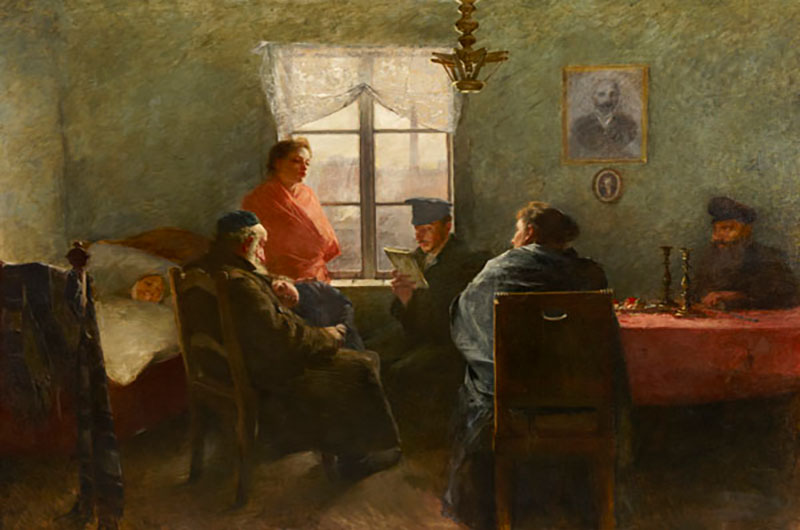
Hirszenberg’s Sabbath Rest (also known as Sabbath Afternoon) is a quiet, intimate domestic genre painting and a deeply contemplative tableau rendered with attention to mood, lighting, and psychological nuance that captures a moment of spiritual and emotional repose in a Jewish home during the Sabbath. The scene is set in a modest, warm, and lived-in interior. To the left of the canvas is a neatly made bed with a white cover, an object that adds to the aura of rest and cleanliness associated with the Sabbath, next to which the wife and mother stands by a sunlit window, her posture and position creating an impression of calm vigilance and spiritual elevation.
Toward the center-right of the painting, an older man in a black yarmulke and clad in traditional Jewish garb sits in a wooden chair with a child, likely his son or grandson, resting his head affectionately on the elder’s lap in a gesture both tender and evocative of familial security and warmth. His presence anchors the painting in a deeply Jewish paternal ethos: continuity, love, rest, and Torah-infused quietude. On the far right is another figure, possibly an adult son, wearing a cap or brimmed hat, reading from a periodical or publication, which reflects the increasing presence of secular reading in Jewish homes at the time, a subtle nod to the emerging currents of the Haskalah and modernity.
The absence of work, the seated figures, the resting child, and the reflective woman all convey the cessation of weekday toil and the embrace of sacred time, and Hirszenberg does not portray Shabbat here through a grand synagogue ceremony but, rather, as something sacred rooted in the home. In doing so, he aligns with the traditional Jewish understanding of the Sabbath transforming even the humblest dwelling into a spiritual palace. This painting, like many of his works, is deeply psychological, as each figure seems lost in thought or absorption rather than interaction: the mother by the window does not turn to the others; the man reading is caught up in his text; the elder sits in introspection; even the child, though resting on the elder, is quiet. This stillness underscores the inward quality of the Sabbath: not a day of external celebration but internal retreat, reflection, renewal. And yet, there is a warmth of connection; the figures may be isolated in their thoughts, but they are joined in the same sacred time, the same physical space, there is no tension or disjunction – the sanctity of Shabbat is the true meeting point.

A dramatic, visceral evocation of persecution, martyrdom, and Jewish survival in a hostile Christian world and one of the most dramatic paintings by a Jewish artist in the nineteenth century, Hirszenberg’s HaYehudi HaNitzchi (“The Eternal Jew,” 1899) is one of the most potent artistic expressions of Jewish collective suffering in modern European art. The composition is dominated by a single male figure, centrally positioned, who is clearly the symbolic "Eternal Jew," not in the folkloric Christian sense, but as a stand-in for the Jewish people in exile and torment. Bareheaded, cloaked in ragged clothing, and appearing aged and anguished, his right hand is raised, palm outward, in a gesture of protest, refusal, or defiance, reminiscent of biblical prophets or martyred saints, and his left arm crosses his brow, either to shield his eyes from what he sees or to signal a kind of emotional torment or psychic overload. His face is tormented, anguished, and turned toward the heavens or the desolation before him, and his pose emphasizes emotional exhaustion, mental despair, or even existential protest.
The background is bleak and overwhelming, heightening the psychological and historical weight of the scene. Corpses lie around the central figure – Jewish bodies, presumably the victims of pogroms, persecution, or martyrdom – reinforcing the idea that he does not walk alone but, rather, over the graves of his own kin, adding a dimension of collective tragedy, genocide, or historical trauma. Scattered across the background are numerous tall wooden crosses, not simple grave markers but unmistakably Christian crucifixes, looming as symbols of death, persecution, and institutional violence. The ambiguity of their placement could suggest that they may be grave markers of the Jewish dead but, more likely, they are meant to represent Christian oppression, historically linked with the Jew's suffering, and the crosses, which dwarf the figure, extend into the distance, suggesting that Jewish persecution under Christianity is vast, unending, and omnipresent.
The figure is not a literal man, nor even a traditional “Wandering Jew;” rather, he is a symbol of the Jewish people across time, bearing witness to centuries of martyrdom, not just exile, but destruction and death. He walks among the murdered, he covers his brow in horror, and yet he raises a hand, as if to protest to heaven, to history, or to G-d Himself. Hirszenberg does not use the crosses as religious symbols; instead, they are accusatory and menacing, reminders of how much Jewish blood has been spilled in the name of Christian dogma, a bold and even subversive choice for a Jewish painter working in predominantly Catholic Poland in the 1890s. It represents a moral inversion of traditional Christian art: the suffering here is not Christ’s, but the Jew’s – and the cross is not redemptive, but implicated in the suffering. This transforms the “Eternal Jew” from a passive figure into a prophet or witness – not cursed to wander, but enduring in order to testify – and it reclaims the narrative of the Jewish wanderer as one of dignity in protest, not disgrace in exile.
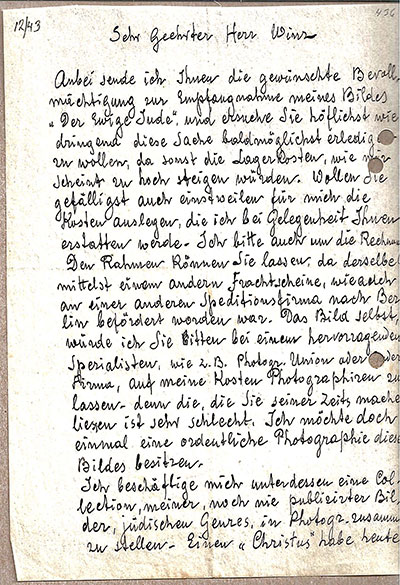
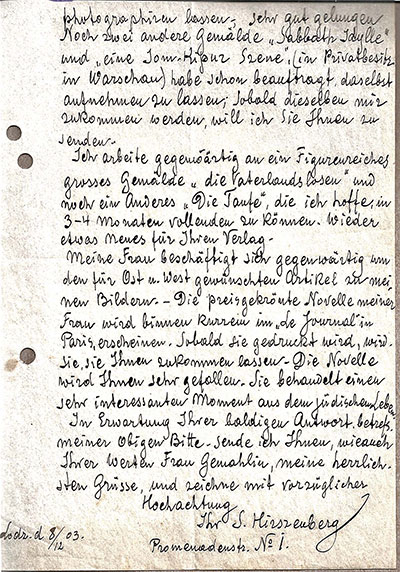
Exhibited here is a remarkable rarity, a December 8, 1903 handwritten correspondence in which Hirszenberg writes about The Eternal Jew and other works:
In this letter, I am sending you the requested rights for the reception of my image “The Eternal Jew” and kindly ask you to expedite this matter as urgently as possible, as otherwise the long-term consequences, as I see it, would rise significantly. I also request the invoice for the framing, as it was previously forwarded via another freight bill, as well as to another shipping company to Berlin. As for the painting itself, I would appreciate it if you could have it photographed by an excellent specialist, such as Photographic Union or any other firm, at my expense – because the one you had made at that time is very poor. However, I would like to have a decent photograph of this painting.Hirszenberg was apparently negotiating or formalizing the reproduction or exhibition rights of the painting; “reception” may refer to formal acknowledgment of rights transfer or permission to receive and display the work, and his use of “image” suggests that he may have been dealing with either a reproduction (lithograph, engraving, photograph) or the actual canvas itself, depending on context. His letter suggests urgency, possibly due to an exhibition deadline, financial concern, or geopolitical constraints – recall that this was written during a time of rising antisemitism and increased Jewish migration – and the "long-term consequences" may refer to lost exhibition opportunities, reputational damage, or even financial penalties.In the meantime, I was occupied with a collection of my unpublished pictures, Jewish genres, to put together in photographs. Today I had a photo taken of a "Christ." Two other paintings, "Sabbath Idyll" and "A Yom Kippur Scene" (in private possession in Warsaw), have already been commissioned to be captured there; once I have the same ones sent to me, I will send them to you.
The work is in the style of a figurative large painting "The Loss of the Fatherland" and another "The Baptism," which I hope to complete in 3-4 months. Again, something new for your publishing house.
My wife is currently involved in working on the much-anticipated novel for East and West about my new paintings. My wife's award-winning novella will be published soon in 'Le Journal' in Paris. As soon as it is printed, she will let you know. You will really enjoy the novella. It deals with a very interesting moment in Jewish life. Awaiting your prompt response, I kindly send you, as well as your esteemed wife, my best regards and greetings with warm wishes.
Respectfully,
In 1907, Hirszenberg made aliyah to Eretz Yisrael, then part of the Ottoman Empire, where he joined the faculty of the newly founded Bezalel School of Arts and Crafts in Jerusalem, a move that reflected his growing alignment with Zionist ideals and his desire to help shape a new Jewish cultural identity rooted in the land of Israel. Sadly, his time in Jerusalem was brief; he died in 1908 at the age of forty-three. His final works show a shift in palette and mood, with brighter colors and more optimistic themes, suggesting a new chapter that would remain unwritten.

Herszenberg’s seminal work during his limited time in Eretz Yisrael – and, as will become quickly evident, my favorite of his works – is arguably BaDerekh el HaKotel HaMa'aravi (“On the Way to the Western Wall”), one of his most spiritually evocative and symbolically dense works. Somber in tone, deeply Jewish in subject matter, and symbolist in intent, it is a masterpiece of quiet introspection and communal devotion, and it merits close visual and thematic analysis.
The painting portrays a group of elderly Jewish men, all wearing traditional Eastern European attire – long black kapotes (coats), shtreimels (tall fur hats), and carrying walking sticks – with their backs largely turned to the viewer, giving the sense that the viewer is joining them on this devotional procession. Backs bent, both physically and metaphorically – by age, suffering, and historical burden – they make their way slowly through a narrow, winding alley in Jerusalem’s Old City. The architecture is distinctively Middle Eastern: stone archways, textured walls, and small barred windows create a sense of ancient time and sacred place and, at the end of the alleyway, a sliver of light suggests the approach to the Western Wall. There is no exuberance or visual dramatics; rather, Hirszenberg paints in muted earth tones, with shadows playing over stone and flesh alike.
Hirszenberg arranges the composition along a diagonal line moving from lower left to upper right, guiding the eye forward along the path the pilgrims are walking, and the spatial constriction of the alley produces a claustrophobic feeling, reinforcing the centuries-old struggle of the Jewish people in exile and diaspora. His brushwork is tight and textured, emphasizing the physicality of the stone and the bodies of the pilgrims, and, despite the absence of dramatic action, the painting conveys an overwhelming sense of spiritual momentum. The entire composition is suffused with an almost liturgical rhythm – like a silent prayer moving through space.
The journey to the Western Wall – which, interestingly, is not visible in the painting, only implied – can be interpreted as symbolic of the Jewish people's journey through exile toward redemption. This finds support even in the title of the piece, which emphasizes the way to the Kotel rather than the arrival there, which suggests that devotion, memory, and persistence define Jewish spirituality more than triumph or restoration. Moreover, the men are anonymous, almost identical in appearance, suggesting that they represent not individuals but the collective Jewish people – particularly the older generations who had carried tradition through centuries of oppression.
The painting effectively captures the tension between the old world of European Jewry and the new-old world of Jerusalem, as the men wear Galician clothing but are walking through Jerusalem stone, a visual dissonance that is central to the emotional power of the painting: it expresses a diasporan Jewish soul that has come home but still bears the marks of exile. Hirszenberg, relatively new to Eretz Yisrael, expresses a visual meditation on the unbreakable bond between the Jewish people and the Land of Israel. In an era when much Jewish art – including much of Hirszenberg’s own pre-Eretz Yisrael work – depicted the tragic or catastrophic dimensions of Jewish history, On the Way to the Western Wall suggests an alternative mode of heroism: faithfulness, constancy, and the humble repetition of sacred acts.
Today, Hirszenberg is recognized as a pioneer of modern Jewish art, a bridge between tradition and innovation. His paintings, which are held in major collections, including the Israel Museum, the Jewish Museum in New York, and museums in Poland and Germany, continue to resonate not only as artistic achievements but as profound meditations on Jewish existence in the modern world. Through his work, he created a visual theology of the Jewish condition and chronicled a people torn between past and future, exile and homeland, faith and doubt. His Judaism was not simply the content of his art; it was the very language in which he painted.
Although there is no direct testimony from Hirszenberg himself regarding the degree of his personal observance, the available evidence suggests that he did not maintain full halachic practice in his adult years. Nonetheless, his Jewish identity remained deeply rooted and emotionally powerful, as seen in the subject matter of his paintings: exile, persecution, messianic hope, and the struggle of Jewish survival. He was buried on the Mount of Olives, in the Jewish cemetery, the most sacred Jewish burial ground in Jerusalem, and the burial, arranged by the Bezalel community, attests to his recognition as a treasured Jewish artist and a respected member of the Jewish national revival.