 October 9, 2026
 Categories: Headline / Names and Numen / Torah
The Journey Hidden in a Name


Author’s note: Future installments of Names & Numen will hopefully focus on answering questions about Jewish Names from readers like you. So if you have any unanswered question about names, or just want to share with us any fascinating insights regarding names, please email me at rabbircklein@gmail.com and we might feature your letter in one of our upcoming articles.
Western Names in the East
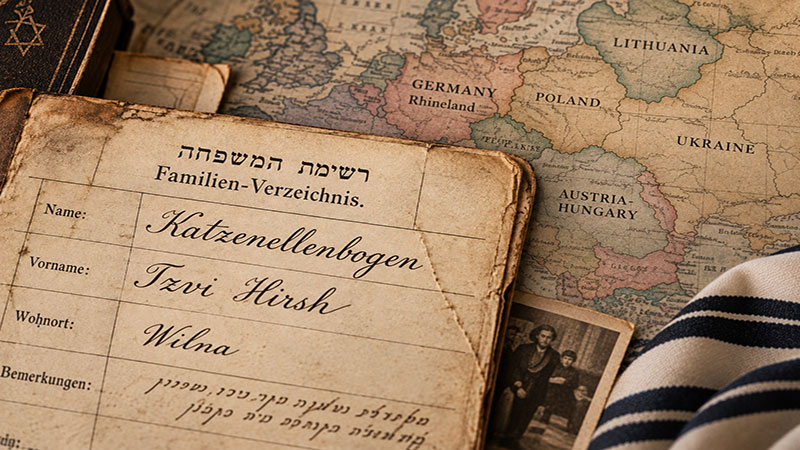
Imagine a Jew in 17th-century Vilna named Tzvi Hirsh Katzenellenbogen, or an 18th-century Warsaw Jew named Eliezer Zussman Ginzburg, or a 19th-century Lublin Jew named Simcha Zelig Landau. Each name feels perfectly natural in an East European Jewish setting. Yet each is also a clue.
The first name in each pair is a Hebrew kodesh name – a sacred name used in religious life and formal records – while the second is a chol name, the everyday vernacular name. And the family names, or surname, situates these individuals as part of a historied clan. Put together, they are not just names; they are tiny historical archives.
In the case of Ashkenazic Jewry, names preserve the memory of a west-to-east migration that began in the Rhineland and northern France and, over the centuries, moved deep into Slavic lands. While these names don't seem out of the ordinary, upon close investigation, they tell the story of Ashkenazi Jewish migrations and serve as onomastic fossils of the history of the Ashkenazim.
Go East, Young Man
Ashkenazic Jewry first crystallized around the Rhinelan
d and northern France in the early Medieval period, with Ashkenazim slowly migrating eastward to Slavic lands after the Crusades. The move accelerated in the later Middle Ages as Western and Central European Jews faced expulsions, mounting restrictions, and outbreaks of anti-Jewish violence; the Black Death (mid 1300s) intensified antisemitic persecution, and many communities were attacked or expelled.
At the same time, the Kingdom of Poland – all the way in the east – offered a very different environment: royal protection, room for economic growth, and a social order in which Jews could fill commercial and administrative niches that were harder to access in the West. What started off as a trickle of Ashkenazi Jews moving eastwards turned into a strong flow of movement in the 1300s and 1400s.
My Name Is What?
That migration is visible in the very names that Ashkenazi Jews themselves had and continued to have throughout the generations, and even nowadays!
Trends in Ashkenazi naming conventions tell this story of eastward migration, as even when Ashkenazi Jews settled in Eastern Europe (in areas like Poland, Ukraine, Lithuania), their names often point back to their origins in Western Europe – particularly in Germany. Two such trends are the use of Yiddish (Judeo-German) chol names as part of one's personal name and the use of German toponyms in Jewish last names (family names) that point back to places in Germany. Such surnames retain a memory of a family's origins in German locales.
Say It in German
As mentioned earlier, the chol name was an everyday name spoken at home and in the street. Many of these names are clearly German (Yiddish) words, which made perfect sense in the German-speaking Jewish world that Ashkenazim inhabited when they lived in Western Europe. But even after those Ashkenazi Jews moved eastward, their descendants continued to use these names, despite the fact that their gentile neighbors were no longer speaking German, but rather Slavic languages like Polish, Lithuanian, Ukrainian, Hungarian, or Belarussian.
Examples abound, but we'll just pick a few interesting ones. The kodesh name Tzvi literally means "deer/gazelle." That Hebrew name is associated with the chol name Hirsh, which is a German word that means "deer/gazelle." Likewise, the Yiddish name Zelig is a repurposing of the German word selig meaning "happy" or "blessed." It’s no wonder that this Yiddish name is often paired with the Hebrew name Asher, which means the same thing (think: Ashrei…).
Other male names carried the same Germanic freight. Gottlieb means “beloved of G-d” it can be broken down as comprising of the German words gott ("G-d") and liebe ("love"). In that way, it's actually a German translation of the Hebrew name Yedidyah. Similarly, the name Fridmann comes from German friede (“peace”) and mann ("man"). It is often tied to the kodesh names Shlomo and Shalom. Other Yiddish first names that follow this pattern include Gutmann (gutt + mann = “good man”) and Zussman/Sussman (süß + mann = “sweet man”). Interestingly, at some point many of these names shifted from being personal names to being family names, although they are probably patronymic surnames, which are family names derived from the personal name of a family patriarch.
Either way, they are not translations into Polish or Russian; they are Germanic words surviving intact inside Jewish naming habits long after the bearers had moved into Eastern Europe. That is precisely why they matter: they reveal continuity of a western Jewish vernacular beneath an eastern geographic setting.
Looking over at the other side of the mechitzah, women’s names preserve the same story even more vividly: Many popular Yiddish names given to Ashkenazi girls in Eastern Europe are derived from German words just like their male counterparts. For example, Leeba comes from the German leibe, Gittel from the German gutt, and Zissel comes from süß – all German words we've seen above.
A whole slew of other feminine Jewish names come from German words, like Shaindel (from the German schön, "beautiful"), Fruma (from frum, "pious"), Frieda (from fried, "happy"), Feiga (from vogel, "bird"), Reizel (from reiz, "charming"), Golda (from gold, "gold"), Blume (from blume, "flower"), and so forth. These personal names continued to be used even after Ashkenazim left German-speaking areas (and some remain popular even nowadays); they embed a memory of those migrations and the eastward movement in the collective memory of Ashkenazi Jews for all times.
By the way, the seven Yiddish names I just listed all have modern Hebrew counterparts that are just Hebrew translations of those names: Yaffa (Shaindel), Chasidah (Fruma), Tzipporah (Feiga), Chen (Reizel), Zehavah (Golda), and Frecha (Blume).
Back in the Alterheim
Then there are the surnames, which are often even more explicit in their allusions to Western European connections, especially to German geography. Here the map of Ashkenazic movement becomes almost visible. The earliest and most prominent Ashkenazi settlements were in the Rhineland, especially three communities of Speyer, Worms, and Mainz. Surnames like Spira/Shapiro point directly back to Speyer; Wormser points to Worms, and Mintz points back to Mainz. The Jewish surname Lichtenstein can point to a town in Saxony, eastern Germany with that name; Ginsburg/Günzburg points to Günzburg in Bavaria, and Landau/Lando traces to Landau in der Pfalz, near Germany's border with France. These surnames are found widely among Jews who lived in Central and Eastern Europe. Essentially, these are “place-memory” surnames: they carry the echo of towns in Western Europe left behind generations earlier.
A few of these family names became almost emblematic of the old Ashkenazic map. Katzenellenbogen comes from the town of Katzenelnbogen in Hesse (near the Rhineland). Throughout the generations, many important rabbis in Italy, Poland, Lithuania, and Germany, bore the last name Katzenellenbogen (which, by the way, literally means "cat's elbow" in German).
Other famous Ashkenazi last names include Halpern/Halperin (traditionally linked to the German town Heilbronn), Oppenheim (points to the Germany town Oppenheim), and Auerbach (which points to a number of German placenames). Similarly, Frankfurter is obviously a call-back to the Germany city of Frankfurt (either Frankfurt on the Main River or the smaller city Frankfurt on the Oder River). In East European Jewish history, these names were not random labels. They were the family’s own moving memorials of origin – a surname saying, in effect, “We came from there, even if we have been here for centuries.”
Layered Names
That is why a name like Tzvi Hirsh Katzenellenbogen is more than simply a double name – it is a record of migration. A Jew bearing that name in Vilna or Kraków was living in a Slavic-speaking world, yet carried within his name the linguistic memory of medieval German lands. His surname continues along that geographical trail pointing back to a place in Germany, even if his ancestors had been living in places far away from Germany for generations.
Taken together, these naming conventions reveal how Ashkenazic migration did not erase earlier identities, but layered them: Germanic-Yiddish vernacular names and geonyms from Medieval Western Europe, lived in the towns and shtetlach of Eastern Europe and were simply added to pre-existing kodesh names that often came straight from Tanach. The Ashkenazim who settled in Poland, Lithuania, Hungary, and Ukraine may have moved eastward, but their names continued carrying echoes of the Rhine Valley, Franconia, and the old Jewish centers of Western Ashkenaz.
Of course, this is only one layer of Ashkenazic history. Earlier southern routes from Italy and other Mediterranean zones, and possible eastern contributions from Slavic Jewish populations, also belong to the larger picture and can also been seen in some names. But the western layer is the one most clearly visible in the names themselves. A people may move, disperse, and reinvent itself, yet still carry its old homeland on its tongue. For Ashkenazim, that homeland from a millennium ago often survives not in maps or chronicles, but in what parents called their children and what families kept as surnames. Names, in that sense, are not merely labels. They are travel documents.