 October 9, 2026
 Categories: In Print / Collecting / Features On The Jewish World
The Judaism and Jewish Music of Mischa Elman


One of the most celebrated violinists of the twentieth century, Mischa Elman (Mikhail Saulovich, 1891-1967) is remembered not only for the rich, lyrical warmth of his tone, but also for the profoundly emotional quality he brought to every performance. He belonged to the great generation of violinists trained in the Russian school of Leopold Auer, alongside Jascha Heifetz, Nathan Milstein, Efrem Zimbalist, and Toscha Seidel, yet he carved out a distinct identity, becoming known for a sound that critics described as almost vocal in its expressiveness, a kind of singing line on the violin that drew comparisons to cantorial chant, and for his approach that emphasized heart over technical fireworks. To hear Elman play was to hear not only the violin sing but to hear echoes of a synagogue cantor, a klezmer fiddler, and a Jewish soul striving for beauty in a complex century.
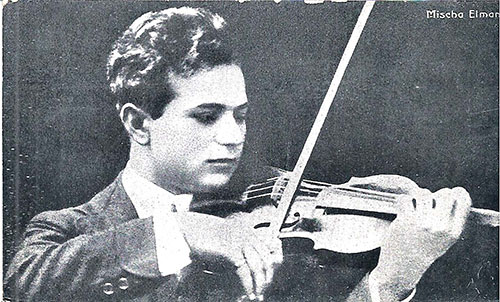
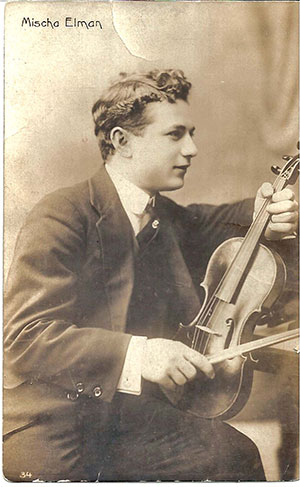
While his career placed him at the center of Western musical life in the United States and Europe, his Jewish origins and identity, the religious traditions in which he grew up, and the wider world of Jewish music profoundly shaped his art and his personal life; his art was inseparable from his roots, and the cadences of Jewish prayer, the modal inflections of synagogue chant, and the emotional ethos of Yiddish song all found their way into his tone and phrasing. The interweaving of these elements – career and faith, artistry and identity – make his story an especially revealing case study of how Jewish musicians navigated the modern world of concert performance while remaining connected to their heritage.

Born in Talnoye, Ukraine into a family steeped in Jewish musical tradition, Elman’s grandfather Yosele was a klezmer violinist, part of the itinerant class of Jewish folk musicians who played at weddings and communal celebrations. Like many Jewish families in the Pale of Settlement, the Elman family valued music both as a form of cultural continuity and as a potential avenue for social advancement, though few could have imagined just how far young Mischa would rise. His father, a melamed (a teacher of Jewish subjects) who was also an amateur violinist, encouraged his son’s obvious talents, and when, at the age of five, Mischa showed extraordinary aptitude, his family brought him to Odessa, a hub of Jewish intellectual and musical life. Odessa’s Jewish community was vibrant, with its network of schools, choirs, and cultural societies, and it was here that Mischa’s early exposure to synagogue music and cantorial traditions seems to have influenced his sense of phrasing and tone. Those who heard him as a boy often commented that his violin “sang like a cantor,” drawing on cadences recognizable from Jewish prayer.
At the age of eleven, Mischa was admitted to the St. Petersburg Conservatory to study under the great violin pedagogue Leopold Auer. (Auer had to threaten to resign his position before he won permission from the authorities for a Jewish boy from the provinces to reside in St. Petersburg.) Auer, who was himself of Jewish origin, though secular in orientation, had assembled around him an extraordinary cohort of Jewish violin prodigies who would transform the art of violin playing in the twentieth century. Under Auer’s guidance, Elman refined his technique, though his natural tendencies were always more oriented toward expression rather than sheer virtuosity. Even in these early years, he was associated with a kind of Jewish soulfulness that set him apart; musicologists believed that his habit of lingering on a phrase, of shaping it as though declaiming a line of liturgy, owed much to his upbringing in the soundscape of Jewish worship.

Elman’s career took off in the first decade of the twentieth century and he toured Europe, where audiences were astonished by the depth of sound he coaxed from his instrument; by 1908 he had made his London debut and, in 1910, his New York debut at Carnegie Hall established him as one of the leading violinists of the era. Critics praised his lush vibrato and his ability to communicate emotion, though some noted that he sacrificed the last degree of technical polish for mood and feeling, but for many audiences, that emotional immediacy was precisely what made him unforgettable. He quickly became a favorite recording artist for the Victor Talking Machine Company, selling over two million records and leaving behind a large discography that captured his artistry at its peak.
From the start, Elman’s Jewish identity was not incidental to his public perception. In an era when antisemitism remained pervasive through Europe and the United States, Jewish musicians often faced suspicion or stereotyping; during his youth, Elman experienced virulent antisemitism, including the destruction of his violin by antisemitic hooligans and being tripped in the street. In The Memoirs of Mischa Elman's Father, privately printed in 1933, Saul Elman told of the hardships, the persecution, and the dangers he and his son experienced together in Russia, then at the height of a wave of antisemitism.
Yet, Mischa’s art seemed to transcend boundaries and he was embraced within Jewish circles as one of their own, a child of the shtetl who had achieved world fame. Accounts of his concerts often mention the large Jewish presence in his audiences, particularly in New York, where Jewish immigrants flocked to hear him as a symbol of communal pride. He represented, in a sense, the possibility of Jewish cultural contribution to the highest levels of Western art, while his tone and phrasing remained recognizably rooted in Jewish sound-worlds.
As a boy, a wealthy patron offered to sponsor Elman's musical studies on the condition that he convert to Christianity, but he refused, underscoring an early commitment to his Jewish identity. He became a U.S. citizen in 1923, two years before he married Helen Katten, the daughter of a prominent Jewish family in New York. The marriage ceremony was performed by the Rev. Louis I. Newman, the rabbi of San Francisco’s (Reform) Congregation Emanu-El, an active Zionist (very rare for the Reform movement), and a prolific writer and anthologist. The couple maintained a Jewish identity and their children were raised with awareness of their heritage.
Elman was not known as a particularly observant Jew in the ritual sense; for example, he was not regularly seen at synagogue services, but he did attend on the High Holidays and for life-cycle events and his family celebrated the major holidays and certain traditions, such as Passover seders and Hanukkah candle-lighting. His marriage endured, and Helen shared his involvement in Jewish community life; their household became a gathering place for musicians, both Jewish and non-Jewish, but always retained a sense of Jewish cultural pride. Colleagues and friends described him as deeply proud of being Jewish, even if his practice was moderate rather than orthodox.
The influence of Jewish music on Elman’s repertoire was substantial. Though he was primarily a performer of the classical canon – Bach, Beethoven, Brahms, Tchaikovsky – he also championed works with explicitly Jewish themes, chief among them Joseph Achron’s Hebrew Melody, a short piece composed in 1911 that quickly became a favorite encore for Jewish violinists. The work draws on a motif resembling synagogue chant; Elman was among the earliest and most prominent performers to popularize it; and his recordings of Hebrew Melody remain touchstones of how to infuse the piece with vocal-like pathos and with a tone that seems almost indistinguishable from the sound of a cantor intoning a prayer. Elman also performed works by Ernest Bloch, particularly those in his Jewish Cycle such as Nigun from Baal Shem, which sought to evoke the spiritual and mystical aspects of Jewish tradition. Though Bloch was Swiss-born, his attempt to create a modern Jewish musical idiom resonated with Elman, who brought to such pieces an authenticity born of lived familiarity with Jewish intonation.

Elman also performed Bruch’s famous Kol Nidrei, originally composed for cello and orchestra but transcribed for violin, which is based on the haunting melody of the famous Yom Kippur prayer. His interpretations of this piece, both in concert and on record, are notable for their intensity, suggesting a personal connection to the sacred source material. Other Jewish and Hebraic music in Elman’s repertoire include Rozhinkes mit Mandlen (“Raisins and Almonds”), a Yiddish lullaby by Avrom Goldfaden, Eili Eili, Nigun from “Baal Shem,” Dance of the Rebbitzen, The Chassid, and Danse Hébraïque, all on which are tracks on the Elman Plays Hebrew Melodies record album.
On occasion, Elman included traditional Jewish or Yiddish songs in his recitals, particularly when performing for his many Jewish benefit concerts. He played arrangements of Goldfaden melodies – the music of the early Yiddish theater – as well as popular folk tunes that resonated with Jewish immigrant audiences. These choices underscored his role not only as a virtuoso, but as a cultural bridge between the Jewish past and the Western concert hall.
His relationship with Zionism was complex but significant. Like many Jewish musicians of his generation, Elman was drawn into Jewish communal affairs, particularly in New York, where he settled, and he gave frequent benefit concerts for Jewish charities, including organizations aiding Jewish refugees and supporting Jewish education.
In 1935, he toured Egypt and Eretz Yisrael, where he gave a concert in Rishon L’Tzion and reportedly made Shalom Aleichem weep, and he played with the Israel Philharmonic as a guest soloist several times during the new Jewish State’s first decade, including a Motzei Simcḥat Torah concert at Ohel Shem Hall in Tel Aviv. Moreover, after the establishment of the State of Israel in 1948, he participated in fundraising concerts for Israel Bonds and other pro-Israel causes and he publicly expressed admiration for the new state. Statements from contemporaneous Jewish newspapers suggest that he spoke warmly of Jewish self-determination and the cultural flowering of Israel, though he stopped short of making overtly political declarations.
Elman’s participation in Jewish charities, his support for Israel, and his engagement with Jewish communal life made him more than a performer; he was a cultural ambassador, consciously or not, of Jewish heritage. Although his role was more that of an artist lending prestige to Jewish causes than a polemicist or activist, his presence at Zionist fundraising events and his willingness to associate his name with Jewish national aspirations place him firmly within the orbit of Jewish communal engagement with Zionism.
He was profoundly affected by the Holocaust, including encountering Nazi political interference as early as the early 1930s. During a 1934 South American tour, he described an incident involving the conductor Fritz Busch (whom Elman accused of bowing to pressure from the Nazis) and used that episode to illustrate how far Nazi influence reached. He accused Nazi emissaries of trying to influence concerts; he maintained that the long arm of Nazi propaganda had even reached as far as South America; and he boldly and proudly announced that he would never play in Germany “as long as Hitler is master there.”
Elman participated in benefit concerts for Jewish relief organizations during and after the war, raising funds for survivors and displaced persons. In one case, he and his wife assisted in providing affidavits for the Hammberschlag family in Germany and sponsored them (the family arrived in the United States on July 13, 1939).

In the January 18, 1939 correspondence on his personal letterhead exhibited here, Elman writes to Nathan Straus, Jr., then head of the United States Housing Authority at the Department of the Interior:
I appreciated so much your kind letter and it gives me much satisfaction to know that you and Mrs. Straus are in sympathy with what I am doing. To have your moral support means a great deal to me and I only hope these concerts will be the means of helping many unfortunate ones.In 1939, Elman broke up his very successful concert tour to to add performances on behalf of oppressed refugees from Nazi Germany. He made a three-month nationwide tour during which he played in twenty-five cities across the United States, beginning at Carnegie Hall in New York City, which at the time was considered the single most strenuous and intensive tour ever undertaken by an artist in the interests of charity. Among the chief beneficiaries of the tour was the American Joint Distribution Committee.Of course, Washington is included among the cities where I am to give concerts, and I am looking forward to meeting you and Mrs. Straus when I am in Washington.
Again let me tell you how greatly I appreciate your kind expressions.

(Verso, not shown:) “Refugees from Nazi Germany will benefit by the skilled fingers of Mischa Elman, noted Jewish violinist, who played here Wednesday night for their aid.”

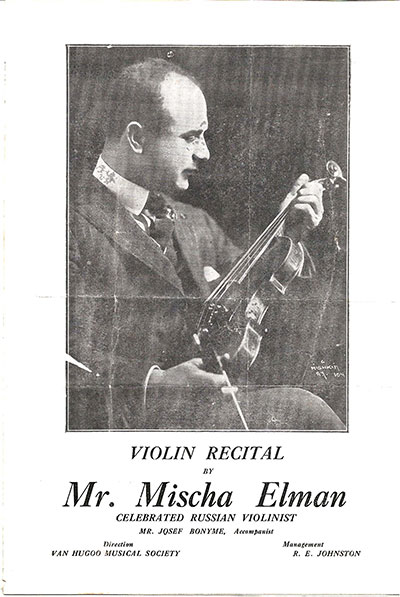
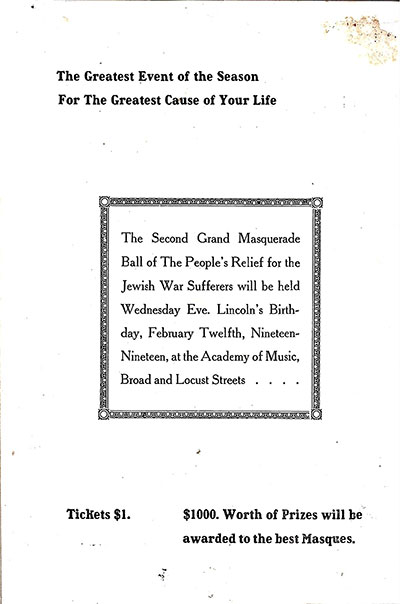
Not as well know is the fact that Elman also played benefit concerts for Jewish War Sufferers during and after World War I. Exhibited here is a program for his violin recital, “The Greatest Event of the Season for the Greatest Cause of Your Life: The Second Grand Masquerade Ball of The People’s Relief for the Jewish War Sufferers will be held Wednesday Eve, Lincoln’s Birthday, February Twelfth, Nineteen-Nineteen, at the Academy of Music, Broad and Locust Streets.”
Elman was also socially connected to several prominent Jewish figures. In New York he was acquainted with leaders of the American Jewish Congress and B’nai B’rith, and he frequently lent his talents to their causes. He was friendly with other Jewish musicians, including the pianists Josef Hofmann and Ossip Gabrilowitsch, the violinist Efrem Zimbalist, and later, younger figures such as Isaac Stern, who saw in Elman a model of Jewish artistic success. Elman’s reputation as a warm, generous man extended to his communal involvement; he was known to give generously to Jewish charities and to accept invitations to perform at Jewish benefit events even when his schedule was demanding.
As his career progressed into the mid-twentieth century, Elman faced new competition from younger violinists, especially Jascha Heifetz, whose razor-sharp technique represented a different aesthetic. Interestingly, in 1953, Elman criticized Heifetz for performing works by Richard Strauss in Israel, characterizing it as an abuse of Israeli hospitality: “I have nothing against Heifetz as an artist, but as an Israel guest he was fully aware of the situation there and he should not have offended the population by playing Strauss.” (The Jerusalem Municipal Council issued a formal apology to Heifetz after he was attacked “by an unidentified extremist who disliked [his] playing the music of Richard Strauss at several of his recent Israel concerts.”)
Critics sometimes described Elman’s style as old-fashioned, too sentimental for the modern era, yet his loyal following remained, especially among Jewish listeners who valued the emotional warmth of his playing; his concerts in Jewish neighborhoods in New York continued to draw enthusiastic crowds, and his recordings continued to sell well. For many, Elman remained the violinist who could make the instrument “sing like a Jewish soul,” a reputation he neither cultivated artificially nor sought to escape.

In the original newspaper photo exhibited here, Elman plays chess with his daughter: “Chess is one of Misch Elman’s favorite games. Here, in his New York apartment, overlooking Central Park, the celebrated violinist plays the game with his 18-year-old daughter, Nadia. Life is now much easier for the Russian-born violinist, now 54, than when he started the hard, long road to fame, though he was only five years old when he played in public for the first time. In 1908, he gave his first recital in New York.”

At the time of his death in 1967, Elman had given over 5,000 concerts, considered a record at the time. He received a Jewish funeral, officiated by rabbis in New York, and he was buried in Beth David Cemetery in Elmont, New York, a major Jewish cemetery, alongside many other notable Jewish figures. The funeral was attended by colleagues, family, and representatives of Jewish organizations, reflecting both his stature as an artist and his role as a communal figure. Eulogies emphasized his contribution to Jewish life through music, his generosity, and his embodiment of Jewish cultural achievement in the wider world.