September 11, 2026
 Categories: In Print / Collecting / Features On The Jewish World
The Judaism of Adolph Sutro
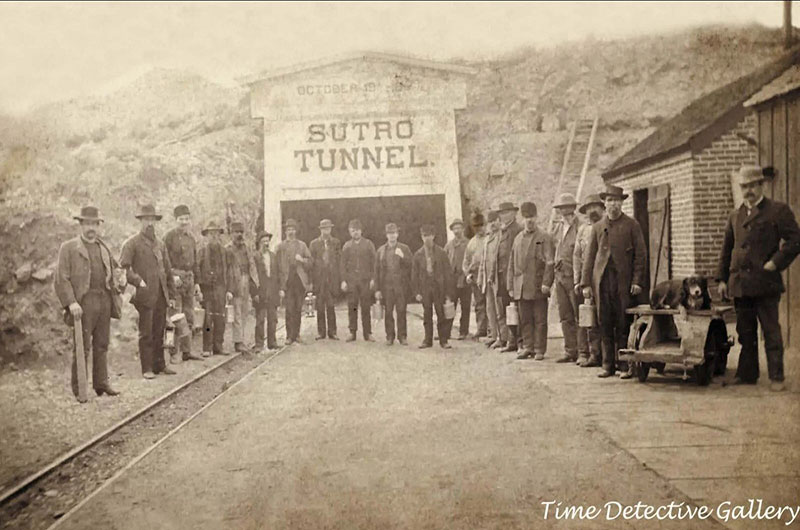


Adolph Heinrich Joseph Sutro (1830-1898), a Jewish German-American politician and philanthropist who served as the mayor of San Francisco, was one of the most colorful and influential figures in the late nineteenth-century American West. He lived a life that combined the boldness of the engineer (although he wasn’t one), the ambition of the entrepreneur, the flair of the politician, and the subtle complexity of the assimilating Jewish immigrant. He is best known for his incredible engineering achievement, the Sutro Tunnel, a four-mile drainage tunnel that pioneered the excavation of large drainage and access tunnels in the U.S. and became an outstanding marvel of the age.

Ironically, although most sources characterize Sutro as a mining engineer, he was essentially an investor who had no apparent engineering training and knew little to nothing about engineering. This is not in any way to denigrate his crucial role as an entrepreneur and the impetus, prime mover, and ardent promoter of the project, which never would have seen the light of day but for his monumental efforts, as described below.
Born in Aachen, Prussia (today North-Rhine Westphalia, Germany) into a Jewish family, Sutro made his way to the United States as a young man, pursued fortune and glory in the mining districts of Nevada, and rose to great prominence in San Francisco as a landowner, builder, collector, and eventually as mayor. While his greatest achievement, the Sutro Tunnel, gave him both wealth and a platform for his later civic endeavors and ensured his fame, throughout his life, and especially in the memory of those who sought to preserve his legacy, questions regarding his Jewishness, including his heritage, his identity, his connections to Jewish life, and his place in the history of Jewish America, hover over his biography.
Sutro, whose parents were freethinking Jews, did not observe any Jewish holidays, did not belong to any synagogue, and did not provide his children with any Jewish education. As such, it is not surprising that Adolph similarly was not a practicing Jew, but his Judaism nonetheless persisted in his family origins, in his funeral rites, in his marriage to a Jewish woman, to his engagement with Jewish charitable causes, in his extraordinary library of rare Hebrew manuscripts, and in the ambivalent way the Jewish community both claimed and distanced itself from him. To understand him fully requires tracing not only the chronology of his career, but also the layered and sometimes elusive dimensions of his Judaism.
Sutro was the eldest son of eleven children born to Emanuel Sutro, a woolen cloth merchant, and Rosa Warendorff, and the upper middle-class family belonged to the cohort of German Jews who navigated the tensions of the nineteenth century between tradition and emancipation, between the pull of assimilation and the persistence of Jewish identity. When Sutro was seventeen, his father died, leaving the family in financial straits, and, when the Prussian Rebellion of 1848 created economic instability that forced the closure of the family factory and further unsettled their lives, the family, like many other German Jews seeking opportunity, left for the United States in 1850.
They all settled in Baltimore, except for Adolph, who decided to seek his fortune in California and, by 1857, was running three flourishing tobacco shops in San Francisco. Drawn by the Gold Rush, he traveled to the town of Victoria, which had become the Gold Rush’s main supply center, to sell his cigarettes; however, when the enterprise failed, he was forced to return to San Francisco with severe financial losses.
His great opportunity came not in California, but in the booming mining districts of the Comstock Lode near Virginia City, Nevada, where $350 million of silver deposits had been discovered. Although the Comstock silver mines were phenomenally productive, they were plagued by a problem that threatened to undermine the industry itself: the dynamite blasts that loosened ore-bearing rock also released pent-up water in underground chambers that caused dangerous flooding and pumping the water out consumed vast resources and curtailed operations. In addition, the temperature in the mines often reached 110 degrees, creating serious adverse health conditions for the miners. Sutro conceived a bold plan to solve all these problems at once: he proposed digging a great drainage tunnel 1,600 feet under Mount Davidson (which contained the Comstock Lode), nearly four miles long, twelve feet wide, and ten feet high that would provide a ventilation shaft for the miners, reducing the extreme heat; carry off the water; and provide miners with safer access to the ore veins, a vision of extraordinary daring, both technically and financially.
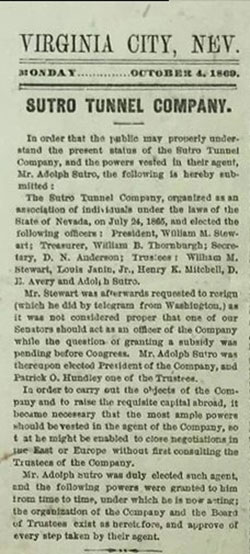
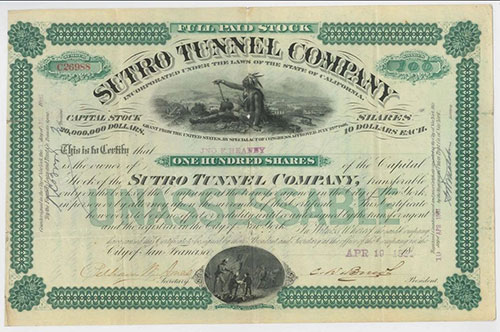
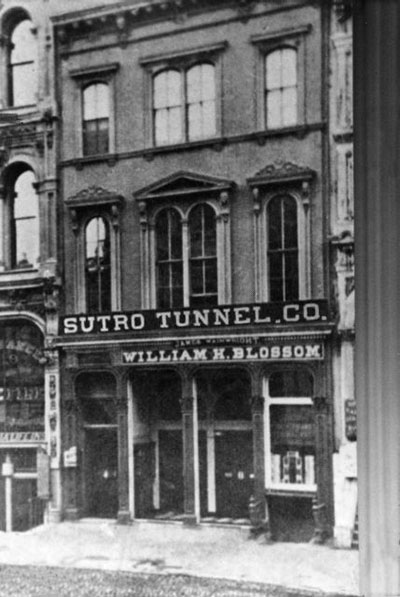
Sutro obsessively spent years lobbying the federal government, the Nevada legislature, and the mining companies, arguing that his plan would secure the future of the Comstock until, finally, he incorporated the Sutro Tunnel Company in 1865 and Congress passed a bill in 1866 granting him an exclusive charter to construct the tunnel. Financing the project proved arduous, particularly when the Bank of California, which originally agreed to finance the project, later rescinded the offer. Moreover, the mining interests of the Comstock initially supported the project, but later opposed the idea because they feared that an alternate access point to the Comstock minerals would threaten their monopoly on the mining and milling of gold and silver in the Comstock.

Nevertheless, he successfully raised the requisite funds after he won miners’ support following a disaster at the Yellow Jacket Mine on April 7, 1869, when dozens of miners were burned to death because they could not escape, which enabled him to successfully lobby the Miner's Union in support of the tunnel. He began construction on October 19, 1869, and the completion of the tunnel nine years later in 1878 made him "the King of Comstock" because it could drain four million gallons of water daily and was rented by mine owners at an average of $10,000 a day. Nonetheless, the tunnel proved to be a losing proposition, and, after a year of running the tunnel, he sold his interest in the tunnel for about $900,000 (almost $30 million in today’s dollars) and moved back to San Francisco. This turned out to be a wise decision given that, by 1899, the tunnel stock had become virtually worthless.
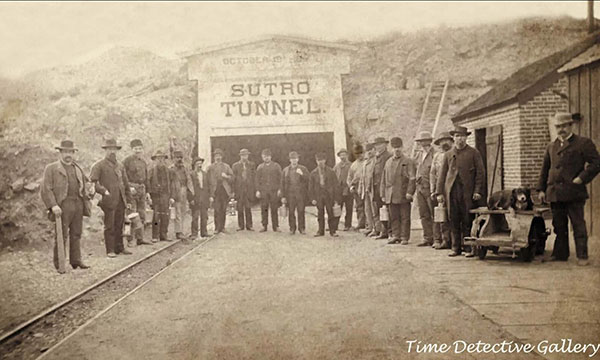
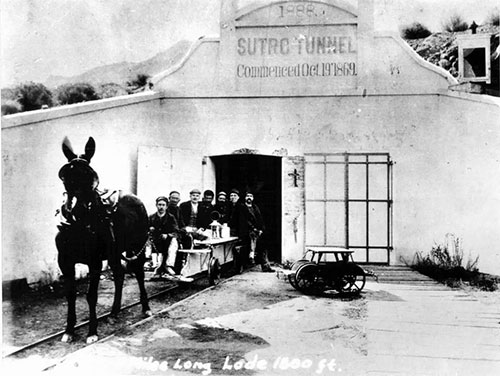
The Sutro Tunnel became one of the engineering marvels of its time and the tunnel’s opening was heralded as a triumph of human ingenuity. Dug through hard rock by men wielding picks, hammers, and black powder, the tunnel was an arduous enterprise that took a decade to complete. The tunnel was completed in 1879, measuring 20,489 feet in length and, at its peak, more than 2,000 men worked for Sutro.

The successful completion of the mammoth and unlikely project gave Sutro a reputation as a man of vision and courage, and he used his prominence to amass land in San Francisco, particularly in the western areas near the ocean. At a time of economic depression in San Franciso, he substantially increased his wealth by investing almost a million dollars in city real estate, eventually owning some 2,200 acres – one-twelfth of the entire city – including the entire northwestern portion of Rancho San Miguel.

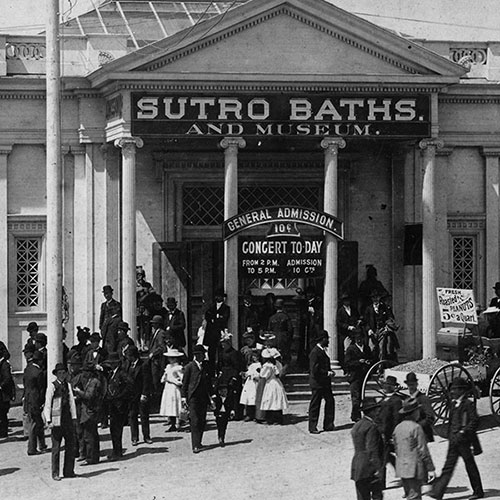
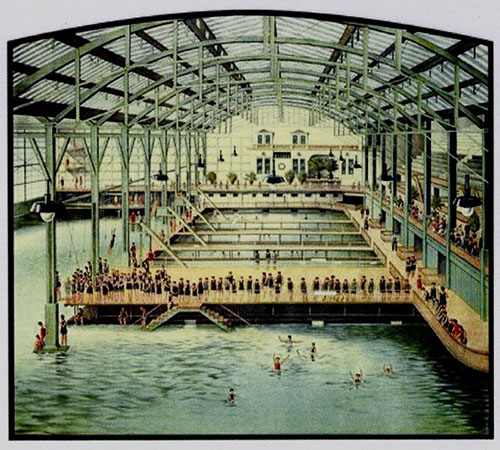
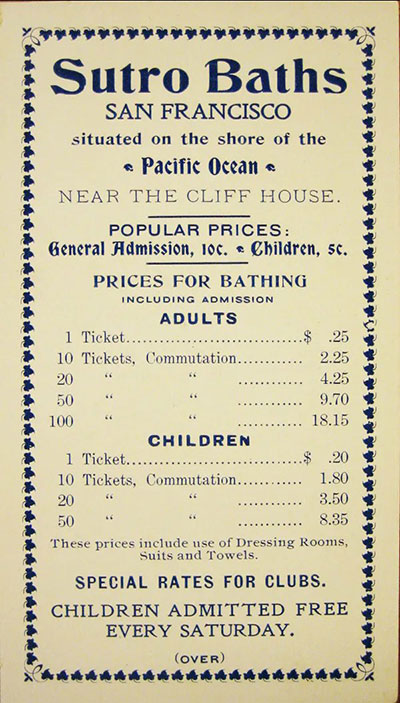
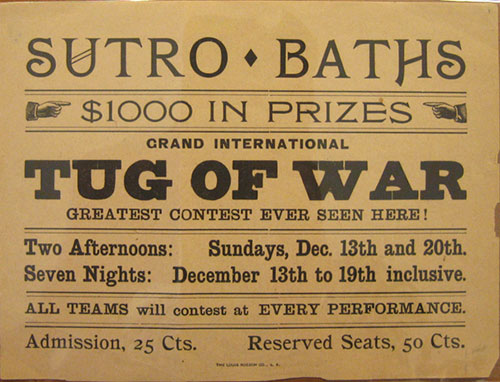
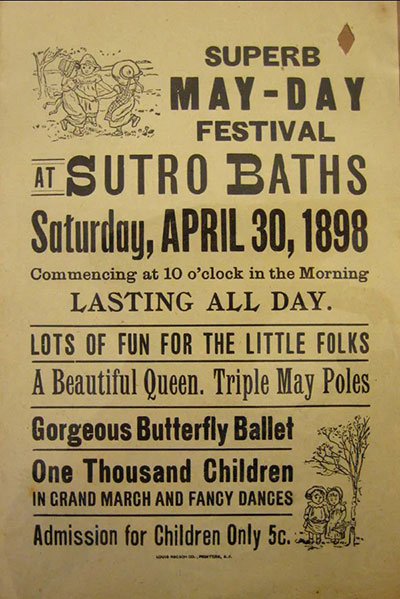
Sutro opened his own estate to the public and he was heralded as a populist for various astute acts of public generosity, such as opening an aquarium and an elaborate and beautiful, glass-enclosed entertainment complex called the Sutro Baths – which housed seven swimming pools (one freshwater, six saltwater), 517 changing rooms, and could accommodate an unfathomable 7,400 bathers – a museum and an ice-skating rink. He built an excursion railroad to facilitate greater ease of access to his entertainment complex and he purposely maintained a low entrance fee to make it possible for the broader public to visit his grounds. Indeed, great throngs of San Franciscans arrived on steam trains, bicycles, carts and horse wagons on Sunday excursions.

The Sutro Baths were segregated in the early years of their operation, but, in 1897, a black man named John Harris sued the Sutro Baths for refusing him entry because of his race; the case was tried in the San Francisco Superior Court, which ruled in Harris's favor. A fire destroyed the baths complex in 1966 – the fire was later determined to be arson – and, sadly, all that remains now are ruins.
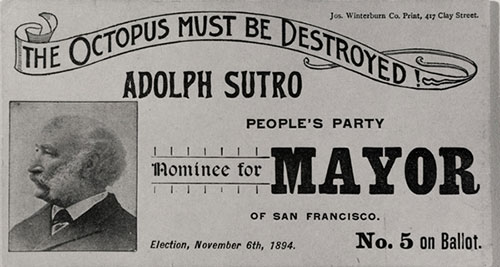
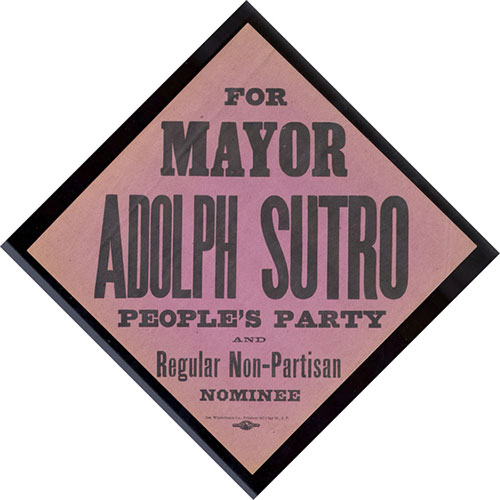
Sutro's reputation as a provider of diversions and culture for the average person led the radical – and politically weak – Populist Party to nominate him to run for mayor on its ticket. He won the 1894 election on an anti-big business platform, inveighing against the tight grip that the Southern Pacific Railroad had over local businesses. He was immensely popular, particularly with the working class because of his defense of the Comstock miners, and had further endeared himself by fighting the Southern Pacific's grip on the city streetcar system. Political commentators at the time generally agreed that Sutro’s popularity was such that he would have won on any ticket, and he was in fact elected by a landslide, particularly notable since the Populist candidate for California governor polled only 11% of the San Francisco vote at the same time. However, Sutro was quickly considered to be a failed mayor because of his political inexperience and his inability to transition to city governance, which he approached in the same way that he had approached his private ventures: by relying on his personal judgment and expecting immediate compliance. This style clashed with the complicated, partisan, and often corrupt political machinery of San Francisco in the late 19th century, and Sutro’s inexperience meant that he had little understanding of how to build alliances with the Board of Supervisors or how to navigate the bureaucratic process.
Moreover, Sutro, whose election initially generated enormous enthusiasm, had been elected largely as a populist reformer who promised to fight corruption, curb the influence of powerful monopolies such as the Southern Pacific Railroad and the Market Street Railway, and promote the public’s welfare. However, once in office, it turned out that he had no concrete or detailed plan for implementing his promised reforms, and his administration quickly stalled when his broad rhetoric proved difficult to translate into workable policy. He had entered office as one of the most popular men in San Francisco, admired both for his business successes and for his gifts to the public, but his failures in office quickly eroded that goodwill such that by the end of his term, his reputation had soured; newspapers, political leaders, and many ordinary citizens criticized him as ineffective, obstinate, and out of touch. This sharp fall from grace is one reason his mayoralty is so often judged harshly, and he did not seek reelection.
Against this backdrop of engineering feats, business ventures, and political ambition lies the thread of Sutro’s Judaism, with his Jewish identity rooted in his family’s background in the German town of Aachen. German Jewry in the early nineteenth century, which was caught in a process of modernization and legal emancipation, also confronted persistent prejudice, and, while families like the Sutros valued education, commerce, and integration into German civic life, they also carried with them the traditions of synagogue affiliation and communal belonging. Sutro’s father as a cloth merchant places the family within a common pattern of Jewish occupational life in that period, and, as the eldest son, Adolph would have been expected to carry forward both the family’s economic survival and its cultural identity. Emigration to the United States did not erase these expectations, but it did transform them; in San Francisco and Nevada, he encountered a Jewish community that was both vibrant and diverse, composed of German Jews like himself as well as newcomers from Eastern Europe. He belonged to this community by origin, but his path was increasingly that of a secular, ambitious entrepreneur.
Accounts of Sutro’s personal religious practice emphasize his distance from ritual observance and, by virtually all measures, he was a secular Jew who did not regularly attend synagogue, keep kosher, or observe the Sabbath in the traditional manner. Contemporary reports and later biographers describe him as a man who seldom entered a synagogue and who did not display overt signs of Jewish piety; yet, despite this, he remained linked to Jewish communal institutions. For example, receipts preserved in his papers show that he contributed to Jewish charities, including the Eureka Benevolent Society of San Francisco, an organization that assisted Jewish immigrants, the poor, and the sick. Moreover, his correspondence occasionally touched Jewish networks, and, though he did not speak often of his Judaism, his name remained well-known within the Jewish community of the city.

Perhaps the most striking testament to his engagement with Jewish heritage lies in his extraordinary library. Sutro was an avid collector of books and manuscripts and, at the time of his death, he owned one of the largest private libraries in the United States, comprising more than 200,000 volumes. Among them were 135 rare Hebrew manuscripts, which later became part of the Sutro Library collection; these manuscripts included rabbinic texts, biblical commentaries, and other works of Jewish learning, some dating back to the medieval period.
In 1893, a scandal that rocked the antiquities trade involved the sale of scroll fragments 900 years older than the Dead Sea Scrolls to the British Museum by a Jerusalem antiques dealer named Moses Shapira, who presented leather scroll strips to the British Museum, claiming that they were an ancient manuscript of Deuteronomy written in Paleo-Hebrew script. Experts of the time declared them forgeries, citing unusual letter forms and suspiciously treated leather; Shapira’s reputation was ruined, and the manuscripts soon vanished. After the 1947 discovery of the Dead Sea Scrolls, which proved that ancient leather texts could indeed survive in desert caves, the question resurfaced: had Shapira been falsely condemned, and were his lost “Deuteronomy fragments” actually authentic and hundreds of years older than the Dead Sea Scrolls?
Modern journalist and scholar Chanan Tigay reopened the case and traced material once owned or sold by Shapira, discovering that Sutro had bought a large trove of his manuscripts in 1884, including genuine Yemenite Torah scrolls and fragments, that provided concrete evidence of Shapira’s legitimate dealings and demonstrated that many of the allegedly “suspicious” physical features described also appear on authentic manuscripts. While the lost Deuteronomy strips themselves have never been found, the Sutro collection helped clarify that Shapira was not a forger but, rather, a serious manuscript dealer whose materials were often genuine, thus transforming the episode from a tale of fraud into an enduring scholarly mystery.
Sutro wed Leah Harris, an English Orthodox Jewish woman, in an 1856 traditional marriage ceremony officiated by Rabbi Julius Eckman, who founded the Anglo-Jewish weekly Gleaner and was active at Congregation Emanu-El and in Jewish communal life. As a good-hearted traditional Jewish woman, Leah, who wanted a simple life devoted to family, Jewish charities, and the synagogue, proved incompatible with her husband who, as discussed, was only ethnically Jewish and cared not at all for Jewish practice. Multiple histories and newspaper accounts report that after the couple produced six children, they separated when Leah discovered a compromising situation involving her husband and the widow Mrs. George Allen in 1879. For the rest of his life, Sutro insisted that his relationship with Mrs. Allen was only platonic but, in any event, an official separation was recorded in 1880. However, the couple never divorced, and, although they maintained entirely separate lives, they began to occasionally appear in public together before her death in 1893.
One of the questions that inevitably arises in any exploration of a prominent Jewish figure in nineteenth-century America is the matter of antisemitism. California, like other states, was unquestionably not free of antisemitic sentiment, but it did not generally reach the virulence of some European locations and, in fact, Sutro was generally respected for his honesty, decency, and civic involvement. Nonetheless, the opponents to the Sutro Tunnel reportedly called him “a crazy Jew-crook” and “Assyrian carpetbagger.”
Sutro’s election as mayor of San Francisco in 1894 is itself a remarkable fact, suggesting that his Jewishness did not disqualify him in the eyes of the electorate, and contemporary accounts of his campaign focused more on his opposition to the railroad and his populist appeal than on his religion. If antisemitic rhetoric was directed against him, it does not appear to have left a major mark in the sources, nor did Sutro himself leave behind any writings about antisemitism. Nor is there any record of Sutro speaking publicly about Jewish persecution abroad, nor did he take positions on Jewish national questions such as the future of Eretz Yisrael.
Sutro’s philanthropy extended beyond Jewish causes, but Jewish organizations consistently acknowledged his contributions, and his role as a civic benefactor in San Francisco included gifts of land, gardens, and public amenities. Still, the Jewish community, particularly through Congregation Sherith Israel, claimed him at key moments. When he died in 1898 at the age of sixty-eight, his funeral was conducted by Rabbi Jacob Nieto, the distinguished spiritual leader of Sherith Israel, and he was buried at Home of Peace Cemetery in Colma, the Jewish cemetery that had replaced San Francisco’s earlier Jewish burial grounds. The choice of Rabbi Nieto, a central figure in the San Francisco Jewish community known for his eloquence and his engagement with civic affairs, to officiate was significant: his presence at Sutro’s funeral confirmed that, whatever Sutro’s private religious practices had been, the Jewish community recognized him publicly as one of its own. However, historical reports indicate that Sutro was cremated, and his burial at Home of Peace Cemetery could potentially refer to the burial of his ashes or to a later memorial.
On December 22, 1979, the Associated Press office in San Francisco issued the following report:
For 81 years, no one knew where they buried the ashes of old Adolph Sutro, the man who made a mint on the Comstock Lode and came to San Francisco to spend it. Now, on a windswept hill which bears his name, Adolph Sutro has probably been found, in a weather-beaten urn cemented into a rock... The area where Sutro built his mansion, a huge section called Sutro Heights, overlooking the famed Seal Rocks and the Pacific Ocean, is now mostly park land...The paradox of Sutro’s Jewish identity is perhaps most apparent in the way he was remembered. During his lifetime, he was regarded as one of San Francisco’s great benefactors, a civic builder whose gifts of land and amenities enriched the city, and, while his Jewish heritage was well-known, it was rarely in the foregrounded or in the general public consciousness. In the decades after his death, however, the Jewish community took increasing interest in reclaiming him, including the preservation of his library, and his rare Hebrew manuscripts became a matter of Jewish cultural pride.
In recent years, Jewish historians and organizations have sought to highlight Sutro’s Jewishness more explicitly; for example, in 2021, a historical marker at Sutro Heights Park was updated to include mention of his Jewish heritage, thanks to the efforts of the Jewish American Society for Historic Preservation. At the end of the day, Sutro is remembered as a model citizen whose civic contributions include a picturesque public park, a library, an aquarium, and, notwithstanding a failed mayoralty, years of incorruptible municipal government.