 September 4, 2026
 Categories: Jewish Community
The Making of the World’s Largest Menorah


It all began during New York City’s financial crisis in 1977. It was an idea to create “the world’s largest menorah in the greatest city in the world, New York City,” said Rabbi Velvl Butman, son of the creator of this concept, Rabbi Shmuel Butman, z”l, the director of the Lubavitch Youth Organization.
The younger Rabbi Butman explained exclusively to The Jewish Press that his father came out of what was then the General Motors Building on Fifth Avenue in Manhattan near the Pierre Hotel and the Plaza Hotel on East 59th Street with Central Park to the north. “A beautiful plaza,” he said. “Wow, this is the place.”
Coincidentally, the address of the Plaza Hotel is 768 Fifth Avenue with the address for adjoining apartments being 770 Fifth Avenue. From 770 Eastern Parkway (the Lubavitch headquarters) to 770 Fifth Avenue (the apartments next to the Plaza Hotel), 770 is the common theme here.
As his son tells the story, his father called Willie Goldberg, who was the head of the Jewish Diamond Club on 47th Street, known as the Diamond District.
“At that time, it cost $5,000 to build the whole menorah,” Rabbi Velvl Butman said. “The first menorah wasn’t beautiful. It was a traditional menorah.”
Goldberg was amazed at the request because “it would bring a lot of attention to the Jews.” The senior Rabbi Butman’s response as told by his son, was, “The Talmud obligates us to create a public menorah. The only mitzvah we have as Jews is to publicize the miracle.” Willie Goldberg paid for the menorah.
At around the same time, scientists discovered a manuscript from Rambam. He depicted exactly what the menorah in the Beis HaMikdash looked like. It wasn’t round like the Arch of Titus; it was actually V-shaped. Ever since that went public, the Rebbe, Rabbi Menachem Mendel Schneerson, zt”l, requested that we should make sure to do what Rambam says and make the image correctly.
Rabbi Shmuel Butman contacted famed Israeli sculptor Yaacov Agam (Gipstein, originally) to build the menorah we see today. Agam studied at the Bezalel Academy of Art and Design in Jerusalem, the Kunstgewerbe Schule. Agam, 97, is now living in Paris, France.
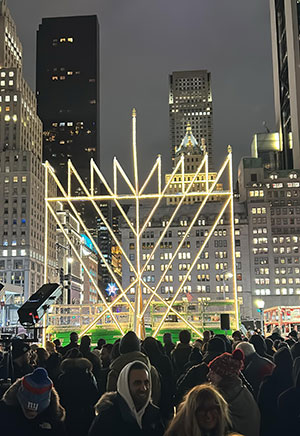
The menorah in Midtown Manhattan stands 32 feet high, is gold-colored, and weighs 4,000 pounds. It is a steel structure recognized by the Guinness Book of World Records as the “world's largest Chanukah menorah.”
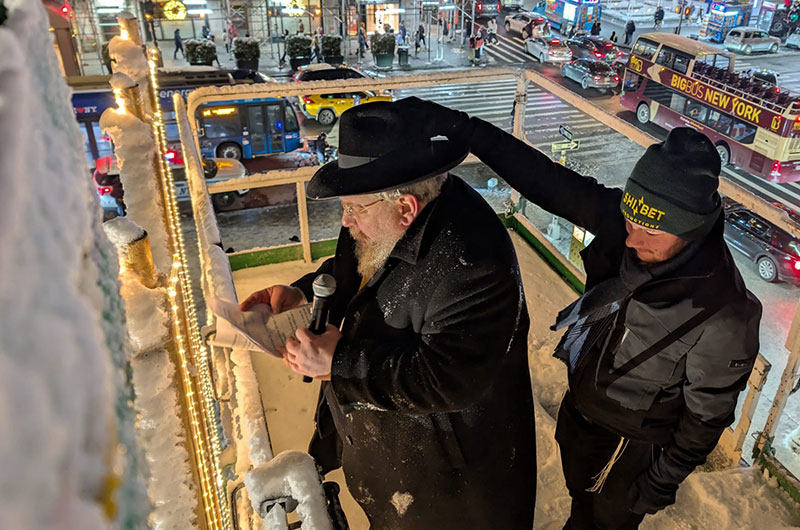
Originally, people would be hoisted to the top of the menorah in a one-person Con Edison utility truck bucket also known as a cherry picker. Now the access has evolved to an electronic lift acting as a stage that can fit more than one person. Every day a new person gets the aliyah to light the menorah. If you are not Jewish, you can only light the shamash.
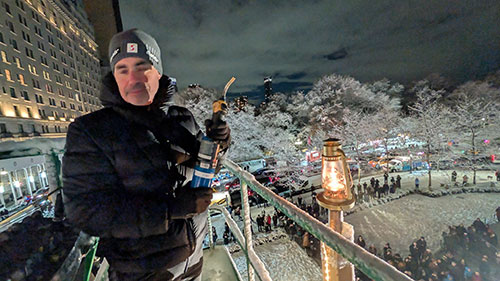
It is possible that next year Zohran Mamdani would be asked to illuminate the first Chanukah light. “In Judaism we honor the seat more than the individual. In Judaism it is not the individual you’re honoring. It is what he represents,” according to Rabbi Velvl Butman. “Each glass cup of the menorah is lit by kerosene, a derivative of oil. A modified camping lantern is used to hold the liquid. The kerosene does not have to be kosher because it is not being ingested. The Talmud says pure olive oil is the best because it gives off the cleanest light,” said Rabbi Butman.
“The night the menorah went up in 1977, unbeknownst to my father, the Rebbetzin, Chaya Mushka Schneerson, z”l, visited the site where the menorah stood and she said in Yiddish, ‘Now I see my husband’s work has been accepted by the world,’” Rabbi Butman recalled. “It’s the most prominent area in all of Manhattan as far as prestige. Every year, without exaggeration, hundreds of millions of viewers see this.
“The message of the menorah, as the Rebbe said, is a multiple message but first and foremost, it’s a universal message. We live in a world of darkness. Never more than today do we see the darkness. The menorah comes along and tells every human being, regardless of race, color, or creed, the answer is do not fight it, illuminate it. Darkness is a coward. It is not a personality. It only invades when you allow it in. When you assert your right with pride, that is when you are respected. I use the acronym of F.L.A.G. – Freedom over Oppression, Light over Darkness, Action over Apathy and Good over Evil. The Rebbe’s message is F.L.A.G. Carry your flag proudly,” Rabbi Butman concluded.
Oil in Judaism is considered wisdom. Why? If you have a bucket full of water and you drop in a teaspoon of oil, it will always come to the surface. In the human body, that’s compared to wisdom. It’s in your head. Your wisdom always remains higher. In Kabbalistic terms, the highest part of the Jew, which we call the Pintelah Yid in Yiddish, the spark of your Jewishness, which lies at the core of your identity, cannot be assimilated. Your body is a vehicle that houses your soul.