 October 16, 2026
 Categories: In Print / Headline / Op-Eds
The Modox Conundrum Goes International


I recently asked a 21-year-old graduate of an Orthodox Jewish high school roughly how many girls in her grade were strictly shomer Shabbos. She asked if that meant no texting, and I answered in the affirmative. She thought, looked me straight in the eye, and said: “I’m having trouble coming up with five.”
Similar responses were given by dozens of students I interviewed who recently attended the top Jewish day schools in America. Kiruv professionals I’ve interviewed, along with the latest Pew polls, continue to paint a dismal future for all things modox (Modern Orthodox). Let’s just say, the Modern Orthodoxy that Rav Samson Rafael Hirsch and later Rav Soloveitchik professed, which adhered to the mesorah and halacha, is no longer running on all cylinders in many communities.
Today, many halachos are simply chucked to the wayside by a large segment of the modox community. The numbers shift depending on community (for example, places like Teaneck fare better than others), friends, school, parenting, and personality type. (For a comprehensive treatment of this issue, refer to my three-part series, printed in this publication in November 2022, "The Modern Orthodox Conundrum.")
This past year alone, I asked dozens of intelligent graduates from different prominent Jewish day schools if they believe that G-d wrote the Torah. Most weren’t quite sure. NOT QUITE SURE? Why would anyone follow the Torah if they didn’t believe in its Divine authorship? A very basic tenet of our belief is Moshe emes v’soraso emes (Moshe is true and his Torah is true) – so much so that two of the Rambam’s fundamental principles of faith are a belief in the Divine origin of the Torah and its immutability.
The Rambam understood that to be a truly observant Jew, we must fully accept that the Torah is the actual word of Hashem, not a book of wisdom penned by intelligent people. The Torah came directly from G-d vis-à-vis mass revelation directly to Klal Yisrael. Yet for some reason, many modox Jews aren’t 100% sold on it. A 2020 Pew poll said that 30% of people raised as modox, ages 18-28, no longer identify as Orthodox.
Even with all of their issues, this nonsense does not fly in the more yeshivish communities, as halachos like davening three times a day, learning every day, making berachos, keeping strictly kosher and wearing tzizis are generally a no-brainer. Their message is resoundingly clear: Moshe emes v’soraso emes. All of it. Not just the fun parts! Sure every community has its problems, but many in the Modern Orthodox community have failed to preserve the mesorah, which is fundamental to being Orthodox. It also bears mentioning that there are countless modox individuals who live very proud Torah-true Jewish lives.
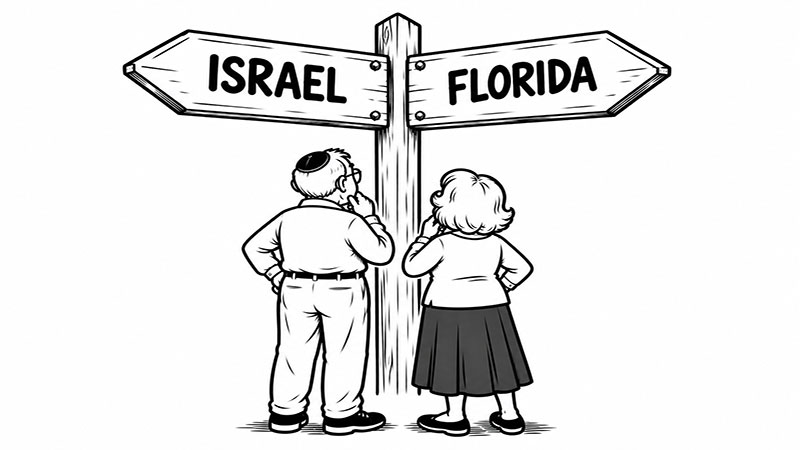
A prominent rav from Israel took some umbrage to my 2022 series, suggesting that while the dwindling numbers within modern orthodoxy are a legitimate problem in America, this issue isn’t a problem for the modox who make aliyah.
Since I don’t live in Israel, I never considered that. And yes, I had assumed that as long as kids grow up in Israel, they’ll have a much better chance of avoiding the pitfalls facing modox Americans.
And then I met a man wearing Israeli-style sandals, blue tzizit, and a kipah serugah. The only thing missing was a “Honk for me if you love Efrat” bumper sticker across his head.
I assumed he lived in Israel, but it turns out he recently retired as a prominent principal for the American Jewish day school system for over 30 years. He agreed that the modox problem was no laughing matter, and I suggested that perhaps the best way to protect our children would be to make aliyah. He stunned me with his response: “Well, if we’re going to be honest, I recently said to my wife, ‘Doesn’t it seem strange that so many of our friends who made aliyah have children who are not observant? It’s true, they all proudly serve the State which is unbelievable. They are fluent in Hebrew and are very proud Israeli Jews, but at the end of the day, they are not Sabbath observant, and aren’t necessarily frum.”
Could that possibly be true? After all, if anything one would assume that moving to Israel would prompt a renewed sense of religious vigor, not the opposite, as he was suggesting.
So I did what every Jewish investigative reporter would do. I noshed over some rugelach and hot tea. And got on the phone.
Having relatives (my daughter and my wife’s whole family for starters) and friends in Israel, I decided to call many of them and ask them flat out: Are your kids frum? Here are the top answers I received:
- “Yes, baruch Hashem. We are very lucky.”
- “Some yes, some not…”
- “Well, that depends on what you mean by frum? He keeps his own version of shabbos.”
Many modox olim teenagers (like their American counterparts) are no less immune to the trappings of social media and the pressures of the secular world. So while they may be prouder, more educated, Hebrew-speaking Israeli citizens who serve the Jewish state, there’s no denying the reality that while many are tremendous heroes, they aren’t technically frum.
It seems that though many of the parents who make aliyah have strong ideologies, that sentiment isn't necessarily shared by their children. Many teenage olim have very difficult adjustment periods trying to make new friends and fit in, alienating them along the way. And similar to the American counterparts, the allure of secular life is simply too overpowering. Some utilize moral licensing, the idea of rationalizing a sin (kashrus or Shabbos) because one does a mitzvah (yishuv ha’aretz or serving in the army.)
I recently discussed this issue with a prominent rav who runs a yeshiva for American girls. He explained that in chutz la’aretz, many feel a distance from Judaism and are more observant in order to feel connected. Once in Israel, because everything feels more spiritual and Jewish (think Purim), many Jews don’t have the same need to connect with certain mitzvos.
There’s certainly no one single answer. but the fact remains that modern orthodoxy is facing very real challenges. Both here and abroad.
To be very clear, it is extremely meritorious to make aliyah, and the great sacrifice that every Israeli makes is not to be minimized, not to mention every single soldier who risks or even gives their lives for Klal Yisrael.
Yet nowhere does the Torah remotely imply that if you live in Israel, you can ignore some mitzvos like keeping Shabbos or putting on tefillin. In fact, some might argue that living in Israel, where we are technically closer to Hashem, might necessitate an even higher level of scrupulousness, as one would behave inside a royal palace.
I think the bottom line is that if you are on the right side of modern orthodoxy, where Torah and mitzvos are top priority and you put your child in a good environment, there’s a very good chance they will turn out ok. But if we place priority in certain mitzvos and ignore others, it’s just a matter of time before the outside world chips away at our observance, along with that of our children. And it doesn’t matter whether your kids are in Hillel Academy, Binghamton, NYU, Bar Ilan or Hebrew University. The yetzer hara needs no passport to reach his destination.