 October 9, 2026
 Categories: Collecting / Features On The Jewish World
The Philosemitism and Zionism of Jean-Jacques Rousseau


Few thinkers of the eighteenth century exercised a wider or more transformative influence than Jean-Jacques Rousseau (1712-1778), whose philosophy and thinking marked the end of the Age of Reason and the birth of Romanticism and was unequaled in European history until Karl Marx a century later. He dramatically shifted political and ethical thinking into an entirely new direction, transforming music and the arts and, perhaps most famously, advancing a philosophy pursuant to which emancipation and freedom are attainable goals for the masses. He reshaped political theory, educational philosophy, moral thought, autobiographical writing, and even musical theory and his life, marked by instability, poverty, emotional volatility, and a pattern of ruptured friendships, unfolded against a backdrop of profound intellectual creativity.
Although he came from a modest Genevan background, Rousseau rose to become one of the most important and controversial authors of the Enlightenment. His Discourse on the Arts and Sciences (1750) first propelled him to prominence; Discourse on the Origin of Inequality (1755) deepened philosophical debates about natural man, freedom, and the corrupting influence of civilization; Émile (1762) and his monumental The Social Contract (1762) were banned and burned in multiple jurisdictions; and his historic Confessions inaugurated an entirely new genre of introspective autobiography. What makes him particularly notable among his contemporaries, however – particularly when considered alongside Voltaire, whose relentless antagonism is well known, and Diderot who, while less hostile, saw Judaism primarily as a historical curiosity – is the singular pro-Jewish, Hebraically conscious dimension of his work. No major Enlightenment thinker in France wrote as sympathetically about Jews or Judaism; none saw the Hebrew political experience as embodying a model worthy of admiration; and none articulated what we would now call proto-Zionist ideas with Rousseau’s clarity or boldness.

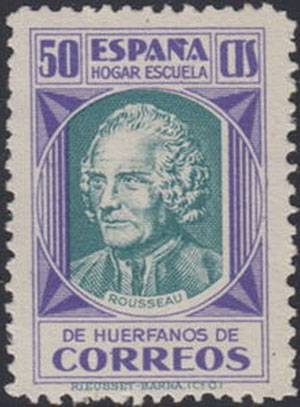
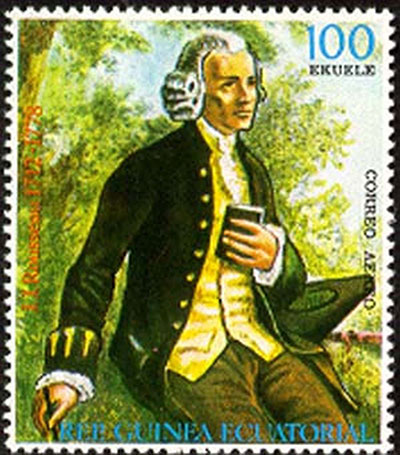
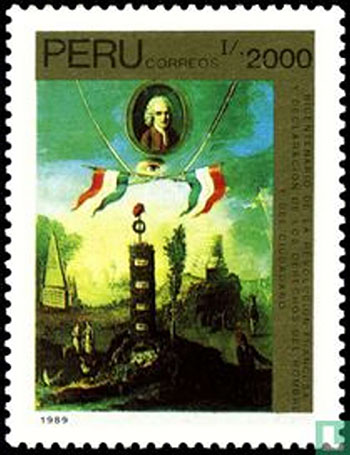

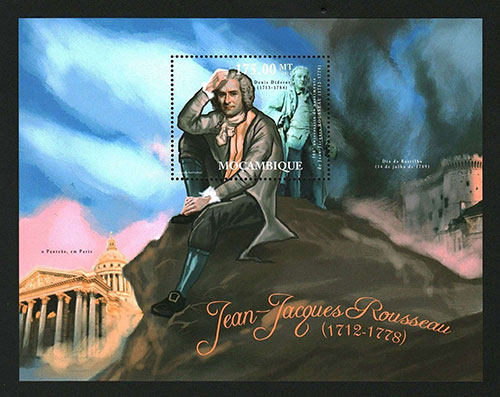
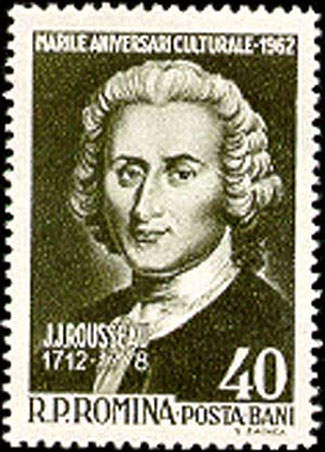
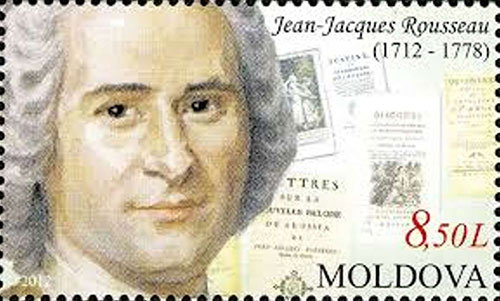
In assessing Rousseau’s relationship to Judaism, it is crucial to recognize how distinctive his position was within the intellectual milieu of his day. The Enlightenment in France was often ambivalent or hostile toward revealed religion and Jews, as representatives of the oldest revealed religion, bore the brunt of philosophic skepticism. Rousseau alone engaged seriously with the Jewish political experience and sought in it not merely historical information but also philosophical insight.
Rousseau’s early experiences did not predispose him to this position; his father, Isaac, was a watchmaker, his mother died only days after giving birth to him, and the young Rousseau grew up in a Calvinist milieu in which attitudes toward Jews tended to be negative, both theologically and socially. Yet, the Scriptures, particularly the Hebrew Bible, played a central role in his moral and imaginative education, and his earliest sustained reading consisted of the Pentateuch and Prophets, which he would later recall as formative. The Hebrew Bible provided him with a vivid sense of human drama, moral responsibility, and the collective destiny of a small nation under divine guidance, and it is impossible to understand his later statements about Jews without recognizing how deeply the biblical narrative etched itself into his understanding of politics, morality, and nationhood.
Rousseau left Geneva at sixteen and lived for a period as a wanderer, eventually finding refuge with Françoise-Louise de Warens, who became his patron, caretaker, and romantic partner. After years of irregular employment, including secretarial positions and work as a music copyist, he settled into the life of a writer in Paris, where he entered the orbit of the philosophes, though he never fully belonged to their circle, partly because his views often diverged sharply from theirs and partly because of his difficult temperament. He became secretary to Madame Louise Marie Dupin, the illustrious salonnière whose intellectual household attracted France’s leading minds, and he assisted her in important research for a massive treatise on the equality of men and women.
It was during this period that he studied, transcribed, and reflected on medieval ordinances concerning Jews, including the 1363 edict of Marshal Marechal D’Audeneham, and his notes on Jewish economic life and on the status of Jewish women are among the earliest documentary indications of his unusual sympathy for Jewish social structures. In his commentary on the ordinance, Rousseau emphasized that Jewish women were legally empowered actors in commerce, functioning on equal footing with men in contractual matters; this struck him as particularly noteworthy and admirable, and it informed his later arguments about the social roles of women and his larger evaluation of Hebraic law.
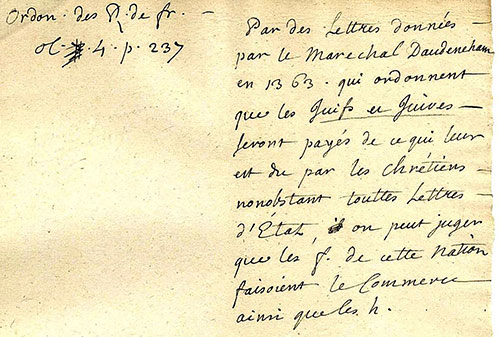
In the 1746 handwritten manuscript page exhibited here, Rousseau discusses Christian commerce with Jews and examines the 1363 Ordinance by D’Audeneham concerning the business of Jewish men or women to whom Christians must pay money. Portraying the Jewish treatment of women in a very positive way, he concludes that Jewish women were on equal terms with Jewish men in transacting business. He made these notes while gathering information for Madame Louise Marie Dupin for her famous book, On the Equality of Men and Women.
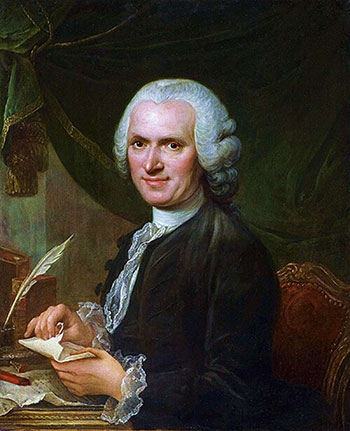
Famous for her intellect and beauty, the aristocratic yet much-beloved Madame Dupin (1706-1795) ran a prestigious Parisian salon attended by the great luminaries of French society, which included some of the best-known writers, poets, and philosophers of the Renaissance, including the young Rousseau, whom she hired as her personal secretary but who later became her close friend, advisor, and protégé. Rousseau, who was also hired by Dupin to tutor her son, Jacques-Armand, wrote Emile (1762), one of his most famous – and, as we will see below, one of his most pro-Jewish – works for the boy.
Rousseau’s admiration for Hebraic antiquity emerges repeatedly in his writings of the 1750s and 1760s. Although he is often perceived as a critic of religion, particularly organized Christianity, his critique was rooted not in atheism, but in a complex deistic outlook that viewed Judaism with far greater respect than he accorded to Christian institutions. For example, in Letter to Christophe de Beaumont (1763), written in response to the Archbishop of Paris’s condemnation of his Émile, Rousseau went so far as to acknowledge the internal coherence and moral seriousness of Judaism, contrasting its ethical orientation favorably with what he considered the institutional and metaphysical distortions of Christianity. This is a theme that appears throughout his work: Judaism is consistently portrayed as a religion of social justice, civic unity, and ethical clarity, whereas Christianity, in his view, encourages passivity and otherworldliness. In fact, he was disgusted by the Christianity of his day, as evidenced by his assertion in The Social Contract that true followers of Christ would not make good citizens. He repudiated the doctrine of original sin, which plays a large part in Calvinism; thus, as he wrote in his Letter to Beaumont, "there is no original perversity in the human heart."
One of the most remarkable expressions of Rousseau’s philosemitism, and one of the most relevant passages for understanding his views on Jewish national destiny, appears in Émile, Book IV, where he makes an explicit argument for the establishment of a Jewish state and for the restoration of Jewish political independence. In a passage that has become one of the most frequently cited proto-Zionist statements in eighteenth-century philosophy, he writes:
I do not think that I have ever heard the arguments of the Jews as to why they should not have a free state, schools, and universities where they can speak freely and argue without danger. Then alone can we know what they have to say... [The Jews] were punished, dispersed, oppressed, enslaved... none of them comes near that city [Jerusalem] anymore.
Although Rousseau does not use the specific modern vocabulary of nationalism, his meaning is unmistakable: he believed that the Jews’ precarious and marginalized situation was a direct consequence of their displacement from their ancient political center. The restoration of their autonomy would, in his view, benefit not only the Jews but also the broader world, which had never permitted them to articulate their thoughts freely. His reflections on the Jews’ separation from Jerusalem, not merely historical, formed part of a broader analysis of the relationship between geography and nationhood, and he believed that national identity requires a territorial foundation and that the loss of such a foundation places any people in danger of dissolution. The Jews, extraordinarily, had resisted this fate and their survival, in his estimation, testifies to the power of shared laws and memory.
Although he never traveled to Eretz Yisrael, Rousseau did occasionally refer to the Land of Israel as a historical and symbolic locus. His reference to Jerusalem in Émile evidences his understanding that the Holy Land was the vital axis of Jewish political and spiritual identity and, although he did not propose a concrete political program for Jewish restoration, his language expresses unmistakable hope that a return might one day occur. His reflections on Eretz Yisrael, while brief, are symbolically rich. He understood Jerusalem not merely as an ancient city, but as the spiritual heart of Jewish identity, and his lament that “none of them comes near that city anymore” expresses a clear awareness that Jewish exile entailed more than mere geographic displacement, but it also represented a rupture of political and religious continuity.
This is all the more remarkable because virtually none of Rousseau’s Enlightenment contemporaries expressed anything comparable. Voltaire advanced a caustic anti-Jewish polemic, calling Jews “an ignorant and barbaric people” and repeatedly casting Jewish law as superstitious. Diderot and Helvétius offered more moderate assessments, but did not express any sympathy for Jewish national restoration. Rousseau’s position thus stands out not only for its content, but also for its moral courage; in an age in which Jews were still legally restricted in most of Europe, he imagined them as a sovereign people capable of contributing meaningfully to world civilization.
Rousseau’s views on Jewish political destiny attracted significant attention in the nineteenth century among early Jewish nationalists. Pre-Zionist thinkers such as Rav Judah Alkalai and Moses Hess engaged deeply with Enlightenment and post-Enlightenment political philosophy and, while Rousseau is not always cited explicitly, his articulation of national sovereignty and civic religion influenced the broader intellectual environment in which modern Jewish nationalism emerged. Especially in Hess’s Rome and Jerusalem (1862), echoes of Rousseau’s insistence that a people requires territorial cohesion and shared civic commitments can be discerned, and Hess’s idea that Jewish national life must be rebuilt in Eretz Yisrael resonates strongly with Rousseau’s suggestion that the Jewish condition in exile was abnormal and politically untenable.
Rousseau did not advocate Jewish emancipation in the modern political sense – he died before the French Revolution – but he did insist on the principle of civic equality. His discussions of civil religion in The Social Contract do not single out Jews negatively; in fact, he treats the ancient Hebrew polity as a legitimate exemplar of a cohesive theocratic republic, even though he believed such a form could not be transplanted wholesale into modern Europe. The biblical Israelites, he argued, possessed an extraordinary unity rooted in religious law, which enabled them to endure circumstances that would have annihilated any other people. In his chapter “On Civil Religion,” he even suggests that Christianity is less suited to the needs of a republic than the ancient Hebraic religion, the clear implication being that Judaism possessed a political vitality that Christianity lacks.
Rousseau elaborates on this idea at length in Considerations on the Government of Poland (1772), a work that reveals much about his attitude toward ancient Israel. He viewed Judaism as surpassing Christianity in its emphasis on compassion and justice, in effect urging modern nations to become more Jewish. In his Considerations on the Government of Poland, he advises Polish reformers on how to preserve national character, citing Moses as the greatest of all legislators and, in a beautiful passage comparable to the more famous quote by Mark Twain in Concerning the Jews (Harper’s Magazine, 1899), he writes:
Moses formed and executed the astonishing project of instituting as a national body a swarm of wretched fugitives who had no arts, no weapons, no talents, virtues or courage and who, since they had not an inch of territory of their own, were wandering as a horde of strangers over the face of the earth... Out of this wandering and servile horde Moses had the audacity to create a body politic, a free people; and while they were wandering in the desert without a stone on which to lay their heads, he gave them that durable set of institutions, proof against time, fortune, and conquerors which five thousand years have not been able to destroy or even to weaken and which even today still subsists in all its strength, although the national body has ceased to exist.
For Rousseau, the survival of the Jews and their persistence despite dispersal was a phenomenon requiring philosophical explanation. With the following astonishingly positive lines, he elevates Jewish endurance into a philosophical exemplar of national cohesion:
The Jews present us with an outstanding spectacle: the laws of Numa, Lycurgus and Solon are dead; the far more ancient ones of Moses are still alive. Athens, Sparta, and Rome have perished and all their people have vanished from the earth; though destroyed, Zion has not lost her children. They mingle with all nations but are never lost among them; they no longer have leaders, yet they are still a nation; they no longer have a country and yet they are still citizens.
Not blind to the hardships that Jews suffered in his era, Rousseau argued that the prejudices directed against them were rooted in social conditions rather than inherent qualities, and he saw antisemitism as an unfortunate product of Christian animosity and political exclusion. Although the term “antisemitism” was not coined until after his death, the phenomenon was readily identifiable in eighteenth-century Europe, and Rousseau repeatedly condemned prejudice against Jews as irrational and unjust. He argued that Christians, who accused Jews of narrow-mindedness and superstition, were often the very ones who refused to allow Jews to live as equals. In Émile, where he laments that Christians “hate the Jews,” he states that Jews have been denied the conditions under which any fair evaluation of their intellectual or moral character could occur, and his insistence on hearing Jews “argue without danger” presupposes his awareness that they were frequently endangered simply for speaking. He was also among the first to clearly express that antisemitism arose from political sources, particularly the refusal of Christian societies to integrate Jews as full members; he believed that persecution made Jews defensive and inward-turning and he saw the remedy not in cultural pressure but in the granting of rights, views that were virtually unprecedented in Enlightenment France.
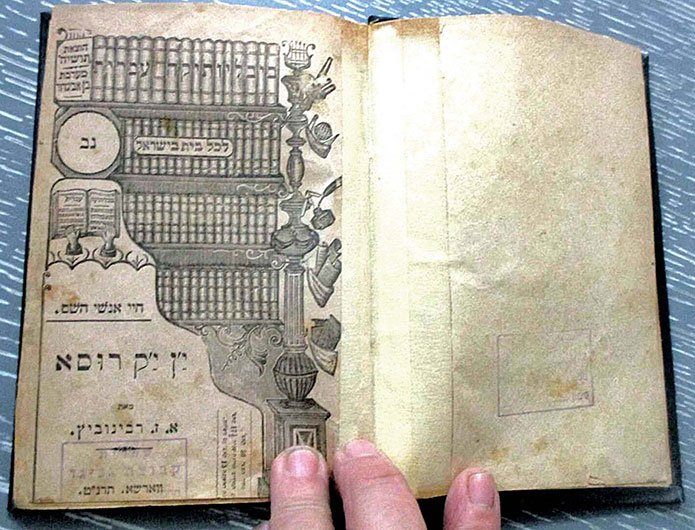
Rousseau’s philosemitism was not merely theoretical, with his personal relationships also demonstrating a genuine openness toward Jews, rare among the philosophes. He knew several Jews in Parisian intellectual circles, most notably prominent Portuguese and German Jewish financiers who moved through the salons. Although there is no evidence that he developed close friendships with Jewish scholars, his interactions were characterized by courtesy rather than hostility. Several Jewish correspondents and readers admired him; the maskilim (leaders of the Haskalah, the so-called “Enlightenment” movement) in the late eighteenth and early nineteenth centuries explicitly cited Rousseau as a crucial influence; for example, Isaac Euchel, founder of the Ha-Me'assef society, regarded his educational theory in Émile as foundational for Jewish pedagogical reform, and the Haskalah’s dual emphasis on civic virtue and moral autonomy owes much to Rousseau. Émile became an important reference point in debates about Jewish schooling, particularly in German-speaking lands where the Haskalah flourished, and Rousseau’s belief that education must cultivate independent judgment resonated with Jewish intellectuals, who wished to integrate secular knowledge with Jewish tradition.
Rousseau’s sensitivity to oppression, one of the hallmarks of his political and autobiographical writings, gave him an intuitive understanding of Jewish suffering. He saw in the Jewish historical experience a paradigm of endurance under injustice, and his own feelings of persecution may have heightened his empathy; while one should not overstate this psychological connection, it is plausible that his sense of embattlement made him receptive to the plight of a people long subjected to discrimination and hate.
Rousseau’s biblical interests culminated in The Levite of Ephraim, his adaptation of Judges 19-21. Although framed as an exercise in narrative imitation, the work reveals his deep engagement with Hebrew Scripture, as he did not treat the text merely as a literary curiosity but, rather, as a vehicle for exploring human passion, social breakdown, and the need for political order. The Hebrew Bible’s capacity to depict moral and political reality with stark clarity appealed to him, and his ability to animate the narrative testifies to how naturally he moved within the biblical world. His use of the Hebrew Bible, which is not casual or superficial, pervades his writings; even in his private notebooks and marginalia, he quoted biblical passages and reflected on Hebraic law as a model of cohesion, and his research for Madame Dupin, discussed above, reinforced his view that Jewish legal traditions were internally consistent and socially sophisticated. His references to Jews in Émile, Government of Poland, and his unpublished notes are consistently respectful.
In his mature writings, Rousseau was capable of harsh judgments about many groups, such as French society, philosophers, and priests, but one finds no pejorative generalizations about Jews. His only critical observations arise in contexts where he evaluates ancient institutions from a theoretical standpoint and, even then, his tone remains analytical rather than hostile. His references to “distinctive rites and ceremonies” in Government of Poland are not offered as criticisms, but as explanations for the remarkable cohesiveness of the Jews throughout history. In fact, for Rousseau, the Jewish separation from the nations was not a flaw but, rather, a brilliant political strategy that ensured the survival of a threatened people:
To keep his people from dissolving among foreign peoples, [Moses] gave it morals and practices incompatible with those of other nations; he overburdened it with distinctive rites, ceremonies... and all the bonds of fraternity that he placed among the members of his republic were so many barriers which kept it separate from its neighbors... That is how this singular nation, so often subjugated, so often dispersed and apparently destroyed has nevertheless preserved itself up to our times and how its morals, its laws, its rites, continue to exist and will endure as long as the world does.
This beautiful passage is comparable to the more famous quote by Mark Twain in Concerning the Jews. Few Christian writers of his era expressed themselves with such respect and awe, and Rousseau’s comment that the Jews “will endure as long as the world does” positions Judaism as one of the fundamental pillars of human civilization.
Rousseau, who deeply admired Judaism’s ethical teachings, believed that modern nations could learn from Jewish law, particularly its emphasis on communal responsibility, social justice, and the harmonization of individual and collective interests, and his political philosophy, particularly his theory of the general will, owes much to his reading of biblical accounts of covenant. The idea that a people can collectively will its moral and political destiny evokes the biblical covenant at Sinai, where the Israelites unanimously accepted divine law, and the communal unity and shared purpose depicted in the Hebrew Bible offered Rousseau an exemplary model of civic cohesion.
The emotional intensity of Rousseau’s writing about the Jews is also worthy of comment. Although he was usually guarded in his praise of historical peoples, he expressed genuine admiration for the Jews’ enduring spirit. The rhetorical flourishes in his descriptions of ancient Israel – “Zion has not lost her children,” “they are still a nation,” “they are still citizens” – reflect a depth of feeling unusual for a writer who distrusted enthusiasm. The biblical themes of exile, covenant, and national preservation resonated with his own sense of existential fragility and his longing for community.
Rousseau’s political philosophy contributed indirectly but significantly to the emancipation of Jews in France and Western Europe. His insistence that sovereignty resides in the people and that legitimate political authority derives from the general will lay philosophical groundwork for the French Revolution, whose leaders abolished legal discrimination against Jews. Although he did not personally argue for emancipation directly, the universalist implications of his thought created conditions under which Jewish equality could be justified. Revolutionary figures such as Abbé Grégoire, who championed Jewish civil rights, drew on Rousseau’s philosophy of citizenship.
Rousseau’s reputation in Jewish intellectual history has grown steadily with time. Nineteenth-century Jewish scholars such as Leopold Zunz and Heinrich Graetz acknowledged his unusual respect for Jewish antiquity, and twentieth-century Haskalah historians recognized him as an important source for Jewish modernity. His influence is visible in the emergence of modern Jewish nationalism, in debates on Jewish education, and in the broader Jewish encounter with Enlightenment political thought.
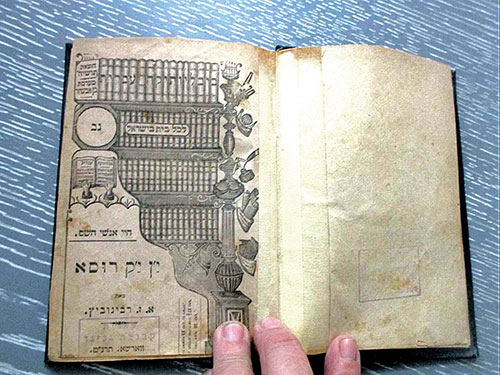
In assessing Rousseau’s relationship to Judaism, it is crucial to recognize how distinctive his position was within the intellectual milieu of his day.
In conclusion, Rousseau was, in a meaningful sense, the most pro-Jewish major thinker of the French Enlightenment; his thought opened intellectual space for modern Jewish identity, religious, civic, and national; and his writings remain a significant chapter in the history of Western views of Judaism. Even today, scholars of political theory and Jewish studies continue to examine the implications of his engagement with Hebraic sources. His appreciation of Jewish resilience, his recognition of Jewish nationhood, and his proto-Zionist reflections on the Jewish return to their ancient homeland stand as enduring contributions to the intellectual bridge between Enlightenment Europe and the modern Jewish experience.