 October 9, 2026
 Categories: Headline / Perspectives / Op-Eds
The Rise of the DSA Is Terrifying, But It Also Has Something to Teach Us


The rapid rise of the Democratic Socialists of America is profoundly troubling for American Jews. Before 2016, the organization had roughly 6,000 members; today it claims well over 100,000 – and is growing fast. The movement’s recent successes in New York, from Zohran Mamdani’s election as mayor to the recent sweeping victories by DSA-backed candidates in congressional and state legislative primaries, underscore that democratic socialism is no longer a fringe movement but an increasingly influential force. Yet since October 7, DSA chapters and many of their political allies have justified Hamas’s brutality, denied our right to self-determination, and helped create an environment in which many Jews no longer feel safe. For many Jews, the stakes feel existential. Our fear is real, and rightly so.
But if the only lesson we draw from the DSA’s rise is that it is dangerous, we will not have learned nearly enough. The more important question is why movements like the DSA are flourishing in the first place – and what that should teach the Jewish community about the kind of society in which Jews are most secure.
Political extremism rarely emerges in a vacuum. People turn to radical solutions after years of watching institutions disappoint them and their economic opportunities grow increasingly out of reach. When enough people become convinced that the existing political order is incapable of addressing their problems, they begin looking for alternatives that promise sweeping change. That is one of the principal reasons the DSA has grown so dramatically over the past decade.
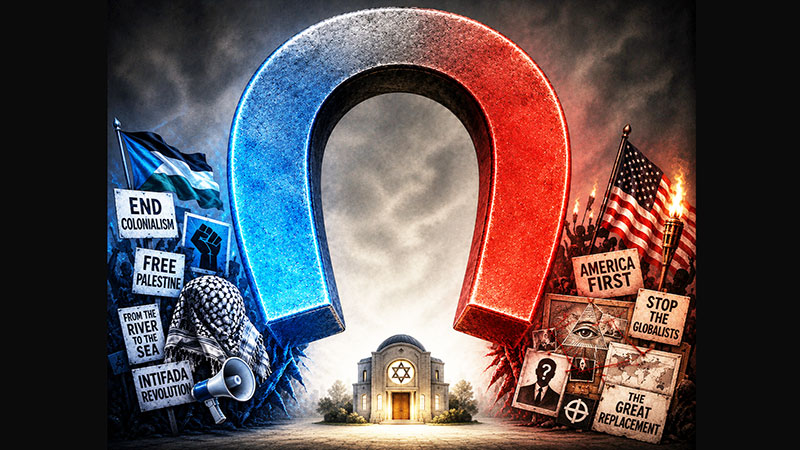
Ironically, the same forces also help explain the rise of MAGA. Trump’s movement emerged from many of the same underlying conditions that fueled the DSA’s growth – declining trust in institutions, economic insecurity, and deep dissatisfaction with the political establishment – albeit among very different segments of the population. Trump’s election in 2016, in turn, fueled a wave of new DSA members, just as the growing strength of the DSA and the progressive left has reinforced support for Trump and other figures associated with the right. Although these movements define themselves against one another, they increasingly feed off each other’s success. Polarization rarely goes in just one direction.
Little coincidence, then, that Israel has become a kind of political Rorschach test onto which elements of these opposite movements project everything they despise. The left-wing and right-wing versions are obviously very different from one another. Today’s progressive left increasingly demonizes Israel as the embodiment of colonialism, racism, militarism, and oppression. The far right (and I exclude Trump and many of his supporters here) has long vilified Jews as the hidden force behind globalization and America’s cultural decline. But both turn the Jewish state – and Jews – into convenient scapegoats for much broader societal grievances.
Jewish history offers too many examples of this pattern to ignore. During the Black Death, terrified European communities accused Jews of poisoning the wells. In France, the Dreyfus Affair turned a single Jewish officer into a symbol of national betrayal amid deep political and cultural anxiety. As Czarist Russia descended into political turmoil in the early twentieth century, the blood libel against Mendel Beilis and The Protocols of the Elders of Zion cast Jews as revolutionary conspirators bent on destroying Christian Russia, even as others denounced Jewish merchants and financiers as symbols of capitalist exploitation. The circumstances were completely different, but the mechanism was painfully similar: when societies become anxious and unstable, Jews are often transformed into someone small enough to blame and visible enough to symbolize society’s anxieties – on any side of the political spectrum.
That history, alongside the rise of the DSA, should influence the way we think about politics today.
American Jews have flourished unlike any Diaspora community in history. We have prospered during an era marked by constitutional government, the rule of law, strong civic institutions, extraordinary economic opportunity, and a political culture that generally prized stability over revolution. Those conditions did not eliminate antisemitism, but they did strongly constrain it. More importantly, they created the space for American Jews to build thriving communities, shuls, schools, charities – and one of the strongest Jewish communities in the history of the Diaspora.
For that reason, we have a particularly strong interest in preserving the conditions under which minorities flourish. We should care not only about defeating one extreme political movement or another, but about strengthening the institutions that make extremist movements less attractive in the first place. We should value leaders who tackle problems while lowering the political temperature rather than inflaming it.
This is also one reason we should be exceedingly cautious about our own political rhetoric. In recent years, it has become commonplace to describe mainstream politicians – including those with whom we strongly disagree – as existential threats to our community. Sometimes such warnings are necessary. But more often than not, they inflame an already polarized political climate and reinforce the sense that ordinary politics has failed. That, in turn, fuels precisely the kind of anti-establishment movements that many of us now fear. Ironically, by casting even mainstream politicians as the enemy in an effort to protect ourselves, we end up making ourselves less safe.
None of this means remaining silent in the face of antisemitism or pretending that all political movements are morally equivalent. The DSA’s hostility toward Israel and its willingness to excuse or rationalize terrorism are despicable. But condemnation is a losing strategy.
If the rise of the DSA teaches us anything, it is that our security depends on more than defeating one movement or electing one candidate. It depends on preserving a society in which our institutions command confidence, economic opportunity remains attainable across the country, political disagreements stay civil and constitutional, and leaders work to reduce polarization.
The Jewish community did not become one of America’s greatest success stories by living through periods of revolution. We flourished because this country offered something far rarer: conditions strong enough to protect minorities while allowing them to thrive.
Preserving those conditions may not be as emotionally satisfying as defeating a political enemy. But Jewish history – and a close reading of today’s political map – suggests that in the end, it is every bit as important.