 October 9, 2026
 Categories: Featured / Parsha / Torah
The Silver Box


“They have tested Me these ten times …” (Bamidbar 14:22)
Our Sages tell us (Erchin 15a), “From the punishment of the meraglim (the spies) we learn how powerful lashon hara is. If those who denigrated the wood and rocks of Eretz Yisrael received such a severe punishment, all the more so will one who disparages another human being be badly punished.”
Why, indeed, did the meraglim receive such a severe punishment merely for deprecating inanimate objects?
The Ish L’Rei’eihu answers that it is because they spoke ill specifically about Eretz Yisrael, which Hashem sanctified from all the other lands. R’ Chaim Sonnenfeld cited the pasuk from Tehillim (128:5), “See the good of Yerushalayim all the days of your life.” Even though inanimate objects do not feel pain, as a human being does, the Torah teaches us that one must be careful to see everything in creation with a “good eye” – to take note of that which is praiseworthy.
How much more so should a person see the good qualities in man – the crown of Hashem’s creations, who was created in His image – and not his defects.
The Torah notes too that when Yehoshua and Calev spoke about Eretz Yisrael they said (Bamidbar 14:7), “The land is very very good.” In light of their great reward for praising the land – they were the only men of that generation who merited to enter Eretz Yisrael after the 40 years in the Midbar – we can only imagine the severity of retribution for denigrating the land.
In this context, the Tiferes Shlomo points out when Yaakov Avinu told Yosef (Bereishis 37:14), “Re’eh es shlom achicha – look into the welfare of your brothers,” he wanted to rectify the way Yosef had spoken badly of his brothers earlier, so he used the word “shlom” from the root word shalem, completeness. Look into their good and not their shortcomings.
Rashi mentions in the beginning of the parsha that the meraglim did not take a lesson from Miriam who was punished with leprosy after speaking lashon hara about her brother, Moshe Rabbeinu.
Yet, the question still remains: How can we equate slandering Moshe Rabbeinu, the greatest prophet alive, to maligning Eretz Yisrael, an inanimate object? Why would they take a lesson from Miriam’s fate?
The Oznayim LaTorah explains that Moshe was very humble and could withstand insult even more than the wood and rocks. Nevertheless, Miriam was punished.
R’ Mordechai Glick suggests that the meraglim sinned because they did not believe that Hashem wanted to bring the Jewish people to a good land. Instead, they spoke negatively about Eretz Yisrael, in essence speaking unfavorably of Hashem Himself. That is even more egregious than Miriam’s transgression. Indeed, they did not take a lesson from Miriam.
The pasuk in Tehillim (34:13) states, “Who is the man who desires life, he should love to see good.” It is understood to mean that a person who desires life will only want to see the good in others and avoid speaking lashon hara.
The great tzaddik R’ Eliyahu Dessler was living in the Diaspora when he was elderly. The rosh yeshiva of Ponovezh suggested he should come to Eretz Yisrael to be the mashgiach in the yeshiva in Bnei Brak.
Rav Dessler accepted the position and went to Eretz Yisrael in Elul for the first time in his life. Within a few days he was speaking about his admiration and esteem for Eretz Yisrael. His nephew, R’ Shlomo Zalman Dessler, asked him how he could possibly give his opinion on Eretz Yisrael, when he had not left the sanctum of the yeshiva and had not toured Eretz Yisrael.
Rav Dessler said: Do you think I am interested in seeing the houses and fields of Eretz Yisrael? Within the first two hours after I landed in Eretz Yisrael I was able to achieve spiritual levels that I would have to work on for months in chutz la’aretz.
When one of the Steipler’s grandsons became a bar mitzvah, the Steipler told him to take on one mitzvah which he could observe scrupulously and meticulously. He suggested that the mitzvah should be lashon hara.
The Steipler himself was always very careful in his speech and he would never speak needlessly. When something did need to be said, he would exercise extreme caution and use the least number of words possible.
Someone once came in and asked whether it was permitted to say a particular detail with regard to a shidduch. While speaking, the individual accidentally revealed the name of the young man about whom he was inquiring.
“Lashon hara!” shouted the Steipler. “How could you speak lashon hara? Why do I need to hear lashon hara?” asked the Steipler.
The Steipler often spoke also of the benefits of a taanis dibbur as a means of doing teshuvah, whereby one sets aside specific times when he refrains from idle or mundane speech.
Usually when tefillin fall on the floor a person gives money to tzedakah, and he could also fast. The Steipler would suggest a taanis dibbur in such a situation.
When the Steipler was asked what could be done in response to serious accidents or misfortunes that occur, he would note that these are difficult times for the Jewish people. He pointed out that the Talmud tells us that when a community was attacked by wild animals, they would declare a taanis tzibbur. Nowadays, traffic accidents and other adversities are the wild animals. He stated that those who could fast (abstaining from food and drink) should fast. However, those who find that difficult should take on a taanis dibbur – to be very careful not to engage in forbidden speech. If they would only be careful in this matter they would see wonders.
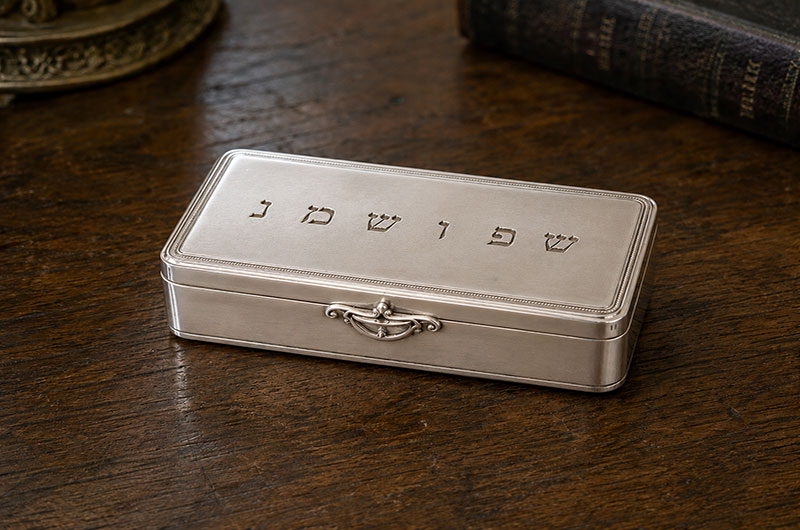
The great Beis HaLevi once went to visit an individual who had a little silver box on the table which was engraved with the letters shin, peh, vov, shin, mem, nun. The Beis HaLevi was curious, and asked his host what the letters stood for. The host explained that they were the first letters of the pasuk in Mishlei (21:23), “shomer piv u’lshono shomer mitzarros nafsho – he who guards his mouth and his tongue guards his soul from troubles.” As he sat at the table talking to various guests and businessmen, said the host, this box served as a constant reminder to be careful in his speech. “The silver box never leaves my table,” said the host.