 July 3, 2026
 Categories: Perspectives / Op-Eds
The UN Did Not Create Israel
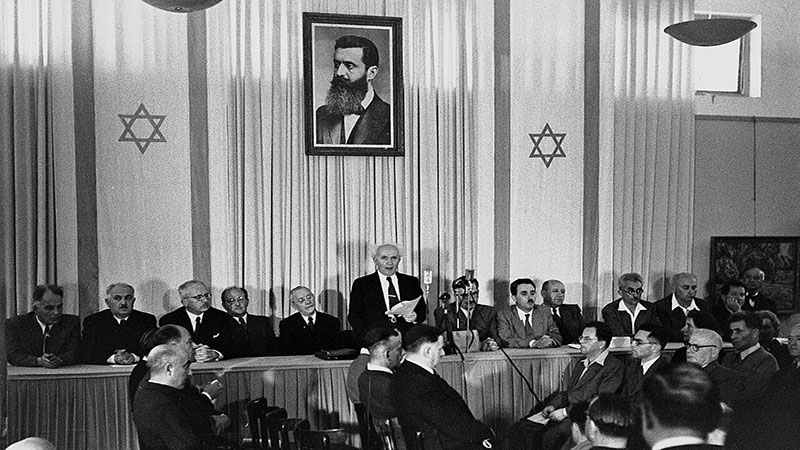


It appears in the most respectable places, dropped in passing, as though it were a fact too obvious to footnote. A few days ago, it surfaced again in a Fox News column by the media analyst Howard Kurtz, who wrote that Israel, in the wake of the Holocaust, was “created by the United Nations in 1948.”
Kurtz is no enemy of Israel. He was making a sympathetic point. And that is why the sentence is so corrosive. The falsehood at the heart of the campaign to delegitimize Israel is no longer carried only by its enemies. It has been absorbed by its friends as well, repeated so casually that it now passes for established fact.
So let it be said plainly. The United Nations did not create Israel.
What the United Nations did, on November 29, 1947, was vote. The General Assembly passed Resolution 181, recommending that the land west of the Jordan be partitioned into a Jewish state and an Arab state.
A recommendation is not a creation. The General Assembly has no army and no treasury. It can’t drain a swamp or plant an orange grove. Its resolution was non‑binding – a suggestion the Arab world rejected the next morning and the Arab armies set out to erase by force.
Israel already existed when that vote was taken. Not yet as a sovereign state – that would come the following May – but as the living substance of a nation: its land, its cities, its farms, its schools, its university, its courts, and its militia and underground armies. The Jewish people had built it with their hands over half a century, while the world watched and, more often than not, looked away.
The distinction matters because the myth has a purpose. “The UN created Israel” is the gentler cousin of a harsher claim – that Britain created Israel, that the West planted a colony in Arab soil, that Zionism is a settler‑colonial project to be undone. Strip the Jews of their role as builders of their own home, and the whole enterprise becomes something done to the Arabs by outsiders.
The truth is almost exactly the opposite – and it is one of the greatest nation-building stories in modern history. Zionism was not a longing. Jews had longed for Zion for 2,000 years, and longing changed nothing. What changed everything was the decision to stop longing and start building – to return as farmers, engineers, soldiers, and citizens and make a country of a neglected Ottoman backwater.
No Wall Street bank, no rational investor on earth, would have backed such a plan. It went forward anyway, financed by the pennies of poor Jews dropping coins into the little blue boxes of the Jewish National Fund – and the pennies bought land, deed by deed.
By the end of the Mandate the Jewish community had lawfully acquired some two million dunams. Not seized. Not conquered. Bought.
Nothing captures the cost of that building more than the story of Hadera, and it begins with the man who bought the land. Yehoshua Hankin – the tireless negotiator the movement would come to call the Redeemer of the Valley – acquired the Hadera tract in 1891, and over a lifetime of patient dealing with absentee landlords he purchased more than 600,000 dunams for the Jewish people, among them the great Jezreel Valley, bought from a family in Beirut and turned into a belt of farming villages. He struck some of those bargains before he had the money in hand, so certain was he that the Jews would come.
The Hadera tract was mostly swampland, sold cheap because it was deadly. The Jewish pioneers drained the marshes by hand, planting eucalyptus to soak up the standing water, and the swamp answered with malaria. Of some 540 settlers in the first two decades, more than 200 died of the fever. And still they would not leave. They would not abandon the land they had paid for with their lives. Colonizers go home. These people stayed, and died, and stayed – because for them the land wasn’t an investment but the homeland, and there was nowhere else on earth to go. By 1948, Hadera was an important regional town with a population of nearly 12,000.
In 1909, on the empty dunes north of Jaffa, 66 families drew lots with seashells – gray for the plots, white for the names – and founded Tel Aviv, the first all‑Jewish city built in the Land of Israel in 2,000 years. Within a generation it was a Mediterranean capital of Hebrew culture. A daily Hebrew press – from the liberal Haaretz to the labor movement’s Davar to the papers of the Revisionist right – carried the arguments of a reborn people to every kitchen table, while literary magazines and publishing houses poured out Hebrew poetry and fiction.
There was the Habima theater performing in the revived tongue, cafes where poets argued through the night, the gleaming Bauhaus “White City,” and a symphony orchestra that Bronislaw Huberman filled with Jewish musicians rescued from the orchestras of Nazi Europe. They revived the language itself – Hebrew, the tongue of prayer, willed back into the living speech of a nation, a thing no people had ever done.
Around the language they built the architecture of a state before they had a state: the Jewish Agency as a government‑in‑waiting, the Jewish National Fund holding the land in the name of the people, the Histadrut, the kibbutzim and moshavim that turned ideology into bread. The Yishuv governed itself, taxed itself, and defended itself for decades before any vote in New York.
They did not only build a state on paper. They planted it in the ground, sometimes overnight. When the Arab Revolt of 1936 made open settlement deadly and the British began choking off new Jewish communities, the Yishuv found its loophole: an old Ottoman law, still on the books, held that a building once roofed could not be torn down without a long court fight.
So they struck before dawn. Convoys rolled to a patch of legally purchased land carrying prefabricated walls – double wooden frames packed with gravel to stop bullets – and a watchtower crowned with a searchlight, and a knot of volunteers raised the whole compound in a single day, roof and all, before the authorities could move. By nightfall a new kibbutz stood where that morning there had been bare earth, its settlers already on guard.
It began at Tel Amal in December 1936, and within three years more than 50 of these “tower and stockade” settlements had gone up, from the Galilee to the edge of the Negev, many where no Jewish village had ever stood. Built under the very noses of the Mandate, they did more than survive the night. They drew the map. Where the towers rose, the borders of the state‑to‑be would later run.
And here the settler‑colonial slander collapses, for a colony extracts while a civilization creates. The Jews shipped no wealth back to a mother country. There was none. They poured everything in.
In 1923 Pinhas Rutenberg founded the Palestine Electric Corporation – today the Israel Electric Corporation, the largest supplier of electrical power in Israel – and by the early 1930s his hydroelectric station at Naharayim was lighting Tel Aviv, Haifa, and the towns of the coastal plain, until Iraqi troops went out of their way to destroy it in 1948.
At the lowest place on earth, Moshe Novomeysky wrested potash and bromine from the Dead Sea and sold them to the world.
The Jews built banks, hospitals, factories, a shipping company, and one of the most sophisticated agricultural economies in the Middle East before independence was ever declared.
And they built a university. On July 24, 1918, with the guns of the Great War still firing, 12 foundation stones, one for each tribe of Israel, were laid on Mount Scopus. In 1925 the Hebrew University opened at a ceremony graced by Lord Balfour, by General Allenby who had taken the city, and by Albert Einstein, who lectured in Hebrew.
A people that lays the cornerstones of a university while the guns of a world war are still firing isn’t planting a colony. It’s a nation coming home.
They knew a homeland could not survive on goodwill. It began with Hashomer, the mounted watchmen of 1909, and the NILI spies who aided the British against the Turks in the First World War. During that same war a one‑armed Russian Jew named Joseph Trumpeldor joined Ze’ev Jabotinsky to raise the first Jewish fighting unit in nearly 2,000 years; and in 1920, at a Galilee outpost called Tel Hai, Trumpeldor and seven comrades fell holding their ground, his dying words – “It is good to die for our country” – becoming the rallying cry of a generation.
Jabotinsky named his youth movement Betar, the Covenant of Joseph Trumpeldor, and its members greeted one another not with “hello” but with “Tel Hai.”
From Trumpeldor’s example came the Haganah and its strike force the Palmach, and the Revisionist undergrounds, the Irgun and the Lehi – a people prepared to throw off an empire.
The myth of British largesse pretends the empire midwifed the Jewish state. In truth Britain spent the last decade of the Mandate trying to strangle it. The 1917 Balfour Declaration had committed Britain to a Jewish national home, written into the Mandate by the League of Nations. But as Arab pressure mounted, Britain retreated – until, in May 1939, the White Paper repudiated Balfour in all but name, capping Jewish immigration at 75,000 and handing the Arabs a veto over any more.
The British did this months before Hitler invaded Poland, at the precise moment the Jews of Europe needed a refuge as never before. The empire that had promised the Jews a national home shut the gates of that home when Europe’s Jews needed it most. This is the benefactor the myth would have us thank.
The Jews came anyway, running the blockade. Two ships still wound the memory: the Patria, sunk in Haifa harbor in 1940 when a Haganah charge meant to stop a deportation went tragically wrong, drowning more than 250 people within sight of the shore; and the Struma, turned away with nearly 800 aboard and sunk in the Black Sea in 1942, leaving a single survivor.
Then, in 1947, came the most famous ship of all – the Exodus, with 4,500 survivors aboard. The Royal Navy rammed her in international waters and sent in boarding parties swinging clubs and firing guns. The refugees fought back with bare hands and tins of food, and when it was over three of them were dead. One was Bill Bernstein, a 24-year-old American volunteer, clubbed to death defending the wheelhouse. Another was a boy of 15 who had outlived the Nazis in Poland only to be killed by a British bullet a few miles short of the shore he had crossed a continent to reach. Some 150 more were wounded.
The British towed the battered ship into Haifa – and there, as members of the United Nations committee then weighing Palestine's future watched from the dock, they dragged the survivors off and caged them aboard deportation ships. This time they were not even sent to Cyprus. They were shipped back to Germany, behind barbed wire, in camps guarded by Germans. The photographs went around the world.
The UN did not bestow the world's conviction that this people needed a state; it stood on a pier and witnessed it, and could not look away.
After the war, the underground fighters turned the full force of revolt against British rule, and Britain poured 100,000 troops into a tiny country and still could not hold it. Bankrupt and disgraced, the empire that had ruled a quarter of the earth handed the problem to the UN and left.
The British didn’t give Israel to the Jews. The Jews drove them out – and the price was paid on the gallows by 12 members of the Irgun and Lehi. The first to climb them was Shlomo Ben-Yosef, a Betari, hanged at Acre in 1938, who went to his death crying, “Long live the Jewish state! Long live Jabotinsky!”
In 1947, Dov Gruner, an Irgun member who was captured in a raid on a British police station in Ramat Gan, refused every inducement to appeal for clemency, for to appeal was to recognize the right of a foreign power to judge a Jew in the Jewish homeland. He and his comrades walked to the gallows singing Hatikvah while the other prisoners took up the song through the walls. A people that produces such men cannot be ruled for long.
Through all of this history runs a pattern the myth cannot survive: at every turning point, the Zionists said yes, and the Arab leadership said no. When the Peel Commission proposed partition in 1937 – offering the Jews a barely defensible sliver – the Zionist movement agonized and accepted the principle. The Arab leadership rejected it outright. So it went, down to the vote of 1947. The Jews accepted partition. The Arabs chose war.
And who led that rejection? Haj Amin al‑Husseini, the Grand Mufti of Jerusalem – whose very office was a British invention, for the British High Commissioner elevated him in 1921 and built the Supreme Muslim Council around him. This British‑appointed cleric spent the war as an honored guest of the Third Reich, raising Muslim divisions for the Waffen‑SS and pressing the Nazis to extend the Final Solution to the Jews of the Arab lands. Set him beside the Jews who kept saying yes to a sliver of land, and the moral architecture of the conflict stands revealed.
Then came the vote. The General Assembly passed its recommendation. The Arab states answered with five invading armies. The UN sent not a single soldier to defend the state it had supposedly created. The Jews defended it themselves, and buried 6,000 of their own – one percent of the Jewish population of the land – to keep it.
Israel was not granted. It was earned – not invented in a chamber in New York City but built in the orange groves and the swamp‑drainage ditches, in the lecture halls of a university founded before the state, in the holds of the refugee ships and on the gallows of Acre, dunam by dunam and act of courage by act of courage. To call it a gift of the United Nations is to erase the greatest collective achievement of the Jewish people in 2,000 years.
The miracle is not that the world at last gave its blessing – the world has been miserly with its blessings, before 1948 and ever since. The miracle is that a scattered, hunted, half‑murdered people willed itself back into history, built a nation against every odd and every enemy, and held it against all comers.
And Israel had founders worthy of the name – not a vote in a distant chamber, but men and women who bent history with their hands. Herzl, who dreamed it; Weizmann, who pleaded it before the powers of the earth; Jabotinsky, who taught a generation to stand and fight; Ben‑Gurion, who rose in a Tel Aviv hall and declared the state into being; Begin and Shamir, who led the underground soldiers, and the others who carried it through war after war. They were rivals who fought one another bitterly and agreed on almost nothing – save the one thing that mattered: that the Jewish people would again be masters of their own fate in their own land.
The famous and the forgotten alike, they did what every sober authority swore could not be done.
So the next time you read – in a sympathetic column, from a friendly pen – that Israel was “created by the United Nations,” correct it. Gently, if you like; fiercely, if you must. But correct it. The swamp‑fighters of Hadera and the watchmen of Hashomer, the spies of NILI and the eight who fell at Tel Hai, the families who drew lots in the sand at Tel Aviv, the drowned of the Struma and the Patria and the young men who climbed the gallows singing... the founders and the fighters... they did not wait for the world’s permission.
The least we owe them is the truth.