 October 16, 2026
 Categories: Headline / Perspectives
The Unimaginable Attack Was Already Imagined


In 1969, a little-known French journalist and novelist named Robert Buchard published a thriller with an eerily memorable title: Thirty Seconds Over New York.
The plot concerned a secret Chinese plan to send a passenger aircraft, carrying a nuclear bomb, toward New York City. It was Cold War fiction, written more than three decades before September 11. The details were different: Buchard imagined a state-directed nuclear attack, not Islamist hijackers using the planes themselves as weapons. But the central image was there: a civilian airliner transformed into an instrument of catastrophic destruction over New York.
The Cold War made such fears part of the public consciousness. Americans grew up expecting that nuclear destruction, if it came, might arrive by Soviet bomber or missile. Yet the possibility that civilian aircraft already flying inside the country could be seized and turned against American cities belonged mostly to fiction.
Buchard saw it. So did Tom Clancy. In his 1994 bestseller Debt of Honor, a suicidal pilot flies a Boeing 747 into the Capitol during a joint session of Congress, wiping out the President, much of Congress and the Supreme Court. The scene was so close in spirit to 9/11 that it became a grim curiosity afterward.
But the most important warnings did not come from novelists.
The first World Trade Center bombing, on February 26, 1993, provided an even more direct warning. Ramzi Yousef, the Islamist terrorist who masterminded the attack, and his accomplices drove a truck loaded with explosives into the underground garage beneath the North Tower, hoping to topple it into the South Tower and kill tens of thousands. The plot failed to bring down the buildings, but succeeded in killing six people and injuring more than a thousand.
In 1994 and 1995, Khalid Sheikh Mohammed, later the principal architect of the September 11 attacks, and Ramzi Yousef developed the Manila, or Bojinka, plot: an intended campaign to blow up multiple American airliners over the Pacific. The plot also included the idea of crashing an aircraft into CIA headquarters. It was disrupted before it could be carried out.
A few years later, KSM brought Osama bin Laden what became known within al-Qaeda as the “planes operation.” The targets discussed included the World Trade Center, the Pentagon, the White House and the Capitol. The ultimate plan was not a spontaneous inspiration on September 11, 2001. It was the result of years of terrorist imagination, planning, recruitment and training.
American officials had fragments of the picture. An FAA threat assessment in 1999 even considered a “suicide hijacking operation.” It judged such an attack unlikely because the old assumptions still prevailed – that hijackers wanted hostages, publicity, negotiations, prisoners released and didn’t want to die.
That assumption proved fatal.
On September 11, the attackers exploited not merely weaknesses in airport screening or intelligence sharing, but a deeper failure of imagination. Americans had prepared for the hijacking they knew. They had not prepared for the hijacking their enemies had conceived.
Yet New York had long occupied a special place in the hostile imagination. Hitler’s Germany explored the Amerikabomber: a long-range aircraft intended, at least in theory, to reach the United States and strike New York. Nazi engineers also considered the still more fanciful Amerika-Rakete, a transatlantic rocket project.
Neither plan ever became operational. But the thought was unmistakable: if one wished to strike America psychologically as well as physically, New York was the target – and it had been in the sights of German militarists since before World War I.
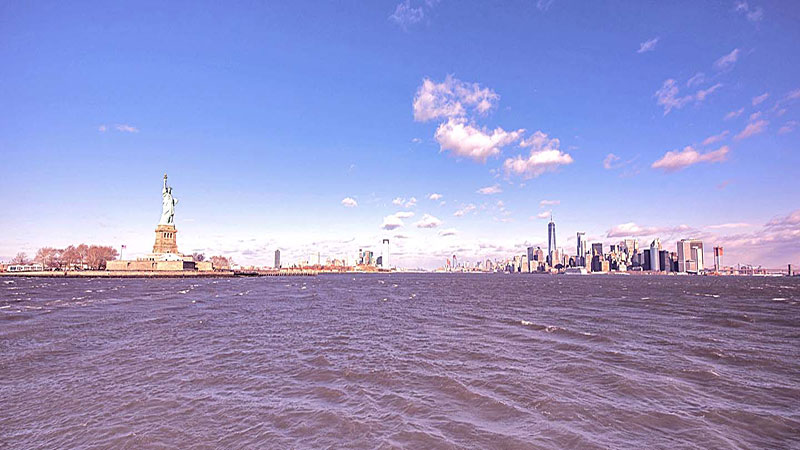
In July 1916, the Kaiser’s agents and their accomplices carried out a deadly bombing in New York Harbor. Explosives stored on Black Tom Island were detonated in an act of sabotage intended to disrupt American arms shipments to the Allies during the First World War. The blast, which equaled a 5.5 magnitude earthquake, shattered tens of thousands of windows in Jersey City and lower Manhattan, damaged the Statue of Liberty and was felt as far away as Philadelphia. At least four people died, including security guards and an infant. The attack showed how vulnerable a major port and industrial gateway could be.
Four years later, a bomb exploded on Wall Street in the heart of New York’s financial district. Suspected anarchists carried out the attack. The blast killed dozens and injured hundreds, damaging the Morgan building and demonstrating that a small group could bring violence directly into the symbolic center of American capitalism.
And, as every middle school or high school student knows – or should know – Imperial Japan attacked Pearl Harbor on December 7, 1941. The possibility of a surprise assault on an American military installation was not unimaginable in the abstract. It had been discussed, war-gamed and feared. Yet the U.S. was caught unprepared when the attack came.
October 7: The Pattern Repeats
The same pattern appeared in Israel on October 7, 2023. The details of Hamas’s assault were shocking: the mass breach of the Gaza border, the use of paragliders and motorcycles, the slaughter of families in their homes, the massacre at a music festival, the kidnapping of hostages – including children and the elderly – into Gaza.
But the attack did not emerge from nowhere. Hamas had never concealed its commitment to Israel’s destruction. Israeli authorities reportedly possessed a detailed Hamas attack plan, sometimes called the “Jericho Wall” document, that described an assault remarkably similar in broad outline to what later occurred. There were warnings, surveillance, intelligence reports, public statements and evidence of training.
What was missing wasn’t information. It was the willingness to believe that Hamas would actually attempt an operation of such scale and brutality – and that it might succeed.
Like America before 9/11, Israel had come to see its enemy through a reassuring framework. Hamas could be contained. Hamas wanted money and permits. Hamas governed Gaza and had something to lose. The border barrier, sensors and military superiority would prevent disaster. Technology ruled.
Until it didn’t. The fatal assumptions didn’t merely underestimate Hamas’s military capacity. They misunderstood the organization’s real intentions. The enemy had imagined the attack. Its victims had not imagined it with sufficient seriousness.
There is a difficult balance here. A free society cannot organize itself around every nightmare. Governments cannot treat every thriller, rumor or hypothetical as prophecy. Most terrible possibilities never occur.
But the opposite error is equally dangerous – treating a threat as irrelevant because it seems too theatrical, too irrational or too politically inconvenient to contemplate.
The history of Pearl Harbor, the Wall Street bombing, Black Tom, the first World Trade Center bombing, September 11 and October 7 suggest a recurring lesson. The warning signs are often present. The methods may be discussed in advance. The targets may be obvious. What fails is not always the ability to imagine the attack, but the willingness to believe that an enemy would attempt it – and that the existing defenses might fail.
The next major attack may not resemble September 11 or October 7. The attack may not come from the air. It may come through a border, by drone or cyberattack, against critical infrastructure, or from the sea. A port is not simply a place where cargo arrives; it is a densely populated gateway to the national economy. A ship can carry more than commerce.
That isn’t a prediction. It’s a warning against the habit of dismissing what does not fit yesterday’s model.
The phrase “unimaginable attack” should make us uneasy. Often, the attack was imaginable. Someone wrote about it. Someone planned it. Someone warned about it. Someone even drafted a scenario. The failure came when others decided it was too unlikely to matter.
Robert Buchard’s forgotten novel did not predict September 11 in any literal sense. But its title and premise now carry an unsettling truth. Long before New York watched passenger aircraft strike its skyline, the image had already entered the imagination. And long before that, New York had already been bombed, sabotaged and targeted by enemies who understood its symbolic and strategic importance.
The responsibility of a free society is not to predict every attack. It is to take seriously the possibility that its enemies may be imagining what it has taught itself not to see.