 October 16, 2026
 Categories: Halacha & Hashkafa
The Universe Is a Giant Kal V’chomer


Zevachim – Daf 69
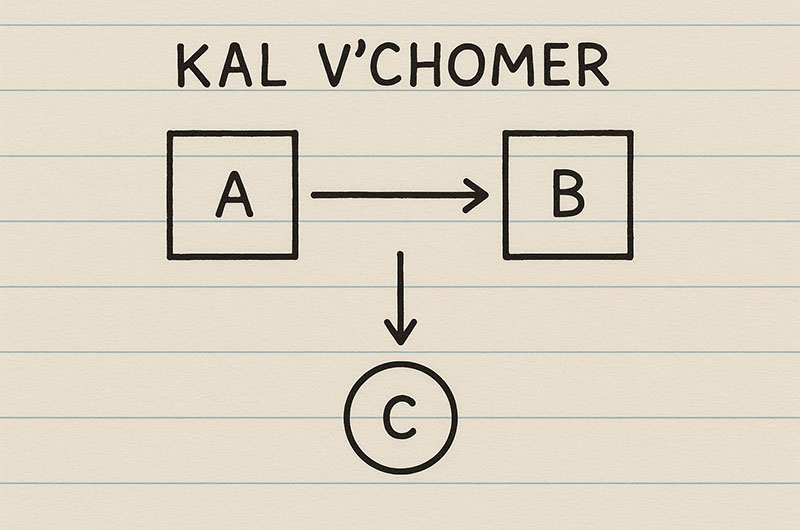
Our Gemara on amud beis discusses the source for the famous rule of dayo by kal v’chomer.
Kal v’chomer is the first of the thirteen rules used to derive halachos from the Torah, as per the famous beraisa of Rabbi Yishmael that we recite in the daily morning liturgy. A kal v’chomer is a logical inference where if a law applies in a lighter situation, surely it must apply in a more severe situation. For example, if speeding incurs a $150 fine and three points on your license, then surely, kal v’chomer, driving drunk should incur at least the same punishment.
Taking the logical inference further, since we know driving drunk is at least twice as bad, perhaps the fine and points should also be double those for speeding. This is where the dayo principle kicks in. Even though such an argument can be made, we don’t know how far to go, so we conservatively stay with the same punishment as in the lighter case.
This limiting argument is learned from Hashem’s response to Moshe regarding Miriam’s punishment and why she had to suffer isolation for at least seven days. Hashem says (Bamidbar 12:14): “If her father spat in her face, would she not bear her shame for seven days? Let her be shut out of camp for seven days, and then let her be readmitted.” That is to say, if she angered her mortal father, would she not be shamed for seven days? Surely, then, she must be so punished for arousing G-d’s ire. Yet despite arousing G-d’s anger being a worse sin, the penalty is not greater than in the original case – seven days. This is due to the principle of dayo.
Kedushas Levi (Ki Tisa) asserts that the thirteen derivational methods correspond to G-d’s Thirteen Attributes of Mercy – Middos HaRachamim (Shemos 34:6). He understands that the first attribute is E-l and matches with the rule of kal v’chomer. That is why Moshe uses the name E-l in his prayer for Miriam (Bamidbar 12:13), and G-d engaging in the kal v’chomer was also an activation of His merciful attributes, beginning with E-l.
What does this really mean? G-d in relation to the world is one giant kal v’chomer. After all, in essence, a kal v’chomer says that if you have the lighter item, surely you have the stronger item. In Sanhedrin (91a), a Sage argues in favor of the validity of the resurrection of the dead to a skeptic by way of a kal v’chomer: If G-d can create ex-nihilo, surely, He can revive the dead.
But going even deeper, that G-d allows a tzimtzum – some retraction of His presence for reality to exist and function independently – shall we not say that this is the very essence of dayo? Even though in reality G-d is much greater, He allows His manifestation to be on the scale of the lighter case – physical reality instead of His reality. And what could be more merciful and loving than for a father to make room for his child’s autonomous behavior and development, even as the child may at times be disobedient?
Our efforts to derive Torah laws from Scripture are an attempt to see G-d. We see Him through His laws and morals. But those laws and morals are organized by His Thirteen Attributes of Mercy – because it is how He manifests in this world but still makes room for physical reality. Therefore, these are all one and the same. Although it is difficult to fully comprehend the specifics of the correspondence between them (see Kedushas Levi for more details and explanation for how many of the Middos correspond), we can understand the Torah’s overall truth and marvel at a depth we are barely able to peek at.
Abandoned Corpses and Buried Potential
Daf 70Our Gemara on amud beis refers to the ritual of the unidentified corpse. If an apparent murder victim is found near a city, the elders of the closest city must undergo an atonement ritual. There is some presumptive guilt for fostering a callous disregard for life or lack of care for fellow Jews; otherwise, the crime would not have happened there. There would be no murderer, or someone would have quickly offered him shelter and lodging. Part of the ritual is to axe the neck of a never worked calf by a river, on ground that is hard and not plowed (and will be forbidden to be used for future crops).
The obvious symbolism is that this murder victim’s life was cut short, and he was deprived of the opportunity to be productive and fulfill his purpose in the world. Hence the irony of the life-giving, flowing river juxtaposed with the sudden violent death of the young calf which never plowed, and the field which will never produce. The elders are compelled to grieve and absorb the loss so as to be inspired to make the necessary societal changes that will forestall such tragedies.
The Maharal (Tiferes Yisrael 3) takes this idea further and relates it to the state of man and his responsibility in this world. An animal is born almost fully functional – how long does it take for a baby mountain goat to start prancing from cliff to cliff? But it takes humans years and years to fulfill their potential. This is not an accident. The more complex the mission and the greater the potential, the greater the preparation needed. The Hebrew word for animal, “b’heima,” hints at “bah-mah,” Hebrew for “What is in it?” – as if to say, rhetorically: What you see is what you get. Man is adam; in Hebrew, adamah is earth. Man, like earth, has a vast ability to give forth fruit – but must be worked to bring it out.
While an anonymous abandoned corpse is a desecration of human potential that requires swift and structured steps for atonement, the Maharal is warning that every human life can be littered with abandoned dead bodies and lifeless corpses of abandoned potential. This, too, we must grieve and attempt to rectify.
Ox-ford University: Studying the Mind of a Beast
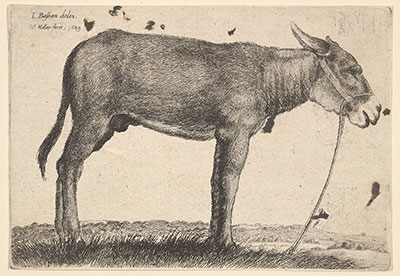
Daf 71Our Gemara on amud aleph discusses the animal who killed a person, whose ordinary fate is to be put to death. Why is the animal put to death? After all, does an animal have intelligence and awareness that make it liable for its actions?
There is an interesting verse (Bereishis 9:5): “However, of the blood of your souls, I will demand an account; from the hand of every beast will I demand it. From the hand of man, even from the hand of man’s own brother, will I demand an account of man’s soul.”
The simple reading of the verse seems to indicate that G-d will punish a beast for killing a human. Ramban (ibid.) offers several answers, the simplest being that it is not so much about the animal’s culpability, but more about the sanctity of man. The death of a person is such a serious trespass that no matter the motivation or intent, that there must be a strong consequence. Ramban says that this is why the same fate occurs to an animal in the wilderness who has no owner.
Sefer HaChinuch (52) says something similar; however, the focus is to impress upon man the seriousness of death, even to the point of eliminating anything related to the death of another human being.
Both Ramban and the Sefer HaChinuch could argue that this notion is hinted at in other areas of the Torah, where there is a suggestion that the land itself becomes polluted by murder and must somehow be cleansed to avoid further ramifications of this injustice. See, for example, Bereishis (4:10) and Devarim (19:10 and 21:9).
There is also an odd Midrash that seems to hold animals responsible for higher-order thought and a decision to martyr themselves in the name of G-d. Pesachim (53b) tells us that Chananiah, Mishael, and Azariah decided to defy Nebuchadnezzar’s orders and allow themselves to be thrown into a furnace based on the behavior of the frogs during the plague, who threw themselves into the Egyptian ovens:
With regard to frogs, which are not commanded concerning the sanctification of the name of G-d, it is written: “And the river shall swarm with frogs, which shall go up and come into your house, and into your bedchamber, and onto your bed, and into the houses of your servants, and upon your people, and into their ovens and kneading bowls” (Exodus 7:28). When are kneading bowls found near the oven? You must say that it is when the oven is hot. If in fulfilling the command to harass the Egyptians, the frogs entered burning ovens, all the more so, we – who are commanded concerning the sanctification of the name of G-d – should deliver ourselves to be killed in the fiery furnace for that purpose.However, the commentaries explain this Gemara in less literal ways, something along the lines that Chananiah, Mishael, and Azariah drew inspiration from the idea that the frogs could defy survival instinct; or perhaps the opposite, that a Jew must follow G-d’s command without forethought, like an animal behaves with instinct.
We also find the donkey of Rabbi Pinchas ben Yair who would not eat untithed produce (Chullin 7a), although that might have been due to some spiritual effect or instinct instilled via ownership. In support of this, according to Gemara Shabbos 151a, an animal does not attack a human unless the human diminishes himself and behaves as a beast. Likewise, we may say that the spiritual standing of the owner affects the behavior of the animal. The Midrash (Bereishis Rabbah 28 and Rashi on Bereishis 6:11) tells us that not only were the humans promiscuous in the generation of the Flood, but the animals followed suit, mating indiscriminately across species. And Meiri (Bava Kama 40a) states, “When the ownership changes, the animal’s nature and mazal change as well.”
Interestingly, Radak (ibid.) seems to hold there is a degree of animal liability. He states, “In relation to actions committed against man, the animal is held culpable for its behavior.”
Rav Dovid Tzvi Hoffman (Bereishis ibid.) makes the strongest statement: “Even animals are liable for killing humans.”
While there is no evidence of intelligence in the form of advanced reasoning in animals, that does not categorically eliminate the possibility that, to a degree, an animal has a will and can make a choice. The Gemara (Bava Kama 4) delineates the liabilities incurred by an ox that gores, as opposed to one that tramples or eats and causes damage. The distinction lies in the fact that when the animal eats or tramples, it possesses no “intention” to cause harm, whereas when the ox gores, it “intends” to cause damage.
It appears that the Rabbis of the Gemara were not constrained by the sometimes arbitrary classifications of scientific terminology. I do not believe Rabbinic or Biblical Hebrew employs a specific term for self-awareness or consciousness, as they did not evaluate animals through that lens. Nevertheless, they did consider humans to possess superior intelligence, primarily due to their ability to express themselves through language (see Targum, Rashi, and Mizrachi on Bereishis 2:7). However, the intention to cause harm, while not seen as a sign of high intelligence, was viewed as the product of having some thought process, at least a capability of wanting to cause damage and carrying out that desire. According to the Rabbis, an ox is indeed capable of intention.
This specific intention is not sophisticated. The ox did not “intend” to build a fusion reactor – as this ox is no rocket scientist – but it did intend to cause damage and succeeded with its plan. Destruction is much easier than construction or repair, and so even an ox can accomplish this.
A different Gemara (Nazir 10a) tries to understand a strange declaration made by the protagonist in the Mishna. The fellow is frustrated with his cow that is refusing to budge, and declares, “This cow says, ‘I am hereby a Nazir if I get up.’” Obviously, the cow cannot make declarations. The Gemara explains that when the person said “This cow says,” he meant to say, “This cow thinks she is not going to get up…” – and then the person makes an oath in frustration. This seems to indicate the belief that the cow can have a thought process.
It seems from some of the sources we quoted that some of our Sages may have held that animals are capable of rudimentary thought and benefit, or may suffer in the physical world based on their decisions.