October 2, 2026
 Categories: Featured / Collecting / Features On The Jewish World
The Versatile Halachic World of the Shadal


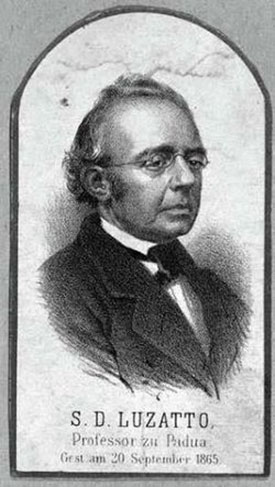
Rav Samuel David Luzzatto (1800-1865), universally known by the acronym “Shadal,” emerged in the turbulence of early nineteenth-century Italy as a figure whose combination of traditional learning, philological expertise, and intense moral seriousness made him one of the most respected Jewish scholars of his age. Born in Trieste, he spanned a period in which Jewish life was reshaped by political emancipation, the challenges of the Wissenschaft des Judentums (“Science of Judaism”), and the gradual erosion of the intellectual walls that had surrounded Jewish communities for centuries.
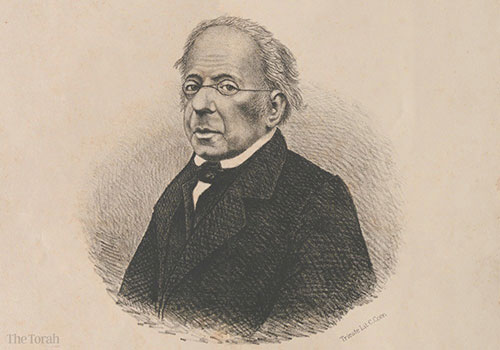
The Shadal’s versatility and the scope of his learning can best be seen through his correspondence with the Jewish luminaries of the day and through his wide-ranging commentaries and studies. Among his vast works, he translated the Ashkenazi Siddur into Italian (1821) and wrote Hebrew commentaries on the Chumash, the Haftarot; Sefer Yishayahu (Isaiah), along with a translation into Italian, Sefer Yirmiyahu (Jeremiah), Sefer Yechezkel (Ezekiel), Sefer Tehillim (Psalms), Sefer Eyov (Job); and a long Hebrew dissertation on Kohelet (Ecclesiastes). He edited the medieval chronicle Seder Tannaim v'Amoraim (1839) (see discussion below); did pioneering work in his editions of Yehuda Halevi's poetry and published an anthology of medieval Hebrew poetry; and published various linguistic and grammatical works. In Avnei Zikaron (1841), he became the first to treat Hebrew tombstone inscriptions as an important primary source for Jewish historical research. A great traditionalist, he had particular veneration for Rashi and great respect for Onkelos, to whom he devoted his Ohev Ger ("Lover of the Proselyte," 1830), and he believed very deeply that Hebrew language and literature help to foster and deepen Jewish spirit and loyalty.
Although his scholarship extended into multiple fields, including biblical commentary, philology, liturgical poetry, Hebrew grammar, philosophy, and pedagogy, the Shadal always conceived of himself as fully rooted in the chain of Jewish tradition. His most enduring contributions include his commentary on the Torah, his defense of the authenticity and sanctity of the Hebrew Bible, his critiques of medieval Aristotelianism and modern rationalism, and his voluminous correspondence, in which he expressed a deeply personal and emotionally charged vision of Judaism. Although he maintained cordial relationships with many modern scholars, he often stood at odds both with the radical “scientific” critics on the one hand and with rigid traditionalists on the other. His writings reveal a thinker who valued reason, but resisted rationalism; who revered tradition, but rejected blind imitation; and who insisted that Torah, when studied with linguistic precision and moral integrity, could speak meaningfully to the contemporary world.
A few themes characterize his life’s trajectory. From early childhood, he revealed both unusual intellectual precocity and a remarkably tender emotional sensitivity; his early Hebrew poetry testifies to a mixture of imagination and self-scrutiny not common in pre-modern Jewish writing. The death of his mother when he was still a young boy marked him deeply and colored his subsequent reflections on human fragility and divine Providence. His education took place primarily at home, under the influence of his father, who exposed him to both traditional texts and the Italian humanistic tradition, a dual background that shaped his scholarly personality for the rest of his life. His marriage to Bilhah Abulafia, his move to Padua, and his appointment in 1829 as professor of Bible, Hebrew grammar, and Jewish thought at the newly founded Istituto Convitto Rabbinico in Padua all provided the institutional framework that enabled him to devote the next three and a half decades to teaching and writing. The Convitto became the center of modern rabbinic training in Italy, and the Shadal’s students carried his influence into synagogues and communal life from Florence to Mantua. His essays, letters, and commentaries circulated widely, reaching German, French, and later Eastern European scholars, who regarded him as a distinctive voice within the broad conversation of modern Jewish scholarship.
The Shadal occupies a unique place within the spectrum of Orthodox Judaism. Italy did not have the same denominational divisions that characterized German and Eastern European Jewry; instead, there was a continuum ranging from deeply traditional communities to more moderate, culturally integrated ones. The Shadal was an Orthodox Jew in the Italian mode: strictly observant, committed to halachic continuity, skeptical of philosophical theology, and morally serious and, although his Jewish practice was traditional, his intellectual orientation was critical and independent. In contemporary terms, he would be classified not as Charedi or as Modern Orthodox but as a classical Italian traditionalist: reverent, learned, and open to general culture while remaining loyal to the halachic system. His students included both strictly traditional rabbanim and culturally modern thinkers, a diversity that testifies to his broad appeal.
A summary of his thought could be framed in the tension he articulated repeatedly: Judaism, he insisted, rests on moral sentiment rather than on metaphysical speculation. Influenced in part by the eighteenth-century Italian philosopher Antonio Rosmini but also drawing from his own reading of the Hebrew prophets, he held that Israel’s selection by G-d was rooted in its innate moral sensitivity, not in philosophical sophistication. He rejected medieval Aristotelianism (which, of course, made him a bitter critic of the Rambam), which he believed had distorted Judaism by importing conceptual machinery foreign to the biblical spirit, and he attacked radical biblical critics who denied Mosaic authorship of the Torah. Yet, at the same time, he was fully aware of textual difficulties, linguistic concerns, and philological problems, which he frequently addressed directly. This combination of critical awareness and deep piety explains both his admirers and his opponents: he was too critical for the strict traditionalists, but too traditional for the radical critics.
The Shadal’s biography begins in Trieste, a thriving port city whose Jewish community was relatively cosmopolitan compared to the ghettos of northern Italy. His family traced its origins to German and French Jewry, although over generations they had become fully Italianized. His father, David Luzzatto, was a cultured merchant with a strong interest in Hebrew literature; his mother, Diamante Luzzatto, died when he was only three. The young boy displayed unusual linguistic talent, writing Hebrew poetry by the age of ten and studying Latin and Italian literature alongside rabbinic texts.
During his adolescence, the Shadal struggled both financially and emotionally; his family’s business underwent periods of instability, and he was often forced to take important time away from his studies to tutor children or copy manuscripts to contribute to the household’s finances. By the 1820s, he had begun work on Hebrew grammar, biblical philology, and liturgical poetry, and his interest in Semitic languages led him to study Syriac and Arabic, sometimes with Christian scholars in Trieste and Padua. Some of his early poems, particularly his elegies, reveal a great sensitivity to human tragedy, shaped in part by his memories of his beloved mother and the precarious circumstances of Jews in the Habsburg world. In 1828 he married Bilhah Abulafia, a woman from an old Sephardic family; the marriage was affectionate and stable, and his letters often refer to her with tenderness unusual in rabbinic correspondence of the time.
In 1829, the Shadal accepted an appointment to serve as professor at the Rabbinical College in Padua, a newly created institution intended to produce modern rabbis capable of interacting with the broader Italian culture, and he quickly became a central personality at the school. His teaching style blended grammatical rigor with ethical exhortation; students recalled that he would pause in the middle of linguistic analysis to deliver short homilies on moral sensitivity or compassion. He often berated medieval Jewish philosophers for what he perceived as their cold rationalism, referring to Maimonides’ Guide for the Perplexed as chochmah karah (“a wisdom that chills the heart.) Students appreciated his sincerity even when they disagreed with his critiques; he once interrupted a discussion on Hebrew verb forms to tell the class that “grammar is a ladder to Torah, not a cage for the soul.”
The Shadal’s major early scholarly production, which centered on Hebrew grammar, includes his Grammatica della lingua Hebraica and related writings aimed at correcting what he saw as errors of the medieval grammarians and to distinguish the roots of Hebrew words with greater precision. He cultivated a comparative approach, drawing parallels with Aramaic, Syriac, and Arabic, though always with the understanding that Hebrew possessed a distinct poetic and religious genius. In his view, dikduk ha-lashon (“Hebrew grammar”) was not merely an academic exercise but, rather, a means of apprehending the divine will embedded in Scripture.
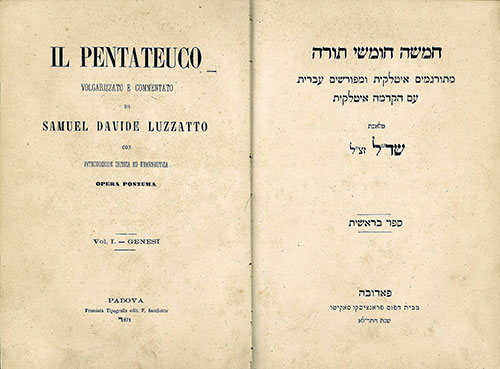
The Shadal’s biblical commentary became the cornerstone of his reputation, and his commentary on Chumash, written over many years and published in parts, combined philological precision with moral sensitivity. He unquestioningly accepted Mosaic authorship of the Torah, but he acknowledged the existence of minor glosses, scribal additions, and textual difficulties, a position that put him at odds with the rising school of German higher criticism, particularly that of Abraham Geiger and Heinrich Ewald. He rejected the documentary hypothesis, arguing that the unity of style and the internal coherence of the Torah pointed toward an overarching authorship; yet he carefully analyzed variations in vocabulary and syntax, sometimes conceding that certain passages bore traces of early prophetic redaction or later editorial shaping. His method, which accepted limited emendation while defending core Mosaic authorship, made him a target for critics at both extremes.
The most contentious of his works in terms of halachic implication was his long debate with the proponents of radical rationalism and Aristotelian philosophy. In essays such as Vikkuah al Chochmat ha-Kabbalah, Te’udah be-Yisrael (“A Disputation on the Wisdom of the Kabbalah”) and in numerous letters, he argued that medieval Jewish philosophy had introduced foreign metaphysical assumptions that contradicted the spirit of biblical revelation. In particular, he accused Maimonides and his followers of subordinating prophecy to philosophy, thereby draining Judaism of its emotional vitality, a charge that was not merely theoretical; for Shadal, the essence of halachic practice lay in cultivating moral feeling, rachamim, ahavah, yir’ah (“compassion, love, and reverence”), and he believed that excessive philosophical speculation led to spiritual dryness. His opposition to Aristotelianism and to parts of the Jewish philosophical tradition rendered him unpopular among some Italian rabbis trained in that system, particularly in Mantua and Livorno, where Maimonidean rationalism had long been dominant. However, to be clear, he never declared Maimonides heretical; he simply believed that his philosophy had been taken too far by later followers.
His critique of Kabbalah, especially of the Zohar, also drew significant controversy. The Shadal considered the Zohar to be a medieval creation, not an ancient work, and, while he admired the ethical purity of early Jewish mysticism, he believed that the metaphysical system of the Zohar represented a degeneration of authentic Jewish theology. His students recorded how he sometimes grew emotional when explaining why he objected to Kabbalistic cosmology; he felt that the anthropomorphic language of the Bible, when properly understood, conveyed deep truths about divine involvement in history, whereas the Kabbalistic system, with its “emanations” and sefirot, risked diluting monotheism. Some traditionalists accused him of undermining established doctrines, to which he responded by insisting that he was returning Judaism to its original purity; this tension placed him in the middle of ideological disputes between traditionalist rebbeim and emerging scientific scholars.
Among the most interesting episodes of the Shadal’s life is his correspondence with prominent Christian biblical scholars, particularly the French Orientalist Ernest Renan, who had immense respect for the Shadal’s philological expertise and often sought his advice on Hebrew questions. The Shadal would always respond graciously, but he was quick to criticize Renan’s skepticism regarding divine revelation. Their exchanges reveal a delicate dance: while the Shadal appreciated Renan’s linguistic knowledge, he bristled at his secularizing tendencies. These letters also show the respect that the Shadal commanded across the non-Jewish world.
The Shadal also corresponded extensively with the German maskilim, though these relationships were often tense. He maintained cordial but cautious relations with Leopold Zunz, the father of the Wissenschaft des Judentums movement, who admired Shadal’s mastery of Hebrew style but considered his theological conservatism old-fashioned. His relationship with Abraham Geiger, however, was more openly strained; Geiger’s radical historical reinterpretation of Judaism, his denial of Mosaic authorship, and his support of Reform positions were deeply offensive to the Shadal and, in various correspondence, he accused Geiger of “dismantling the Holy Ark plank by plank.” Geiger, for his part, regarded the Shadal as brilliant but reactionary, unable to see the necessity of modernizing Jewish religion. Their dispute fairly represents a microcosm of nineteenth-century Jewish intellectual life.
Anecdotes from his life reveal a man of deep feeling. In one story from his Padua years, when a student complained that the grammar exercises were too demanding, the Shadal replied, “The Torah was not written in Italian; if you wish to hear it speak, you must learn the language it loves.” According to another well-known story, when a Christian scholar visited Padua to challenge him on a point of Hebrew etymology, the Shadal brilliantly refuted his argument and, when the scholar marveled that the Shadal’s mastery of Hebrew seemed almost miraculous, he replied, “There is no miracle; only love and patience.”
One significant episode of his life that is sometimes overlooked is his journey to Eretz Yisrael in 1860 when, at the age of sixty, he accompanied his son, Filosseno, a noted Arabist, on a trip that was motivated partly by health and partly by scholarly curiosity. The Shadal had long dreamed of seeing the land of the Bible and of comparing its landscapes with his philological insights, and he visited Jerusalem, Chevron, Tzefat, and Yaffo, recording his impressions in letters later published by his students. He met with Sephardic rabbis in Jerusalem, corresponded with European emissaries active there, and observed the varied communities, including Ashkenazi, Sephardi, Maghrebi, and even small groups of Italian Jews. His letters from Jerusalem describe a mixture of awe and sorrow; he marveled at the sight of the Western Wall, describing how he “touched the stones worn smooth by generations of tears,” yet lamented the poverty and internal disputes that plagued the local community. Although he disagreed with aspects of the mystical orientation he observed in Jerusalem, he expressed admiration for the steadfast piety of its inhabitants, and the journey renewed his sense of connection to biblical history and deepened his commitment to the spiritual revival of the Jewish people.
Regarding Zionism, it is important to clarify that the Shadal died decades before political Zionism emerged. However, he did articulate a vision of Jewish peoplehood and national attachment to the Land of Israel, and he strongly rejected the idea, then common among some German Reform thinkers, that Judaism was merely a religion divorced from national identity; instead, he emphasized that the Jewish people were bound to their land by divine promise and historical mission. In Ohev Ger, his commentary on Leviticus, he interprets the laws of the Jubilee as evidence of the unique relationship between Israel and its land, and, in letters from the 1830s and 1840s, he argued that assimilation, particularly in German lands, threatened to erode the Jewish people. Although, given the political realities of his time, he did not advocate mass return to Eretz Yisrael, he objected strongly to movements that sought to redefine Judaism purely as an ethical monotheism without national particularity and he expressed hope that Jews would eventually be restored to their homeland. As he wrote in one correspondence, “The land is our cradle; our exile is a sickness of history, and healing will come in G-d’s time.” This sentiment aligns with later proto-Zionist currents, although the Shadal himself remained focused on spiritual rather than political restoration.
Exhibited here is a truly unique rarity, the Shadal’s original handwritten front-page introduction to his Seder Tannaim va-Amorim, a short scholarly edition in pamphlet-like form concerning the rabbinic sages of the Mishnah and the Talmud. Unlike his popular or canonical works, like his Pentateuch commentary or his Yesodei ha-Torah essays, it was aimed at sophisticated readers, and its reception was accordingly limited to the scholarly and philological readership of the day (contributors/readers of Hebrew periodicals and Jewish scholars). Cited in bibliographies of the Shadal’s writings and appearing in modern catalogues, it is not a work that entered mainstream synagogue use or general Jewish education. Though not in broad contemporary use, it survives in library copies and in bibliographies of Shadal, and modern researchers consult it when studying his critical method or when working on Tannaitic/Amoraic bibliographies.
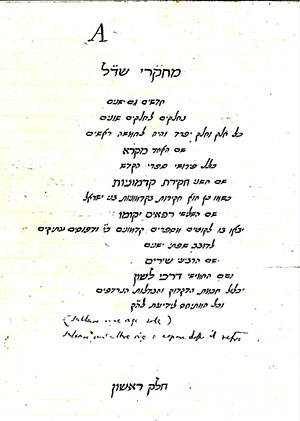
STUDIES BY THE SHADALNovelties and Mainstays Divided into various parts Each part will split and have five headings One part will be Mikra, a gathering of all the Holy Books. The name of the second is Chakirot Kadmoniot, as its name, so it is, Ancient Investigations. The name of the third is Refaim Yakumu (“Spirits will Arise”), which will include collected anthologies from ancient templates and cause the lips of sleepers to speak [from Shir HaShirim 7:10]. The name of the fourth is Shirim (“Songs”). And the name of the fifth is Darchei Lashon (“The Paths of Language”), Including the wisdom of grammar and synonyms distinction.
PART ONE

On the verso, the Shadal has written: “Today the 22nd of Tevet, 1839, I laid the foundation of this book, and I have engraved His name on its five foundations. May Hashem, who was my shepherd from my youth, may he be with me to begin and complete this book in many parts, writing words of Truth, Justice, Wisdom and reverence for Hashem."

Finally, a second page of the Shadal’s introduction to Seder Tannaim va-Amorim reads:
STUDIES BY THE SHADALThe year 5600 (1839)A gathering of all the Holy Books. Each or most of these matters shall include:
Mikra (translations of the Holy Books) Chakira [“investigation”] Kadmoniot [“scholarly antiquity”] Refaim Yakumu [“Spirits will Arise”] (collected anthologies from ancient templates) Shirim [“Songs”] Darchei Lashon (“The Paths of Language”)
PART ONE
A watershed event in the Shadal’s final years was the death of his beloved son, Filosseno, in 1854, a tragedy that devastated him and produced some of the most poignant letters in his corpus as he struggled to reconcile his personal grief with his belief in divine justice. He rejected simplistic explanations of the righteous person’s suffering; emphasized the mystery of divine Providence; and his commentary on the Book of Iyov (Job), written partly in this period, reflects his deep wrestling with suffering. Despite declining health, he continued teaching until his death, and his funeral procession in Padua drew Jews and non-Jews alike, a testament to the respect he commanded everywhere.
The Shadal’s legacy is multifaceted. His biblical commentary remains valued for its linguistic insight and moral clarity; his insistence on the emotional foundation of Judaism influenced later Italian Jewish thinkers, even when they disagreed with his anti-Kabbalistic position; his grammatical works contributed significantly to the study of Hebrew philology in Italy; his critiques of radical rationalism and extreme mysticism provided a model for a balanced, tradition-anchored engagement with modern scholarship; and his correspondence, now published in several volumes, offers an unparalleled window into the intellectual ferment of nineteenth-century Jewish life. He also left a great pedagogical legacy, as many of his students became leading rabbis, teachers, and community leaders across Italy. He also left a literary legacy through his Hebrew poetry which, although not widely read outside scholarly circles, reveal a voice of emotional depth and artistic elegance and demonstrate how profoundly he felt the human condition and how central the pursuit of divine closeness was to his inner life.
But perhaps the most enduring aspect of the Shadal’s legacy is his personal integrity. Scholars who disagreed with him respected his honesty and sincerity and his writing exudes an almost prophetic passion for truth and righteousness. He saw the Torah not merely as a text to be analyzed, but as a living source of moral transformation, and his incredible ability to combine meticulous philology with heartfelt religious commitment remains unusual even today.