September 11, 2026
 Categories: Arts / Collecting
Valdemar Langlet: Raoul Wallenberg’s Inspiration
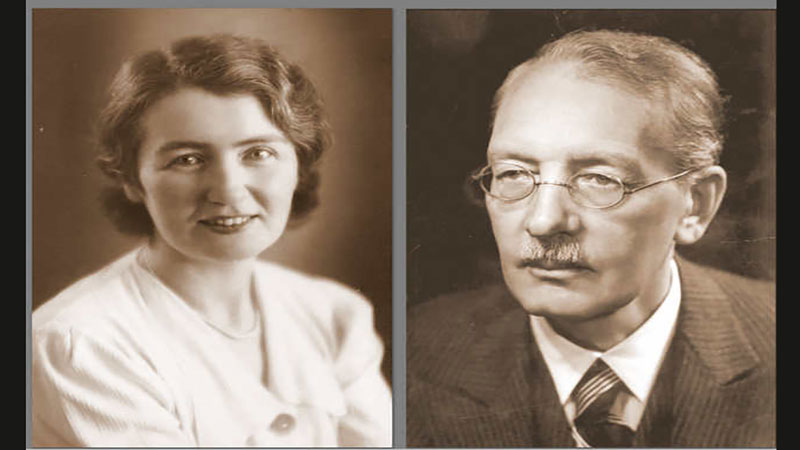


Valdemar Langlet (1872-1960) was born in Lerbo parish in Södermanland, Sweden into a cultivated Lutheran family shaped by the moral seriousness and educational aspirations characteristic of late nineteenth-century provincial Sweden. His father, Emil Victor Langlet, was an architect and his upbringing took place in a society that was modernizing yet still deeply rooted in Protestant civic culture and where literacy, discipline, and a sense of public duty were central values that he absorbed early. He went on to study at Uppsala University, one of Sweden’s foremost intellectual institutions, where he was immersed in literature, philosophy, and languages. His early professional life was devoted to education and cultural work, and he became a teacher, lecturer, writer, and organizer, building a reputation as a man of letters rather than as a political actor.
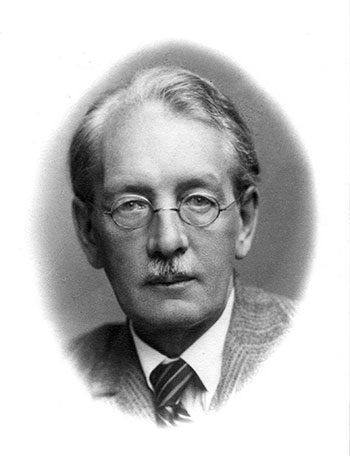
One of the defining commitments of Langlet’s life before World War II was his deep involvement in the Esperanto movement. Esperanto, created in the 1880s by L. L. Zamenhof, a Polish Jewish ophthalmologist, was intended as a neutral auxiliary language that could foster mutual understanding across ethnic and national divides. For many early adherents, Esperanto was more than a linguistic project; it was an ethical and quasi-utopian undertaking grounded in the belief that communication could mitigate hatred, and Langlet became one of the leading Swedish Esperantists, editing journals, teaching the language, organizing congresses, and working tirelessly to promote its adoption. He was a founding member of the Esperanto club of Uppsala in 1891, the second Esperanto club in the world, and for many years he served as president of the club; when the Swedish Esperanto Federation was founded in 1906, he became its president, until the great Ido-schism during Easter of 1909.
Langlet’s high-level involvement placed him in regular contact with an international network that included Jews from Eastern and Central Europe, regions where antisemitism was deeply entrenched. Zamenhof’s own universalist philosophy, sometimes called “Homaranismo,” emphasized the moral equality of all human beings and explicitly rejected ethnic chauvinism. Langlet’s long engagement with this milieu habituated him to think in supranational and humanitarian terms, and it is difficult to overstate how formative this was; decades before the Holocaust, he was already embedded in a community that defined itself against ethnic exclusion.
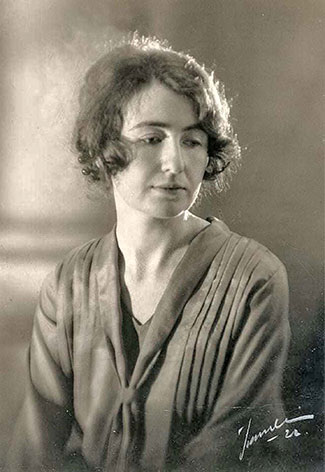
In 1899, Langlet married a Finnish esperantist Signe Blomberg from Turku and, after her death in 1921, he met Nina Borovko, the daughter of Nikolai Afrikanovich Borovko, a friend and a pioneering esperantist in Russia, and the couple married in 1925. Nina’s life experience under the Russian Empire exposed her to authoritarianism and political repression, and their marriage became an intellectual partnership, as Nina shared his cosmopolitan outlook and would later become indispensable to his rescue work in Budapest. The combination of Swedish Lutheran moral culture, Esperanto universalism, and Nina’s firsthand knowledge of the dangers facing minorities under autocratic regimes formed the essential moral architecture of the Langlet household.
During the interwar years, Langlet’s career took him abroad; he was appointed lecturer in Swedish language and culture in Hungary and eventually headed the Swedish Cultural Institute in Budapest, where his long residence acquainted him intimately with Hungarian society. Hungary between the world wars was a country of sharp political currents; the trauma of the Treaty of Trianon, territorial losses, and nationalist resentment shaped public discourse and Hungary also enacted antisemitic legislation beginning in 1938, limiting Jewish participation in professions and public life. The Jewish community in Hungary was large, economically and culturally prominent, and in many cases highly assimilated, and Langlet observed these developments not as a distant diplomat but as a resident intellectual figure with local connections.
When Germany occupied Hungary in March 1944, the situation deteriorated with shocking speed. Adolf Eichmann and his staff organized the deportation of Hungarian Jews to Auschwitz and, within weeks, provincial Jewry had been largely destroyed, but Budapest still contained a vast Jewish population. It was in this catastrophic setting that Langlet’s role changed from cultural emissary to heroic rescuer.
By 1944, Langlet was serving in Hungary as Sweden’s representative of the International Red Cross, in which capacity he had a humanitarian mandate. What distinguished him was his willingness to interpret that mandate expansively and, as deportations accelerated, desperate Jews sought protection from neutral legations.

He and Nina began issuing protective certificates under Red Cross auspices, and their home soon became insufficient to manage the full scope of their extensive humanitarian work. They searched and rented apartments, homes and farms and marked them as under Swedish or Red Cross protection, exploiting the ambiguities of diplomatic privilege. In many locations, both in Budapest and the surrounding areas, they arranged for orphanages and safehouses for older people and, in some of these homes, they secretly hid Jews wanted by the Hungarian fascists or the German SS.
The Langlets’ apartment became a place of constant supplication and survivors later recalled lines of families waiting for documents, interventions, or advice. Nina is remembered as drafting certificates and organizing relief with extraordinary energy; survivors testified that she physically intervened when Jews were being arrested or deported, entering police stations and demanding releases, insisting that detainees were under Swedish Red Cross protection, and escorting Jews out of dangerous situations. Valdemar negotiated with Hungarian officials, sometimes invoking Sweden’s neutrality, sometimes appealing to humanitarian principles, and at other times relying on personal relationships cultivated over years in Budapest. Eyewitnesses described him placing himself between Hungarian fascist Arrow Cross guards and Jews they were attempting to deport, forcing them to release their captives. All these measures predated Raoul Wallenberg’s arrival in July 1944.
(Saul Jay Singer)
(Saul Jay Singer)
(Saul Jay Singer)
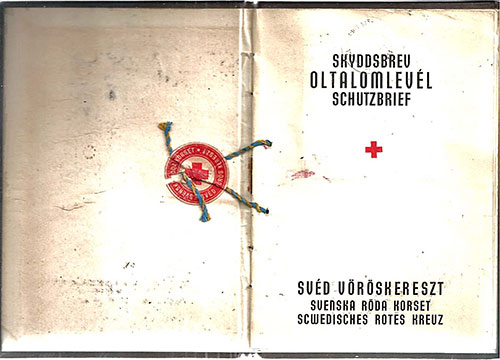
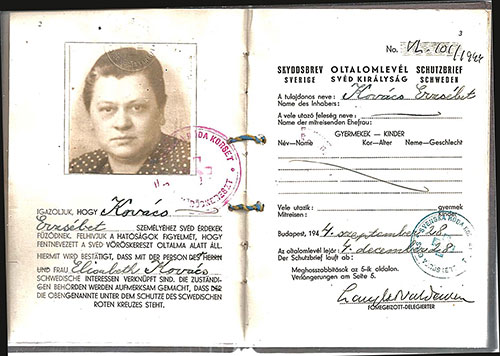
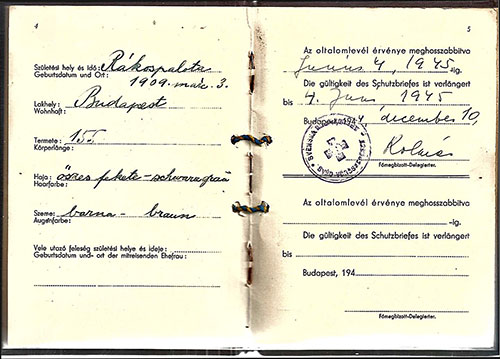
Exhibited aboveis an exceptionally rare 1944 Swedish Red Cross “Protection Letter” signed by Valdemar Langlet. The cloth-bound hardcover passport, 4.25 x 6, eight pages, numbered “VL. 101/1944,” was issued on September 28, 1944 (and was to expire June 4, 1945) to Elisabeth Kovács, a goldsmith from Budapest, and the document, with text in both Hungarian and German, reads, “We confirm that Swedish interests are linked to Miss Elisabeth Kovács. The competent authorities are notified that the above-named is under the protection of the Swedish Red Cross.” The second page features a photograph of Kovács, which has been stamped and embossed by the Red Cross, and the fourth page also features her personal information, such as birth date, residency, height, and hair and eye color.
Kovács was born on May 3, 1909 in Rákospalota, then a semi-suburban municipality with a modest but established Jewish community. (It was an independent town until 1950, when it was incorporated into Budapest as District XV.) The Jewish population there typically consisted of skilled artisans (goldsmiths, tailors, watchmakers), shopkeepers and merchants, and lower-middle and middle-class families, and there was an active synagogue and organized Jewish communal life.
To become a goldsmith in Hungary, Kovács would have entered apprenticeship around age 14–16 (approximately 1923–1925), trained under a master goldsmith, and completed several years of supervised work. Female goldsmiths were less common but certainly existed, particularly in Jewish artisan families. Goldsmithing in Hungary was a skilled artisan profession, often hereditary, and historically associated disproportionately with Jewish craftsmen in Central Europe. Most Jewish goldsmiths in Hungary belonged to an urban Jewish artisan class and were often moderate reform or secular Jews who assimilated culturally. Jewish professionals and artisans often received Schutzpasses because they were skilled workers needed by embassies or Red Cross networks, employed in protected industries, and able to contribute valuables or professional services to rescue networks, and Langlet’s rescue effort was partly funded and supported by Hungarian Jews themselves.
The number on Kovács Schutzpass – 101/1944 – is extraordinarily important because it makes her one of the very early recipients of Langlet’s protection. Langlet began issuing Schutzpasses in spring–summer 1944, and a number as low as 101 indicates that likely applied early, possibly in May – June 1944; that she was among the first few hundred Jews protected by Langlet; and that she was identified as urgently needing protection, which dramatically increased her survival probability. Because she held an early Langlet Schutzpass, she was very likely not deported to Auschwitz, was protected during the Arrow Cross terror of late 1944, and was alive at the liberation of Budapest in January – February 1945. Budapest had one of the largest surviving Jewish populations in Nazi-controlled Europe largely due to Swedish and other diplomatic protection.
Wallenberg was dispatched as a special envoy of the Swedish Foreign Ministry with backing from the American War Refugee Board and his mission was explicitly focused on rescuing Hungarian Jews. When he arrived, he entered an environment where protective measures were already being tested; the issuance of Red Cross certificates by Langlet and the designation of protected houses created precedents, and the Hungarian authorities had, at least intermittently, tolerated such arrangements. This practical groundwork laid by Langlet strengthened the position of subsequent Swedish initiatives, including those by Wallenberg.
Langlet and Wallenberg’s activities intersected geographically and administratively and they met in Budapest. While there is no surviving verbatim statement in which Wallenberg explicitly declares Langlet his inspiration, documentary evidence shows that Wallenberg was aware of and coordinated with existing Swedish efforts, that he referred to cooperation among Swedish representatives in reports to Stockholm, and that he described an expanding system of protection. Historians of the Budapest rescue operations have emphasized that Wallenberg’s large-scale issuance of Swedish Schutzpasses was built upon methods already in use by Langlet and the Swiss vice-consul Carl Lutz. Thus, the structure of protected houses, the bold display of neutral insignia, and the creative stretching of bureaucratic authority were not conjured from nothing in July 1944; they evolved from Langlet’s earlier improvisations.
Langlet’s example was therefore both operational and moral. Operationally, he demonstrated that protective documentation and neutral safe houses could save lives, at least temporarily and, morally, he showed that a representative of a neutral state could confront genocidal machinery without waiting for perfect authorization. His actions required courage, particularly given that Arrow Cross militiamen and German officials were not inclined to defer automatically to humanitarian claims; there were moments of direct confrontation and risk, and the Langlets’ status did not make them invulnerable. As Nina explained, “We discovered that the Arrow-Cross were out to get us. Wallenberg, my husband and I therefore became persecuted, and could have reckoned on being snatched on the pretext of questioning and shot in the back of the head. We tried not to think about it and did our best to go on working.”
Meanwhile, in Sweden, Langlet received criticism for overstepping his authority in Hungary, for taking spontaneous actions, and for failing to have thorough oversight over his core mission, but he determined not to await official responses given the critical situation of the Jews of Hungary and, as a result, they saved more than 10,000 lives. Scholars and historians argue that the actual number is much larger, albeit indeterminate, because many of their actions were informal and undocumented and survivors often later testified that Langlet protection or intervention had saved them, even when no paperwork survived. Many Jews saved by the Langlets remained in correspondence with them after the war; some visited them in Sweden and others supported their eventual recognition at Yad Vashem
Moreover, unlike many diplomatic rescuers who restricted protection to Jews with some national connection, Langlet often issued papers to Jews simply based on humanitarian need. He did not require Swedish ancestry, relatives, or citizenship eligibility; he extended protection broadly, which dramatically increased the number of Jewish lives saved. The Langlets actively worked with Jewish volunteers and Jewish communal groups in Budapest as part of their rescue efforts, particularly to distribute relief, set up children’s homes, and organize protective passes and housing. Some Orthodox Jews trusted Langlet because he respected religious practices; survivors recalled that Langlet and Nina respected Jewish religious identity, treated rabbis and religious Jews with dignity and, unlike some rescuers, never pressured Jews to convert or abandon their identity.
When the Langlets returned to Sweden after the war, they initially moved between various friends in Stockholm. Valdemar wrote articles for the press and, in November 1945, he released a book written in Swedish, Verk och dagar i Budapest. (“Works and Days in Budapest”), and Nina wrote Kaos i Budapest (“Chaos on Budapest”) in 1946 as a complement to her husband’s book (but it was only published in 1982), which she later translated into Esperanto.
After World War II, the Langlets faced significant political, institutional, and personal opposition in Sweden, an opposition culminated in the collapse of a humanitarian aid committee led by Folke Bernadotte and in a damaging smear campaign against the Langlets. The sad story involves bureaucratic rivalry, political sensitivities, antisemitic undercurrents in Swedish society, and conflicts over credit and authority.
After Budapest was liberated in January 1945, the Langlets, despite being nearly bankrupt, remained intensely involved in sending food, clothing, and medical supplies to survivors in Hungary, supporting displaced Jews and other victims, and advocating internationally for continued humanitarian relief, financed by the income they received from Valdemar’s book. The Langlets’ relief effort was semi-private and not fully controlled by Swedish state institutions; this independence became a key source of friction and, in opposition to the Langlet’s independent operation, an aid committee was established in Sweden in 1945–1946 by Swedish Red Cross leadership and Swedish government–connected humanitarian circles with the goal of creating a centralized, officially recognized organization to coordinate aid to Hungary. Bernadotte was chosen to head the Committee because he was vice chairman of the Swedish Red Cross; he had achieved enormous international fame for negotiating the release of prisoners from Nazi camps in 1945 (the “White Buses” operation); he was a member of the Swedish royal family’s extended circle; and he had credibility with both government and international relief organizations.
The opposition to the Langlets and the committee came from several overlapping sources. First, bureaucratic and institutional rivalry was perhaps the primary cause; the Langlets had operated largely independently in Budapest, often improvising rescue methods without strict bureaucratic authorization. After the war, Swedish official institutions wanted centralized control of relief efforts, strict accounting and reporting, and elimination of freelance humanitarian initiatives, and some officials viewed the Langlets as uncontrollable, administratively irregular, and most significantly, as potentially embarrassing to official Swedish neutrality narratives. There was great resentment that Langlet had taken initiative outside formal diplomatic channels and that he had sometimes stretched or improvised Red Cross authority to save lives. Sweden had maintained official neutrality during WWII, but this neutrality was controversial, so that highlighting Langlet’s rescue work raised uncomfortable questions, such as: why had the Swedish government not done more sooner? Why had private individuals taken the lead instead of the state? Langlet’s independence was therefore, at the very least, “inconvenient.”
There was also competition among Swedish humanitarian figures over recognition and historical credit; Langlet had been rescuing Jews in Budapest months before Raoul Wallenberg arrived but, after the war, the Swedish government and international media heavily promoted Wallenberg and Bernadotte which, some argue, was designed to intentionally mute Langlet’s important role.
The smear campaign involved allegations of administrative irregularity, as critics accused Langlet and his associates of poor financial record-keeping, unauthorized relief operations, and improper organizational procedures, allegations that were mainly bureaucratic and reputational attacks rather than criminal charges. Some critics suggested that Langlet had overstated his importance and sought personal recognition, which was deeply painful to him and historically unjustified; modern scholarship confirms his major role. Some Swedish nationalist elements were suspicious of humanitarian work benefiting foreign populations, particularly Jews and Eastern Europeans, which broadly contributed to hostility toward continued aid to Hungary.
There is evidence of antisemitic sentiment in Sweden at the time, as Sweden during the 1930s and 1940s had restrictive refugee policies toward Jews before 1943, antisemitic currents in parts of government and society, and concerns about appearing “too favorable” to Jews; while these attitudes did not dominate Swedish policy, they were present. Indeed, some critics of Langlet’s work were uncomfortable with the fact that most beneficiaries were Jews and that the scale of relief was directed toward Jewish survivors. However, to be clear, there is no credible historical evidence that the official smear campaign publicly accused Langlet of wrongdoing specifically because he helped Jews; rather, antisemitic attitudes likely influenced the climate in which criticism occurred, rather than being explicitly stated as official accusations.
The aid committee headed by Bernadotte was forced to fold shortly afterwards following a smear campaign because public controversy damaged its credibility; internal disagreements undermined its effectiveness; political support for it weakened; and Bernadotte himself became increasingly occupied with international diplomatic work, causing the committee to lose momentum and dissolve.
After these events, Langlet became deeply disillusioned, felt misunderstood and unappreciated, and withdrew from public life. He retired to Solbacken, his home in Sweden, while Nina wrapped up relief operations and eventually joined him. Nina was subsequently appointed as a teacher at the municipal music school in Katrineholm, which meant that she got an apartment in the town, where Valdemar joined her. After his death in 1960, Nina continued teaching music and giving language lessons. After her death in 1988, having just turned 92 years old, she was buried beside Valdemar and his family at Lerbo cemetery.

After the war, the Langlets did receive several commendations, including an award of the Swedish Red Cross silver medals (1946) and Valdemar was made a Knight of the Royal Order of the North Star (1949). A Langlet school and a Langlet street, complete with memorial plaque, have existed in Budapest since 1955. In 1985, Prime Minister Olof Palme gave a speech at the Langlet school in Budapest saying: “I want to honor Raoul Wallenberg and Valdemar Langlet for their efforts of outstanding humanitarian solidarity and bravery in helping people in need.”
In 1987, congressman Tom Lantos of California delivered a speech, which was placed in the U.S. Congressional Record on November 2, 1987, in which he explicitly mentioned and honored Valdemar Langlet, alongside Raoul Wallenberg, and included a testimonial by Dr. Alexander Kasser, who had served as Secretary General of the Swedish Red Cross in Hungary during the Nazi occupation and had personally worked with both men in Budapest during the Holocaust. Lantos, as a Hungarian Jewish survivor who had firsthand knowledge of rescue efforts in Budapest and was deeply committed to honoring rescuers, was uniquely qualified to deliver the address.
Although, following Congress’s 1981 decision to make Wallenberg an honorary U.S. citizen, the tribute was part of continuing congressional efforts in the 1980s to commemorate his rescue work and to raise awareness of his disappearance in Soviet custody, it is significant that Langlet was not mentioned incidentally but, rather, as a co-hero of the rescue effort. Thus, in Kasser’s address – “Raoul Wallenberg, Fearless Crusader; Valdemar Langlet, Tireless Missionary” – he gave substantial attention to Langlet. He emphasized that Langlet was no mere subordinate to Wallenberg but, rather, that he was already running rescue operations before Wallenberg arrived and continued working alongside him: “Mr. Langlet wanted to use the Red Cross to do meaningful rescue work . . . he invited me to organize the administration and activity schedules of the Red Cross. As a result, the Swedish Red Cross under Mr. Langlet’s direction became the official [institutional rescue operation].”
The question of motivation is central: what was it in Langlet’s background that prepared him to assume such risks? There is no evidence of a prior political program focused on Jewish nationalism or Zionism, and he did not enter 1944 as a partisan of a Jewish state. Rather, his life had been steeped in universalist ethics; Esperanto culture, with its Jewish founder and its explicit rejection of ethnic hatred, had normalized for him a moral stance that opposed persecution as such and his Lutheran formation emphasized conscience and moral duty. The Sweden of his youth had not been immune to antisemitic stereotypes, but it lacked the virulent mass antisemitism of Central Europe. His professional circles were cosmopolitan; he had worked with Jews as colleagues in the Esperanto movement and in academic settings, experiences that likely dissolved any sense of Jewish “otherness.”
During the rescue period, Langlet worked in contact with Jewish community leaders in Budapest, and the Jewish Council, rabbis, and communal activists sought his assistance. His interactions were pragmatic rather than ideological, as he responded to concrete needs: documents, shelter, negotiation. Testimonies from survivors often portray him as approachable and decisive, and his wife Nina’s courage is repeatedly emphasized.
As for Eretz Yisrael and Zionism, the documentary record does not show Langlet as a public advocate of Zionist policy and his work focused on immediate survival. There is no reliable evidence that he ever traveled to Eretz Yisrael either before or after the war, nor that he articulated a program for Jewish relocation there, not surprising because rather than conditioning his humanitarianism on a political solution, it was directed toward preserving life under imminent threat.
Wallenberg’s later fame sometimes obscures the collaborative and cumulative nature of the Swedish rescue in Budapest. While he arrived with enhanced political backing and expanded the scale of protection dramatically, he did so in an environment where Swedish humanitarian engagement had already been tested. Scholars have noted that he consulted with Langlet and that the Swedish mission functioned as a network; as such, influence in this context is best understood not as formal mentorship but as precedent and shared ethos. Author Gellert Kovacs perhaps said it best in Twilight in Budapest (2013), when he called the Langlets “the forgotten Swedish heroes.”
Unlike Wallenberg, who was detained by Soviet forces in January 1945 after the war and disappeared into captivity, Langlet returned to Sweden, where he survived to recount aspects of the Budapest operations. In 1965, Yad Vashem honored Valdemar and Nina Langlet as Righteous Among the Nations. The recognition followed documentation and survivor testimony confirming their sustained efforts in Budapest, and the proclamation recognized that they had used their positions with the Swedish Red Cross to issue protective documents and establish shelters, thereby saving numerous Jews from deportation and death. The citation emphasized that they acted at personal risk and that their home became a center of rescue activity and, as with all Righteous Among the Nations, their names were inscribed on the Wall of Honor in the Garden of the Righteous at Yad Vashem. A medal and certificate were presented bearing the Talmudic inscription: “Whoever saves a single life, it is as if he has saved an entire world.”
Nina was not only invited to Israel to plant a tree in the Alley of the Righteous at Yad Vashem, but also to receive her medal; she learned Hebrew for the trip and, perhaps most impressively, she delivered her official speech at the Yad Vashem ceremony in Hebrew, marking an unusual personal effort to speak in the language of the host country, an indicator of her profound commitment to the recognition. She followed up by writing Nyhebreiska IVRIT utan språkstudier: med angivande av uttalet: parlör (“Modern Hebrew Without Language Study: With Pronunciation Indicated: Phrasebook,” 1970), a Hebrew phrasebook intended for Swedish speakers and a Hebrew–Swedish dictionary (1977).
In Sweden, awareness of Langlet’s role has coexisted with the much greater public prominence of Wallenberg. Swedish historiography increasingly situates both men within a broader pattern of neutral diplomatic rescue efforts in Budapest, and the continuity between Langlet’s early Red Cross measures and Wallenberg’s later diplomatic expansion is widely recognized. Although Wallenberg’s disappearance and symbolic status as a martyr of humanitarianism have drawn extraordinary attention, Langlet’s contribution has been generally less recognized.
Langlet’s life after the war did not involve political advocacy on Jewish statehood, and there is no record of him taking a public stance on the Arab-Israeli conflict or engaging in Zionist activism. His recognition by Israel was tied to his wartime rescue, not to postwar political positions; he never sought public acclaim, and his legacy rests on action rather than ideology. At the end of the day, the moral trajectory of Langlet’s life, from Lutheran provincial upbringing through Esperanto universalism to Red Cross rescue in Budapest, reveals a coherent ethical development; he was not transformed overnight into a rescuer but, rather, decades of cosmopolitan engagement and principled conviction prepared him to act when catastrophe arrived.
In assessing his significance, it is appropriate to view him as both an individual savior and a precursor within the Swedish rescue effort. His early initiatives demonstrated that neutrality could be weaponized against persecution, and his courage helped normalize bold intervention. Wallenberg’s subsequent achievements, monumental though they were, unfolded within an operational and moral space that Langlet had helped to launch.