 October 16, 2026
 Categories: In Print / Headline / Perspectives / Op-Eds
Violent Crime’s Real Root Cause: Bad Policies and Programs


New Yorkers are likely to soon be hearing a familiar refrain: poverty is the “root cause” of crime. Expect that argument to be repeated endlessly if radical leftwinger Zohran Mamdani is elected mayor.
The Democratic Party’s candidate – and Democratic Socialists of America standard bearer – opposes the kind of policing that protects ordinary, law-abiding people from the horrific violence that makes cities unlivable. He and his DSA comrades claim capitalism breeds the poverty that causes crime – and that police exist mainly to enforce the system’s oppression.
Setting aside the need to defend capitalism here, it’s worth recalling that New York’s own history demolishes the “poverty as root cause” argument.
During the Great Depression, when unemployment in New York was nearly 25 percent. the city’s streets were widely regarded as safe. People walked home late at night without fear. Subways were orderly. Parks were filled with families. Stores stayed open after dark.
If poverty causes violent crime, the 1930s should have been a bloodbath. It wasn’t remotely like that. Homicides numbered under 500 per year in the early 1930s – less than half the level the city would later endure. The murder rate hovered in the single digits per 100,000 residents, far below the 1970s peak.
The same pattern held in the postwar years. In 1950, with 7.9 million residents, New York recorded just 294 murders citywide. Immigrant families crowded into small apartments. Incomes were modest, and neighborhoods were dense. Yet children played stickball and other street games until dark, women rode the subway home from Broadway shows, and city parks were safe places for recreation and gathering.
Even the subways reflected that sense of security. A 1961 Broadway musical, Subways Are for Sleeping – based on Edmund G. Love’s nonfiction account of neatly dressed, down-on-their-luck New Yorkers living in the subway system while they searched for employment – struck audiences as plausible because the subways were considered safer than the streets. The author had himself slept on the subways for a brief period when he couldn’t afford lodging.
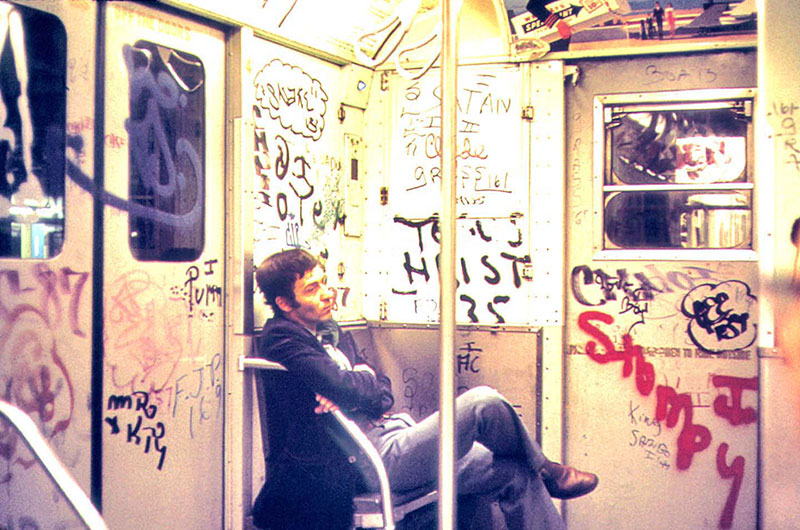
By the late 1960s and early ‘70s, that world had collapsed. Murders more than doubled in a decade, from 482 in 1960 to over 1,100 by 1970. In the ‘70s, the total would surpass 2,000 annually. Robberies, which numbered in the tens of thousands in the mid-‘60s, soared into six figures. Social spending reached record levels, yet violence exploded.
A key factor was the disappearance of the beat cop. For generations, officers walked the same blocks daily, their steady presence deterring crime. In the 1960s, they vanished. Officers were reassigned to random car patrols that proved ineffective at reducing crime or fear. The result was neighborhoods dominated by predators.
Nowhere was the decline clearer than on Manhattan’s famously liberal Upper West Side. In 1968 alone, precincts covering the area recorded more than 8,000 burglaries, 3,200 robberies, 1,100 felony assaults, 36 murders, and 86 rapes. Jewish candy-store owners – once fixtures of neighborhood life – were gunned down in robberies that merited barely a headline.
On West 104th Street, a Holocaust survivor was bludgeoned to death in an apartment building lobby by a mugger. He had lived through Auschwitz – only to be murdered in Manhattan. The killing never made the evening news.
Fear drove the local block association to hire its own nightly patrol guard. Only then did the muggings stop.
Across the city, ordinary families fortified their apartments: multiple heavy locks, reinforced steel doors, windows barred like prison cells.
Meanwhile, repeat offenders cycled endlessly through the courts. Studies showed that a small group of violent criminals was responsible for a large share of violent crimes, but the system released them again and again.
Government policies and programs compounded the problem. In the 1950s and ’60s, welfare-backed conversions of hotels and apartments into single-room occupancy housing destabilized middle-class blocks. The SROs became magnets for criminals and addicts. Massive low-income public housing projects – built on “superblocks” – became concentrations of drugs and crime rather than engines of economic uplift. Working-class neighborhoods that had been safe for generations disappeared.
In the eyes of many voters, it was the beginning of the Democratic Party’s transformation from the party of the working class to the party of the welfare class – and the criminal class.
Successful police innovations were dismantled. The NYPD’s elite “Stakeout Squad,” which deterred – and foiled – armed robberies by placing plainclothes officers in vulnerable stores, was disbanded amid political opposition after the unit produced too many dead criminals. Liberal ideology triumphed over public safety.
The signs of decline were everywhere. Anyone remember “Lindsay Gates?” Those roll-down steel barriers that began covering storefronts during the administration of Mayor John V. Lindsay became the city’s most visible symbol of rising crime and fear.
Adding insult to injury in the ‘60s and ’70s, the victims themselves were often blamed. A rape victim was met with: What was she doing out that late? A stabbing victim was scolded: Didn’t he know better than to cut through the park after dark?
The crime was never the criminal’s fault. It was the fault of citizens for daring to expect safety in their own city. Ordinary New Yorkers were told to shrink their lives, to accept fear as the new normal.
The chaos continued until Rudy Giuliani’s election in 1993, when aggressive policing reversed the tide. Michael Bloomberg built on that foundation. But it took more than two decades for the cycle of collapse to end.
That history is worth remembering now. It is what happens when leaders handcuff the police and abandon law-abiding citizens.
And it will happen again if Mamdani wins the mayoralty. The cycle will repeat, and more brutally than before.
His ideology isn’t the muddled liberalism of John Lindsay. It’s the ideology of a movement that rationalizes crime and excuses criminals.
“We want to win ‘radical’ reforms like single-payer Medicare for All, defunding the police/refunding communities, the Green New Deal, and more as a transition to a freer, more just life,” the DSA website declares while its platform calls for abolishing mandatory minimum jail sentences and cash bail and “demilitarizing” police departments.
Suffice it to say, the consequences of a Mamdani mayoralty will be catastrophic. Unlike Lindsay, who imagined he was running a city of Lincoln Centers, Mamdani will treat America’s greatest metropolis as a revolutionary social experiment.
And that should alarm the Jewish community most of all, for history teaches us that radical upheavals usually don’t end well for Jews.
Rejecting the arguments that support such upheavals – like the false claim that poverty causes crime – is the least we can do to resist demagogues bent on dragging New York into a dark and dangerous future. And, along with the obvious step of not voting for them, it is the only way to keep history from repeating itself.