 August 14, 2026
 Categories: Torah
We Are Each All of the Arbaa Banim: Questions, Answers, and More Questions


I am sure that most readers are familiar with the K’ri-K’tiv phenomenon in Tanach, where every once in a while, a word is written one way and is read a different way. For example, in Parshat Chayei Sara, the future Rivka Imeinu is referred to as naara, a young girl, five times. The word is spelled Nun-Ayin-Reish but it is pronounced as if it were spelled Nun-Ayin-Reish-Hei. I would say that the most common K’ri-K’tiv is G-d’s Name, written Yud-Hei-Vav-Hei and read Ado-Noi. The word for “she” is most often written Hei-Vav-Alef but read as if it were spelled Hei-Yud-Alef. The word for “she” is spelled just like Hu over a hundred times in the Torah; only four times is it spelled as it is read.
In the context of Torah by the Numbers, I am using the terms K’ri for when you are reading these columns and K’tiv for when I am writing them. You read them in order – Vayikra, Tzav-HaGadol, Pesach, Sh’mini. I have already written the Vayikra column. Now I’m writing this Pesach column. At the beginning of next week, im yirtzeh Hashem, will write the Sh’mini column before I write the Tzav-HaGadol column. That’s my K’ri-K’tiv situation. Just taking you behind the scenes.
Last week’s column – that is, what will be last week when you are reading this one – hasn’t been written yet. (Cue Twilight Zone music.) Shades of Back to the Future...
* * * * *
Pesach’s calendar rule is LO B’DU. This means that the first day of Pesach cannot fall on a Monday (Bet), Wednesday (Dalet), or Friday (Vav). It follows that Pesach can begin on a Sunday, Tuesday, Thursday (like this year), or Shabbat. When Pesach begins on Sunday or on Shabbat, there is no Shabbat Chol HaMoed. That leaves two possibilities for Shabbat Chol HaMoed – either the third day of Pesach (the 17th of Nissan, the second day of the Omer), like this year – a 28.57% occurrence – or the fifth day of Pesach (the 19th of Nissan, the fourth day of the Omer), which happens in 31.89% of years. When I came on aliyah 44 years ago, I wondered if I would miss the second Seder. Turns out I didn’t and I still don’t. I do miss the separate days for Sh’mini Atzeret and Simchat Torah – but that’s for a different discussion. Meanwhile, this year’s configuration for Pesach gives you guys in Chutz LaAretz what is colloquially called a “three-day Yom Tov.” We in Israel get the jump on Chol HaMoed on Friday and have a break between Yom Tov and Shabbat. I don’t know if here is the place to discuss the one-day/two-day issue for visitors, but just let me say this: A visitor for Pesach to Israel from abroad will come with one of three different opinions, depending upon who is asked the question. Some rabbis will say: two full days Yom Tov, including two Seders, unless you live in Israel. Some will say: in Israel there is only one day Yom Tov, period. Still others will say: “a day-and-a-half.” This does not mean that one stops Yom Tov at noon. It means that Yom Tov restrictions should be observed, but no second Seder, make Havdalah after the first day, no candle-lighting the second night, no Kiddush on the second day, and so on. The joke (maybe half-serious) is that usually, a person asks his Rav halachic questions and accepts the answer. When it comes to visiting Israel for Chag, you decide what you want to do and then find out who to ask in order to get the answer you want. One way or the other, wherever a Jew lives and wherever he is for Pesach, we all start counting the Omer on the second night of Pesach. This year, that’s Thursday night, eve of the 16th of Nissan, April 2.* * * * *
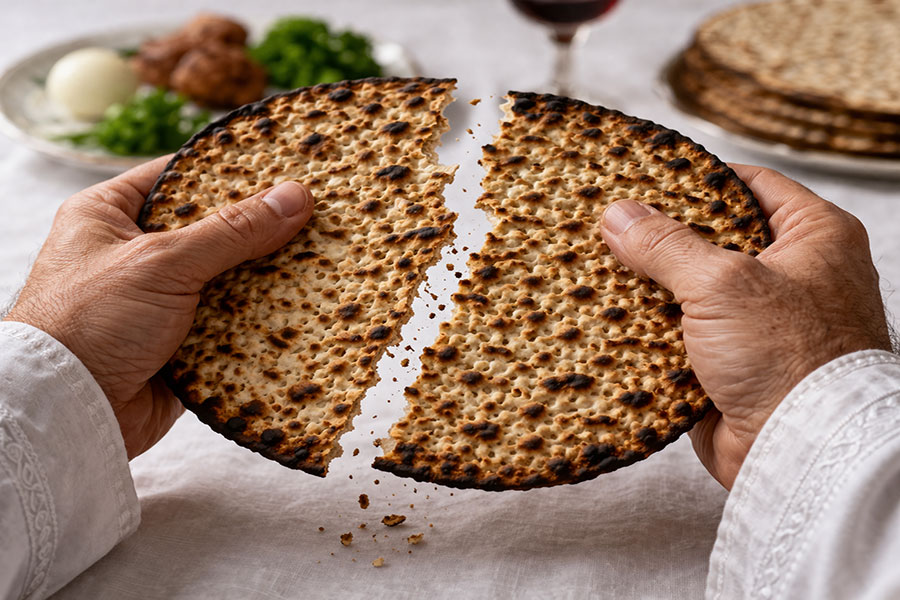
Back to Pesach. Actually, back to the Seder. Or to the Seders, as the case may be. Let me use a couple of numbers to launch some of the ideas and thoughts I’d like to share with you. Three. Who knows three? I know three. Three are the Avot. Yes, but there are other threes. Specifically, three matzot under, on, or near the Seder plate. Why three? Ask this question to someone (child or adult) and you are likely to get the answer Kohen, Levi, and Yisrael. That is not the reason we use three matzot. It is indeed an association with the number three, as would be Avraham, Yitzchak, and Yaakov. As would be Torah, Nevi’im, and K’tuvim. But that isn’t the reason. If we used five matzot, we might associate them with the five Chumashim. But it wouldn’t be the reason. Same with any other number. So why do we use three matzot? Pesach is Yom Tov, and Yom Tov, just like Shabbat, requires Lechem Mishneh – two whole loaves of (pardon the word) bread. Usually challah, but for Pesach, two whole matzot. And since before we will be making HaMotzi (and Al Achilat Matzah), we will be breaking a matzah – the smaller part to be the focus of Magid (the telling of the story of the Exodus) and the larger portion will be used for the Afikoman – to maintain the integrity of Lechem Mishneh, we use three matzot instead of just two. If you knew that, or at least know it now, then you are all set for the next Seder topic. But not yet. The Vilna Gaon has a different Seder plate arrangement and uses only two matzot, not the traditional three. Does he break a matzah? Yes, he does. So, what happens to Lechem Mishneh? Before I answer that, let me comment on another numbered theme of the Seder – namely, the Arbaa Banim, the Four Children. Yes, I know that most Hagadot translate it as the Four Sons. But it is important to include girls in the Seder experience on an equal footing to boys. And children include adults as well. The Seder experience is for all ages. My contention is that all Four Children are in all of us, in varying proportions. And that dynamic changes from subject to subject. The world’s greatest authority on chipmunks would be a chacham vis à vis chipmunks. He might only be a tam when it comes to subatomic particles. And he might be clueless when it comes to European History. And if he has cynical questions about the world of animated movies, he might be categorized as the rasha. Furthermore, one’s status in a particular area of knowledge or as to a particular topic might change depending on the situation. Let’s take the example above – of how many matzot we use at the Seder. The fourth child, the she-eino yodei’a lishol (the one who doesn’t know to ask – or doesn’t care to ask), won’t ask. The tam, simple child, will perhaps ask how come there are three matzot. The chacham will ask if two suffice for Lechem Mishneh every Shabbat and Yom Tov, why do we need three on Leil HaSeder? The rasha might say something like “Why does it matter?” But look what happens to the chacham, and even to the tam, after you explain about the Lechem Mishneh and the need to break a matzah. Both become she-eino yodei’a lishol. Not because they don’t care. Because they don’t know that there is anything else to ask about. Then you add the Vilna Gaon’s two-matzah opinion. An interested she-eino yodei’a lishol becomes a chacham again. Maybe the tam says, “Huh?” But the newly reengaged chacham asks about the Lechem Mishneh of the GR”A, since the latter too breaks a matzah. Now I’ll answer the question about the GR”A’s two matzot. Why do we have Lechem Mishneh in the first place? Not just on Pesach, but every Shabbat and Chag. It is commemorative of the manna that fell in double portion in honor of the Shabbat, when it would not fall on that day. Nor would it spoil overnight, as it would on other nights. Okay. Why the need for whole loaves? Because it is more respectful than broken bread pieces – kavod Shabbat v’Yom Tov. Ah! A whole loaf (matzah) is more presentable throughout the year. But on Seder night, the broken matzah is different and special. The mitzvah of Haggadah is performed specifically on the broken piece. It represents the poor person’s bread. The bread of affliction, lachmay anya, as we say at the beginning of Magid. On that night, it is very honorable to use it as part of Lechem Mishneh. This was just an example of a Seder discussion that should be prompted by the Seder leader’s questions to the assembled. Each Seder participant on his or her own level. And please note that I am not recommending the two-matzah practice. Three matzot is the prevalent custom in most families. But through the questions and answers about the three matzot, we can all learn new insights and ideas. With this week’s column, I am sharing with you Seder insights that I share with my family and guests. If you would be at my Seder, you’d hear it (and many other things) on that special night. But since you won’t be joining me, I am sharing some of this with you in advance of the Seder(s) so that some of you might share it with your Seder participants. Back to the she-eino yodei’a lishol. I grew up with the Haggadahs by Barton’s and Horowitz-Margareten, and others, that pictured the fourth child as a thumb-sucking (or lollipop-sucking) little kid. The fact is, many adults, including knowledgeable ones, are also she-eino yodei’a lishol when they are confident or comfortable with what they do know. And those at the Seder table who have insights to share should react to the she-eino yodei’a lishol by, as the Haggadah tells us, “at p’tach lo” – saying something or throwing out a question that will elicit a question that will in turn lead to lively discussion and new knowledge and insights. The Seder experience, no matter how many you've celebrated, should never be a “been there, done that” experience.* * * * *
Here’s another example. Karpas: celery, parsley, boiled potato – whatever you use. Why is it part of the Seder? It isn’t a requirement like matzah and maror. It is a time-honored custom that is observed by all. Most people, I would guess, know any of several reasons for Karpas. And for dipping the karpas in salt water. There are many reasons. And if you know some of them, you are the new she-eino yodei’a lishol – not the clueless kid, but the one that the chacham becomes when he doesn’t ask because he knows the answers. Karpas was intended to stimulate the appetite, which poor people and slaves do not want to do, but it is a luxurious way of eating. It represents nobility and freedom. It is a reminder of springtime and the significance of the fact that we came out of Egypt in Nissan, when life is renewed after the dead of winter. It allows us to make a Borei P’ri HaAdama and have in mind the maror that will be eaten later. Maror gets a mitzvah-bracha but not a food bracha because it is after HaMotzi, on the one hand, but not a part of a normal meal, on the other. Read backwards, Karpas says Samach – 60 myriad, meaning 600,000 people (iconic count of the adult males, plus women and children) were enslaved with parech (Pei-Reish-Chaf) – hard labor. If you know any of those reasons, and others, you won’t ask “Why Karpas?” And you'd be missing out on a very significant understanding. Rashi on “k’tonet pasim,” the multi-colored, striped coat that Yaakov gave to Yosef, mentions the connection of the word pasim to the green color karpas. Rashi mentions that the word karpas appears in Megillat Esther describing the colorful fabrics that adorned the palace of the king. Now follow the connections: Karpas reminds us of the k’tonet pasim which caused the brothers of Yosef to be jealous of him. This led to Yosef’s being sold into slavery in Egypt. And that is what brought all of the family, which became the Jewish Nation, down into Egypt. Midrash P’li’a says: G-d said to Bnei Yisrael: You sold Yosef; I swear by your lives that you will say every year, “Avadim hayinu l’Faro b’Mitzrayim.” This does not negate any of the other reasons for Karpas, but in my opinion, it packs a serious punch to begin the story of our Egyptian experience.* * * * *
Let’s finish this longer-than-usual column with a gematria. Pesach, Matzah, Maror – the three mitzvot of the night’s menu (we’ll have to wait for the Korban Pesach, but it is on the menu). The gematria of those three words totals 729. The companion mitzvah to the eating at the Seder is the telling of the story. There is a pasuk (Sh’mot 4:2) with a gematria of 729: “And Hashem said to him [Moshe], ‘What is that in your hand?’ And he said, ‘A staff [rod, stick – take your pick].’” We could suggest that this pasuk is the beginning of the story of the Exodus. And here is a phrase (not a whole pasuk) that is towards the end of our stay in Egypt (from Sh’mot 12:12 in Parshat Bo): “And I [G-d] will smite all firstborns.” Gematria? 729. Chag Samei’ach and Shabbat Shalom.