October 2, 2026
 Categories: Headline / Perspectives
What a Family of Deer Taught Me About Teshuvah
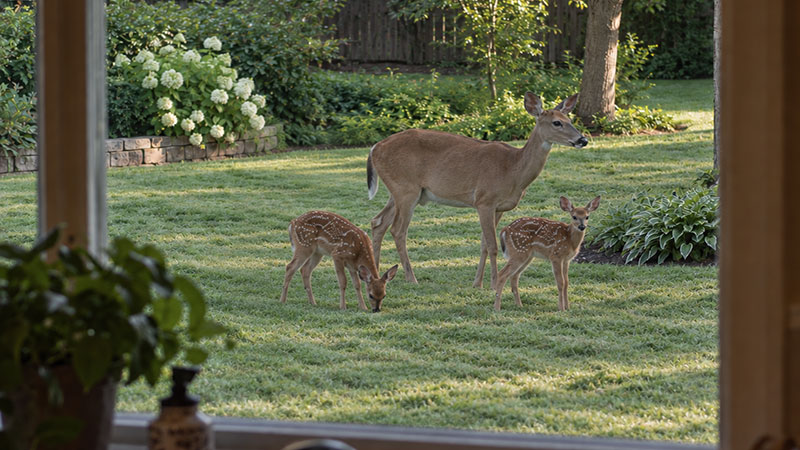


One of the nicest things about my kitchen is the view outside the window. Aside from the evergreens which provide the illusion of perpetual summer, there is also an assortment of wildlife that consists of multicolored birds, athletic squirrels, and the random bunny rabbit. Relative newcomers to the menagerie are deer, who were not so prevalent when we first moved in but now run rampant in our yard, eating our grass, snarling up traffic, and depositing unwanted gifts on our lawn. This year, a family of three – Mama and two speckled fawns – have been frequent guests on our block. The babies were adorable until they weren’t, and as the season progressed, Mama began to treat my presence with the calm confidence of an entitled squatter.
On a sultry Friday afternoon, shortly before candle lighting, Mama and the kids tiptoed into the yard. Annoyed, I tapped on the window, hoping they would run away, but Mama insolently held my gaze, daring me to come outside and mess with her family. My mother came into the kitchen, drawn in by the mysterious tapping, and immediately fell in love with the deer. “Let’s go outside and look at them up close!” she exclaimed.
I tried to explain to her why they weren’t cute, but she remained immune to my protests, so I followed her out into the yard, where she admired the sinewy grace of the mother and fretted when the littlest one couldn’t climb up on the stone ledge to join its sibling. For a moment, I saw them through her eyes: majestic and beautiful, a tiny reminder from G-d that these too are His creatures, a tiny reminder that it’s always good to see a situation through a different set of eyes.
Shabbos morning, the humidity finally dropped. It was the kind of weather that made you feel totally alive in your body, aware of the tiniest details – like oxygen and blades of grass. As I rounded the corner on my way to shul, I saw Mama strutting across the street, impervious to oncoming cars. As she stepped onto the sidewalk, she turned towards me, and once again we locked eyes. We stared each other down for fifteen seconds, and just as I began to wonder where the babies were, they scampered out of the bushes and hustled across the road. I don’t think I’ve ever been this close to such a large animal before, and our proximity was thrillingly primal, albeit a little disconcerting. I stirred slightly and the fawns froze, ready to run. For the briefest second, they looked to Mama for guidance, but unconvinced by her decision to stay put, they fled without a backward glance.
In Bereishis Rabba 17:4, Hashem lined up the birds and animals in front of Adam and asked him to name them, for Adam possessed a special ability to look at each creature and give it a name based on its core characteristics and spiritual lifeforce. Hashem then turned to Adam and asked, “What do you want to be called?” Adam replied that it was appropriate for him to be called Adam since he was created from the adama, the earth. Superficially, this name that Adam gave to himself seems not only simplistic but totally uninspired, devoid of the special wisdom that he was purported to possess. Additionally, all of the animals were also created from the earth. What, then, was Adam trying to convey about the nature of man by giving himself this name?
The Maharal teaches us that although man was created from the same earth as the animals, man contains an extra component, a Divine component, for he was created “b’tzelem Elokim,” in G-d’s image (Bereishis 1:27). On its own, earth is merely clumps of dirt, yet it holds infinite potential for growth. Plant a seed, and earth transforms into flowers, fruit, and trees. Man’s power is the power of potential, the power to nurture that holy spark within our corporeal, earthy selves. This is what separates man from beast.
Our dichotomous nature is at the very core of what it means to be human. To be human means to live suspended between the Earth’s gravity and Heaven’s gentle tug.
By nature, deer are afraid of humans, but through a process called habituation they lose their natural instinct to run away when humans approach. Mama did not lose her inhibition immediately; it started slowly, incrementally. The first time she encountered a human, perhaps taking out the trash, she froze, poised to flee, but no one chased her, and nothing bad happened. As these occurrences repeated themselves, she lost her natural boundaries – she forgot that humans are a different species. For now, her babies are still skittish, still guided by their inner compass, but the more exposure they have to the good life in suburban New Jersey, the more likely it is that they too will suppress their natural instincts.
Psychology teaches us that habituation is the most basic form of learning. The more we are exposed to something, the less we notice it. As earthbound, physical beings, we become so comfortable with our physical selves that we stop noticing how far we’ve drifted from our higher nature; our Divine sparks become smothered with earth.
When we are close to our purest selves, we possess an innate fear of crossing the boundary into actions and thoughts that dampen our inner spark. The first time we sin, we feel guilt and remorse. But the second and third time the behavior is repeated, it becomes easier; we see that the sky didn’t fall and lightning didn’t strike us down. We become habituated to our flaws, accepting them as normal parts of our personalities, forgetting that we were ever someone different.
Like any other learned behavior, habituation is not permanent and can be unlearned. How does a deer become dishabituated? There are multiple factors that can make this happen, but the common denominator is a shock to their routine – any repeated disturbance of their comfortable environment will destroy their sense of safety and force them to revert to their natural, timid selves. It will remind them, very starkly, that they are not human.
The deer’s ability to return to its natural instincts offers a powerful metaphor for our own journey through Elul and Tishrei. Like the deer, we too can return to our purest, most instinctual selves through a dishabituation process we call teshuvah. As children, most of us were taught to approach teshuvah through the lens of the Rambam’s teachings; aveira, regret, confession, and promising never to do that aveira again. Understood in this way, one would presume that the concept of sin was created before the concept of teshuvah, yet we learn in Pesachim 54a that like the Torah itself, teshuvah was created before the world was created. In his seminal sefer, Orot HaTeshuvah, Rav Avraham Yitzchak HaKohen Kook posits that teshuvah is more than just an antidote for aveiros – it is the energy that drives the whole universe, the spiritual force that draws everything back home to Hashem.
On an individual level, the word teshuvah takes on its most literal meaning. It is a spiritual return to our own authentic selves, back to that original, pure tzelem Elokim that was present at birth, bringing man back “to the root of his own soul” (Lights of Penitence 15:10). The Navi Yeshayahu warns Bnei Yisrael that their sins have consequences, “But your iniquities have been a barrier between you and your G-d” (Yeshayahu 59:2). Aveiros are the clumps of dirt that obscure our inner sparks, distancing us from Hashem and our truest selves. Teshuvah, through the Rambam’s classical approach, removes these layers, one by one, revealing our pure neshamos and reconnecting us to Hashem.
Through the prism of Rav Kook’s insights, teshuvah transcends the journey away from sin and expands it to encompass man’s journey toward authenticity and personal identity. The soil that shrouds our sparks is more than just our aveiros; it is any action, thought process, or way of life that is out of alignment with our true nature and creates an obstacle to devaikus and avodas Hashem. Rav Kook urges us to embrace individuality with these beautiful words: “I must find joy in my innermost spaces; not in the approval of people, and not in my career… The more familiar I become with my own unique personhood, and the more I permit myself to be original… with an inner consciousness blended of knowledge, awareness, feeling and poetry, the more G-dlight [a translation for ‘ohr Hashem’] will shine for me” (Mists of Purity 31).
I didn’t see the deer again for about a week. There had been some torrential rainstorms and I presumed that they had either moved on or were still hiding from the elements. The next erev Shabbos, hours after my husband mowed the lawn, the deer returned, lured in by the sweet smell of freshly cut grass. They were closer to the house than ever, and in between bouts of frenzied chewing, they started to roughhouse. One of the babies foolishly tried to climb on Mama’s back, but Mama shook him off and smacked his spine with her hoof, while the other baby stood to the side, interested in the ruckus but not interested in getting involved. The interaction between mother and baby was devolving into something bordering on child abuse, so I went outside to shoo them away. No one cared that I was there; Mama was single-minded, almost feral. I took two brave steps forward and raised my voice, chasing them into the street.
Although all deer physically look the same to me, wildlife biologists use the term “animal personality” to describe the different temperaments that exist within animals of the same species. Some are timid, some are playful, and some, like Mama, are downright aggressive. Like deer, human beings were also created with different temperaments, but our individuality is more profound than mere temperament. “How is man’s uniqueness manifested?” asks the Rav in On Repentance. “In his central aspiration…man’s singularity is expressed in his life’s innermost prayer. It may be what others want too – but each wants it in his own individual way.” Teshuvah summons us back to ourselves and exposes our unique inner lights. What do we do with that light once it is exposed? Do we follow it, or do we suppress it with laziness, self-doubt, and conformity?
The inspiration for this article began as a spark, kindled by a confluence of events posing as coincidence – my mother arriving for Shabbos on Rosh Chodesh Elul, her reaction to the deer, my reaction to her reaction, and then – the flicker of a thought, hovering, waiting.
But it’s Sunday and I’m lazy; I have the house to myself for the morning and plenty of time to do nothing while my husband drives Mom back to Brooklyn. And then, another coincidence: It is the third day of Elul which is Rav Kook’s yahrzeit.
Every day there is a bas kol from Chorev, a tiny voice, a tiny spark, a tiny twitch from a tiny neuron, and every day we have a choice: Do we listen to our innermost stirrings or do we smother them with inertia, with distraction, with willful disregard? Once a year, the shofar blows, sounding a note loud enough to break through our earthiness, loud enough to reveal our truest selves and unleash our Divine sparks. In that moment the choice is no longer a choice but a mission: to focus on the spark, to follow it, and to allow it to ignite before the gravity of life buries it once again.