 September 4, 2026
 Categories: Headline / Perspectives / Op-Eds
What Iran’s Enriched Uranium Stockpile Could Have Become
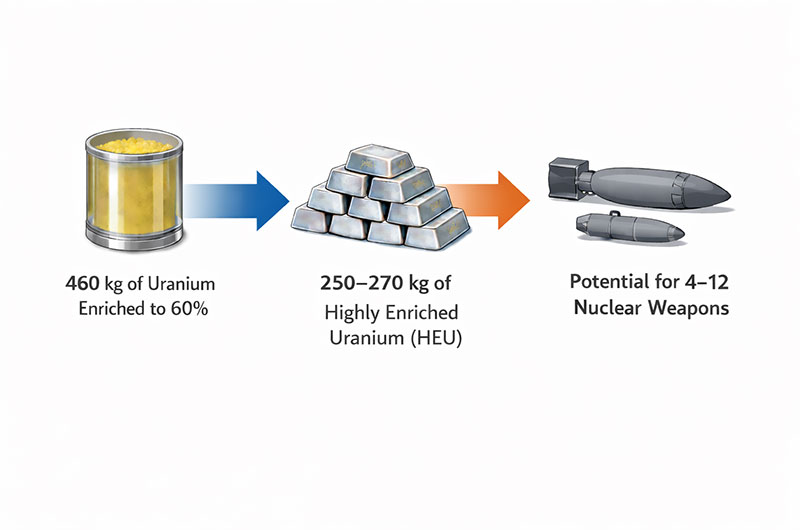


Donald Trump’s envoy Steve Witkoff told Fox News this week that Iranian negotiators boasted of controlling 460 kilograms of uranium enriched to 60 percent – enough, they said, for 11 nuclear bombs. Here’s the full range of what could be made from that single cache, and what the regime might have built in just six more months.
This stockpile of 460 kilograms of uranium enriched to 60 percent is enough raw material to support an entire small arsenal of nuclear weapons. In principle, if it were all pushed up to weapons‑grade (around 90 percent) and converted with perfect efficiency, the material could yield roughly 250–270 kilograms of highly enriched uranium (HEU). That is sufficient fissile content for 10 to 12 first‑generation fission devices, depending on how much HEU each design consumes.
In other words, the material is enough to produce several different types of bombs and warheads, from crude but devastating devices to more sophisticated implosion weapons.
The first and most basic category is the large gun-type fission bomb – the Hiroshima-style design in which one subcritical piece of HEU is fired down a barrel into another piece to create a supercritical mass and start a chain reaction. Gun-type bombs are heavy, long, and inefficient, typically requiring 40–60 kilograms of weapons-grade HEU per device, since there is no compression to improve efficiency. With 250–270 kilograms of HEU produced from this stockpile, a determined state could in principle assemble roughly four to six such bombs. They could be delivered by aircraft, large drones on one-way missions, ships, or heavy trucks. They would be crude by modern standards – but very real nuclear weapons.
The second category is the implosion-type fission weapon. Here the HEU core is surrounded by precisely shaped high explosives that detonate inward, compressing the core and dramatically improving efficiency. Because of this compression, each weapon can use much less HEU – often 15–25 kilograms for a first-generation design. The same 250–270 kilograms of HEU could therefore produce perhaps 10 to 12 implosion-type weapons. These could be configured as aircraft-deliverable gravity bombs, concealed devices in ships or trucks, or – once sufficiently miniaturized and ruggedized – warheads for ballistic or cruise missiles.
A third category is the improvised nuclear device built into non‑standard delivery platforms. Once a state possesses an implosion or even a gun-type package, it can house the device in a ship’s cargo hold, a standard freight container, or the chassis of a large truck. The result is a deliverable but non-aerodynamic nuclear weapon that can be driven or sailed close to a target and detonated.
A fourth category is the true missile warhead – a compact implosion package small and robust enough to fit beneath a reentry vehicle on an Iranian medium-range ballistic missile. In principle, the HEU from this stockpile could support 10 or more such warheads, since each requires only a few tens of kilograms of HEU. The limiting factor is engineering sophistication.
A fifth notional category is the so-called suitcase bomb – essentially an extremely miniaturized implosion weapon, small enough to fit into a large suitcase or backpack. In principle, the 250–270 kilograms of HEU derived from the 60‑percent stockpile is more than enough to fuel a number of such devices, each using on the order of 10–20 kilograms of HEU.
Alongside true nuclear explosives, there is also the radiological category – dirty bombs or radiological dispersal devices. Iran’s 60‑percent uranium could be fashioned into several such weapons, dispersing uranium dust or fragments over a city with conventional explosives.
In short, Iran’s stockpile could in principle support four to six large gun-type bombs, or as many as 10 to 12 implosion-type weapons if the uranium were used efficiently. These could take the form of aircraft-deliverable gravity bombs, ship- or truck-borne devices, and – given sufficient engineering progress – missile warheads or highly compact special-purpose weapons.
What could Iran actually have accomplished over a six‑month period – over the span between now and another Yom Kippur‑style surprise – if the regime had been left in business and had chosen to sprint?
The most straightforward step in that period would have been to push the entire 60-percent stockpile to weapons-grade. With intact centrifuge cascades – linked stages of enrichment machines that gradually raise uranium from one concentration level to the next – the physics and machine capacity would allow Iran to accomplish that in weeks to a couple of months.
In parallel, weapons engineers could have focused on assembling a first slate of actual devices. Six months is enough time to move from sub‑scale experiments and design work to several assembled bombs if the political decision is made and if one accepts the risks of fielding untested or only partially tested designs. A realistic ceiling might have been six to 10 assembled nuclear weapons.
The point isn’t that every one of the weapons would have worked perfectly, but that a handful almost certainly would have.
The stockpile was real – and the clock was running.