 October 16, 2026
 Categories: Headline / Columns
When You Don't Trust Your Own Promises Anymore


It is one thing to know there is something in your life you want to do differently. It is another to remember how many times you have already said that. You meant it last year too, and maybe the year before. You had the conversation with yourself, made the resolution, felt the seriousness of the moment. For a while, things really were different.
And then they weren't.
So by the time Elul comes around again, the problem is not only the habit, or the anger, or the relationship, or the davening, or whatever it was you hoped to change. Something else has been damaged along the way. You no longer quite believe yourself. This time I'm serious has become one more sentence you have heard before, in your own voice, and you know how that sentence has gone.
A woman tells me she has promised her husband things will be different, and she can hear how it sounds, because she has promised him before. A father has sworn that the next difficult evening will not go the way the last one did. Somebody has started the same routine four times, each time meaning it. By the time they get to me, the question is usually not whether they want it. They want it badly. The question is why they should believe themselves.
What people do at that point, almost always, is turn up the volume. The commitment gets bigger, more comprehensive, more dramatic, as though enough intensity could overcome the accumulated evidence. But that is not how trust works anywhere else, and there is no reason it should work that way here.
Think of someone who has told you more than once that he will be there, and then wasn't. At some point another passionate assurance does nothing at all. What starts to move the needle is his showing up. Once, and then again, until his words and his actions begin to correspond. It works the same way inside a person. Self-trust is not a feeling of confidence you can generate. It is the accumulated evidence that what you intend and what you do have something to do with each other. After enough failures, that has to be rebuilt the way it would be rebuilt with anyone else. Not with a larger promise. With a kept one.
Which is part of what I hear in the story that sits at the center of Elul.
The first Luchos had been shattered. Klal Yisrael had stood at Sinai, entered into a covenant, and almost immediately made the Eigel. If there was ever a moment when a promise had lost its credibility, that was it. The Torah had just been given and the relationship had already suffered a catastrophic rupture.
Moshe went back up the mountain anyway. According to Chazal, Rosh Chodesh Elul is when that final forty-day ascent began, the one that ended on Yom Kippur with forgiveness and a second set of Luchos. What strikes me is that nothing in the story sounds like a declaration that this time everything will be different. He climbs again, that is all.
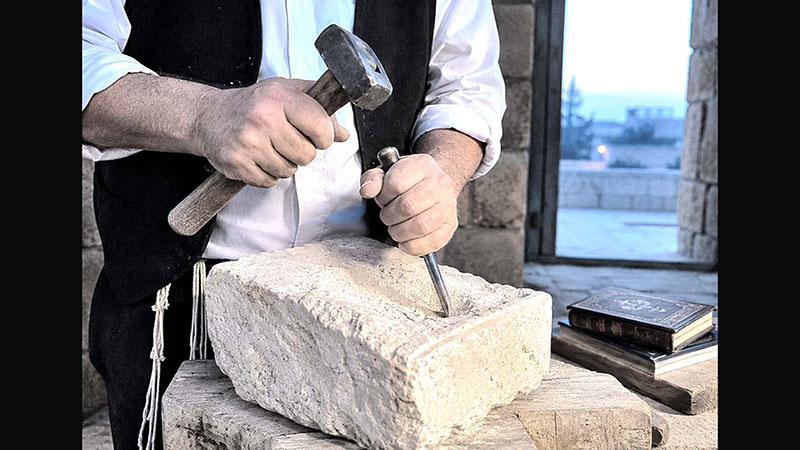
And this time something is asked of him that was not asked before. The Torah describes the first Luchos as maaseh Elokim (the work of G-d) – the tablets themselves were Divine, not only the writing on them. After the breaking, Hashem tells Moshe pesol lecha shnei Luchos avanim karishonim (carve for yourself two stone tablets like the first). The Torah would still come from Hashem. But Moshe had to prepare the stone. He had to carve it, carry it, and climb with it. After the breaking, the return acquired weight.
That seems worth holding onto as Selichos approaches, because we can spend an enormous amount of energy trying to manufacture the right promise about the coming year. We will be more patient. We will daven differently. We will finally stop doing the thing we have told ourselves ten times to stop doing. Some of those hopes are real and none of this is an argument for wanting less; Torah asks a great deal of us, and teshuvah can be radical. But there is a difference between aspiration and expecting intensity to do the work that only repetition does.
Maybe the question before Selichos is not how large a future we can promise. Maybe it is whether there is a piece of stone we can pick up.
Something small enough to be real. An apology that has been sitting there for months. One beracha in Shemoneh Esrei that we will actually slow down for. One evening when the phone stays in the other room. Not because any of that solves the problem, but because it puts intention and behavior back in the same sentence.
There is a word we use constantly this time of year: kabbalah, a commitment we accept on ourselves. We tend to think its strength lies in how ambitious it is. In practice, its greater power may be that it gives our ratzon (our will, our wanting) somewhere concrete to live. I want to be different, and then I do one thing that the person I want to be would do. And then I do it again. What comes of that is quieter than inspiration and probably more durable. I start to know myself as someone whose choices are not entirely disconnected from what I care about.
One of the hardest consequences of having failed repeatedly is the sense that your future has already been predicted by your past. You know what happens next because you have watched yourself do it before. A single kept commitment does not erase that history. It does introduce one small piece of evidence that points the other way.
For people who have lived through a lot of Eluls, there is something almost embarrassing about beginning again. We know the words. We know ourselves. We know how fast a serious moment fades once ordinary life resumes.
Moshe knew exactly what had happened at the bottom of that mountain.
He climbed anyway.
Before Rosh Hashanah asks us to imagine a whole year, Selichos gives us a few days to start moving toward it. Not grandly and without any certainty. Just with enough honesty to ask what is ours to carry up the mountain this time.
And then to pick it up.